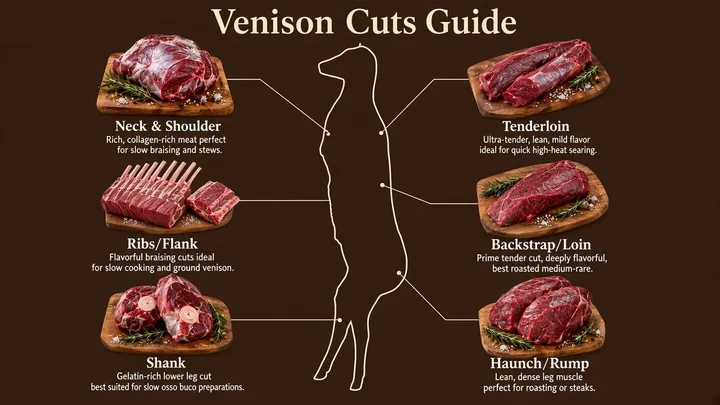
Fish isn't something we cut at the plant. We spend our days on beef, hogs and deer. But the idea is the same as on a steer: know where each piece comes from and you'll know how to cook it. Eastern North Carolina is fish-fry country, so here's the anatomy, the market cuts and how to fillet a whole fish yourself.
Outside the fish
These are the parts you'll see on a whole fish at the counter. Definitions from the South Carolina Department of Natural Resources [2]:
| Part | What it is | Why a cook cares |
|---|---|---|
| Operculum (gill cover) | The bony flap that protects the gills | Your first cut goes right behind it |
| Gills | Feathery tissue the fish breathes through | Bright red gills are a freshness sign; they're removed before cooking |
| Pectoral fin | Side fin behind the gill cover | Marks where the collar is |
| Dorsal fin | Fin along the back | Spiny on snapper and bass; trim it off |
| Pelvic and anal fins | Fins along the belly | Cut away when dressing |
| Caudal fin | The tail | Where the fillet ends |
| Lateral line | Sensing line along each side, gill cover to tail | Roughly where the thick loin meets the thinner belly |
| Scales | Protective covering | Scrape off before cooking skin-on |
| Vent | Opening on the underside | Where you start the belly cut to gut a fish |
Not every fish has scales. Catfish don't [2], which is why catfish is skinned rather than scaled.
The cuts, head to tail
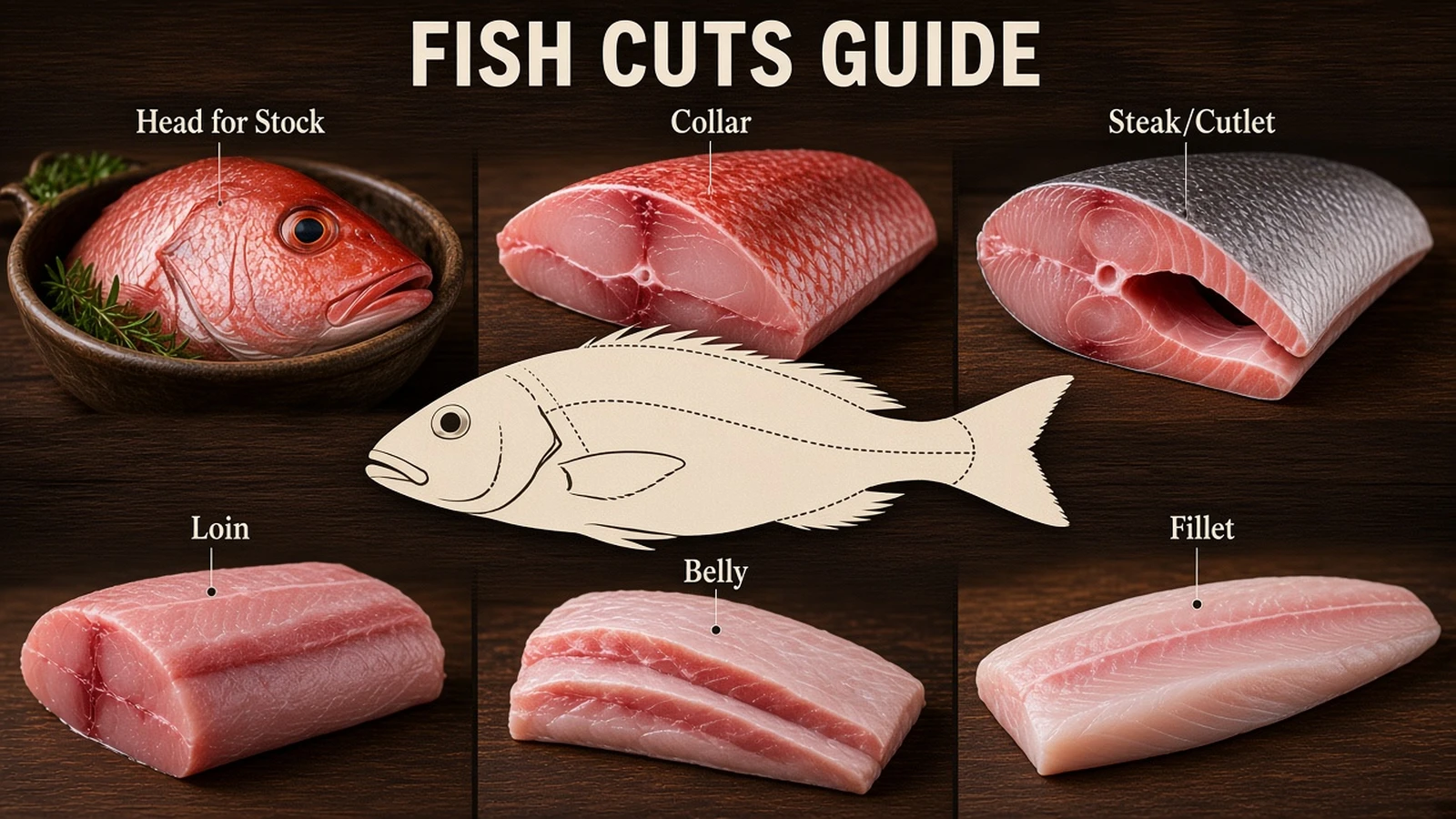
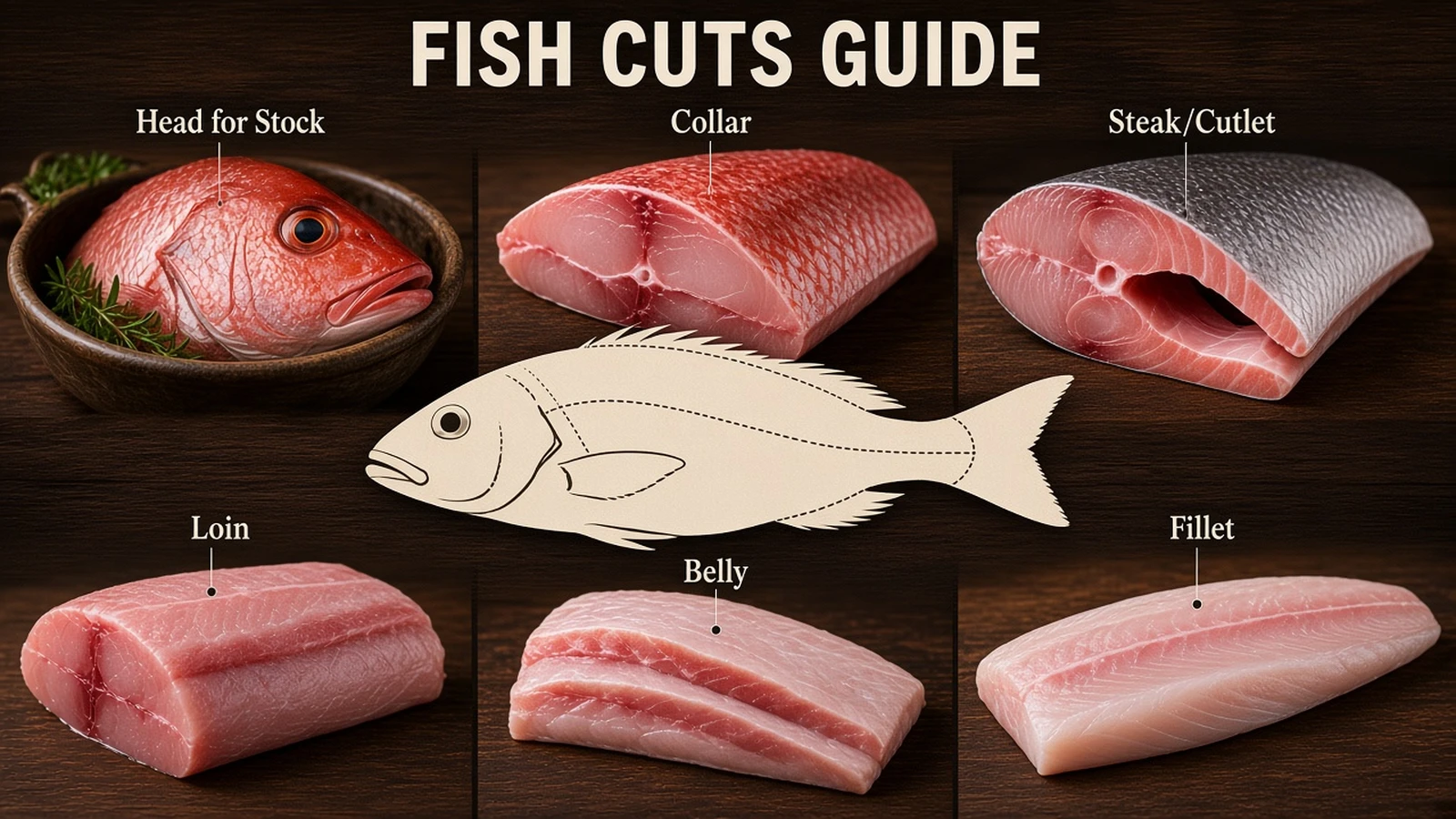
Head and cheeks
The head is bone and cartilage with a little meat in the cheeks. NOAA Fisheries suggests using the head for stock or soup [3]. On a big snapper or grouper, the cheeks are worth digging out with a spoon.
Collar
The collar is the strip of meat and bone between the gill plate and the pectoral fin. Most of it gets thrown away, which is a mistake. NOAA calls fish collars "a seafood delicacy that are great for grilling," and recommends curving your first cut into the head so you don't waste that meat [3]. It's rich, fatty and a little gelatinous. Salt it and grill or broil it hot.
Back loin (top of the fillet)
The thick, even upper part of each fillet, above the lateral line and along the backbone. It's the cleanest, most uniform piece on the fish. Sear it skin-side down, roast it or grill it. On large fish such as tuna or swordfish the loin is cut off as a separate boneless log and portioned into steaks.
Belly
The thin lower part of each fillet, over the gut cavity. It carries more fat than the loin and holds the rib bones (belly bones), which need to come out. NOAA's method is to loosen them with the back of the knife and then slice shallowly under them with a flexible fillet knife [3]. Because it's thinner, the belly cooks faster than the loin. Fry or broil it, or fold the thin tail end under so the whole fillet cooks evenly.
Pin bones
A line of small floating bones runs down the center of many fillets. Run your fingers along the fillet to find them, then pull each one out with fish tweezers or needle-nose pliers toward the head, following the way the bone lies, so you don't tear the meat [3].
Tail section
Thinner, firmer and quick to overcook. Good for fish tacos and frying.
Frame (spine and ribs)
What's left after filleting. NOAA notes you can glaze and grill the spine for the meat left on it, or use it in the garden [3]. Clean, lean frames from white fish like snapper also make good stock.
Market forms: how fish is sold
NC Sea Grant's Mariner's Menu lists the main forms and how much of each you can actually eat [4]:
| Market form | What you get | Edible portion |
|---|---|---|
| Whole (round) | As it came out of the water; needs scaling, gutting and degilling | About 45% |
| Drawn | Gutted; still needs scaling and degilling if the head's on | About 48% |
| Dressed | Ready to cook; usually head, tail and fins off | About 67% |
| Steaks | Crosswise slices of a large fish, ready to cook | About 86% |
| Fillets | The sides cut away from the backbone; usually boneless | No waste |
Whole fish costs less per pound, but you're paying for bones and a head. Do the math with the edible portion, not the sticker.
Red snapper, the classic example
Red snapper is the fish most cut charts use. NOAA Fisheries describes it as sweetly mild, semi-firm, lean and moist, pinkish with yellow tones when raw and lighter when cooked. U.S. wild-caught red snapper comes from North Carolina to Texas, and it's usually sold with the red skin on to help buyers identify it [5]. Lean, firm white fish like snapper suits nearly every method: grilled whole, pan-seared fillets, fried belly strips and a stock from the frame.
How to fillet a round fish
This follows NC Sea Grant's method for a round-bodied fish [4], with NOAA's tips for the collar and bones [3].
- Scale it. Scrape from tail to head with a scaler or the back of a knife.
- Cut behind the head. At the pectoral fin, just behind the gill cover, cut down at an angle toward the head until you hit the backbone. Curve the cut to keep the collar meat.
- Follow the backbone. Turn the knife flat and run it along the spine all the way to the tail, keeping the blade against the bone.
- Turn the fish over and do the other side.
- Take out the rib bones with shallow strokes under them.
- Pull the pin bones toward the head.
- Skin it, if you want. Skin-side down, hold the tail end, slide the knife between skin and flesh with the blade almost flat, and pull the skin taut as you go [4].
- Rinse the fillets under cold running water and pat them dry [4].
Use a sharp, flexible knife and keep the blade close to the bone so you don't leave meat behind [3]. Flat fish like flounder are filleted differently: you cut from nape to tail along each side of the backbone and slide the knife along the bone to lift each fillet [4].
Buying fresh fish
The FDA's checklist [6]:
- It should smell fresh and mild, not fishy, sour or like ammonia.
- Eyes should be clear and shiny.
- Whole fish should have firm flesh and red gills. Fillets should spring back when pressed.
- Fillets shouldn't be discolored, dark or dry around the edges.
- Color alone doesn't prove freshness, because diet, environment and some packaging treatments affect it.
Cooking fish safely
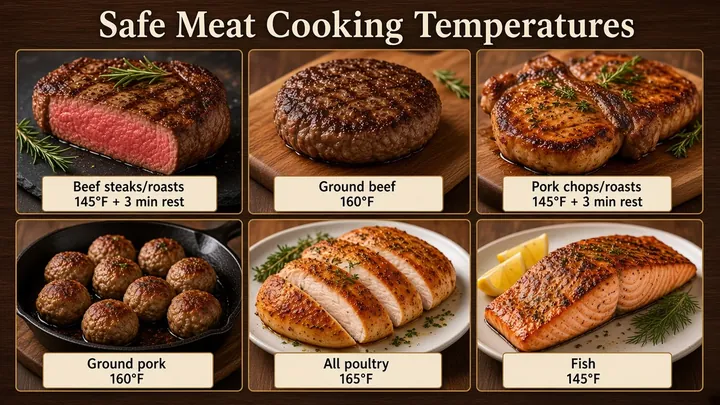
- 145°F is the safe internal temperature for fish [1]. Check the thickest part [7].
- Without a thermometer, the FDA says fish is done when it separates easily with a fork [6].
- If you eat fish raw, the FDA's rule of thumb is to choose fish that has been frozen first, because freezing kills parasites. Freezing doesn't kill every germ, though, and pregnant women, young children, older adults and people with weakened immune systems should skip raw and undercooked fish [6].
- If cooked seafood smells of ammonia, don't eat it [6].
Storing and freezing fish
- Refrigerator: fresh fish keeps 1 to 2 days at 40°F or below. Freezer: 3 to 8 months for best quality [8].
- Fat matters. NC State Extension puts fatty fish like bluefish and salmon at 2 to 3 months frozen, and lean fish like flounder and sea trout at 4 to 8 months [9].
- Thaw overnight in the refrigerator. For a quick thaw, seal it in a bag and submerge it in cold water [6].
- Cooked fish leftovers keep 3 to 4 days [8].
Frequently asked questions
What's the difference between a fish fillet and a fish steak?
A fillet is a whole side of the fish cut away from the backbone, usually boneless. A steak is a crosswise slice through a large fish, often with a piece of backbone in the middle.
What is the fish collar?
The meat and bone between the gill plate and the pectoral fin, just behind the head. It's rich and fatty, and it's great grilled or broiled.
What temperature should fish be cooked to?
145°F in the thickest part. Without a thermometer, cook it until the flesh separates easily with a fork.
How do you remove pin bones from a fish fillet?
Run your fingers down the center of the fillet to find them, then pull each one out with fish tweezers or needle-nose pliers toward the head end, in the direction the bone lies.
The meat side of the fish fry
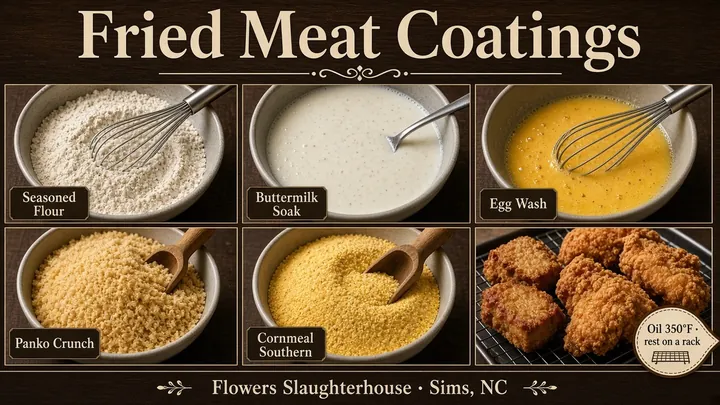
Fish is outside what we cut, but the rest of the menu isn't. If you're planning a fish fry, a cookout or a pig pickin', call or text 252-885-1892 about hogs, beef or deer, or look at our pork page and cut sheets. For cooking temperatures across every species, see our safe meat cooking temperatures chart. For a salmon burger recipe, see our burger patty recipes, and for frying, our fried meat coatings guide.
Sources
- Safe Minimum Internal Temperature Chart — USDA Food Safety and Inspection Service
- Fish Anatomy — South Carolina Department of Natural Resources
- How to Filet a Fish with Chef Matthew Ona of The Culinary Institute of America — NOAA Fisheries
- Market Forms of Fresh Fish and Cleaning Methods — North Carolina Sea Grant, Mariner's Menu
- Red Snapper — NOAA Fisheries
- Selecting and Serving Fresh and Frozen Seafood Safely — U.S. Food and Drug Administration
- Food Thermometers — USDA Food Safety and Inspection Service
- Keep Food Safe! Food Safety Basics — USDA Food Safety and Inspection Service
- Preserving Your Catch & Purchase: A Guide to Freezing and Thawing Seafood at Home — NC State Extension