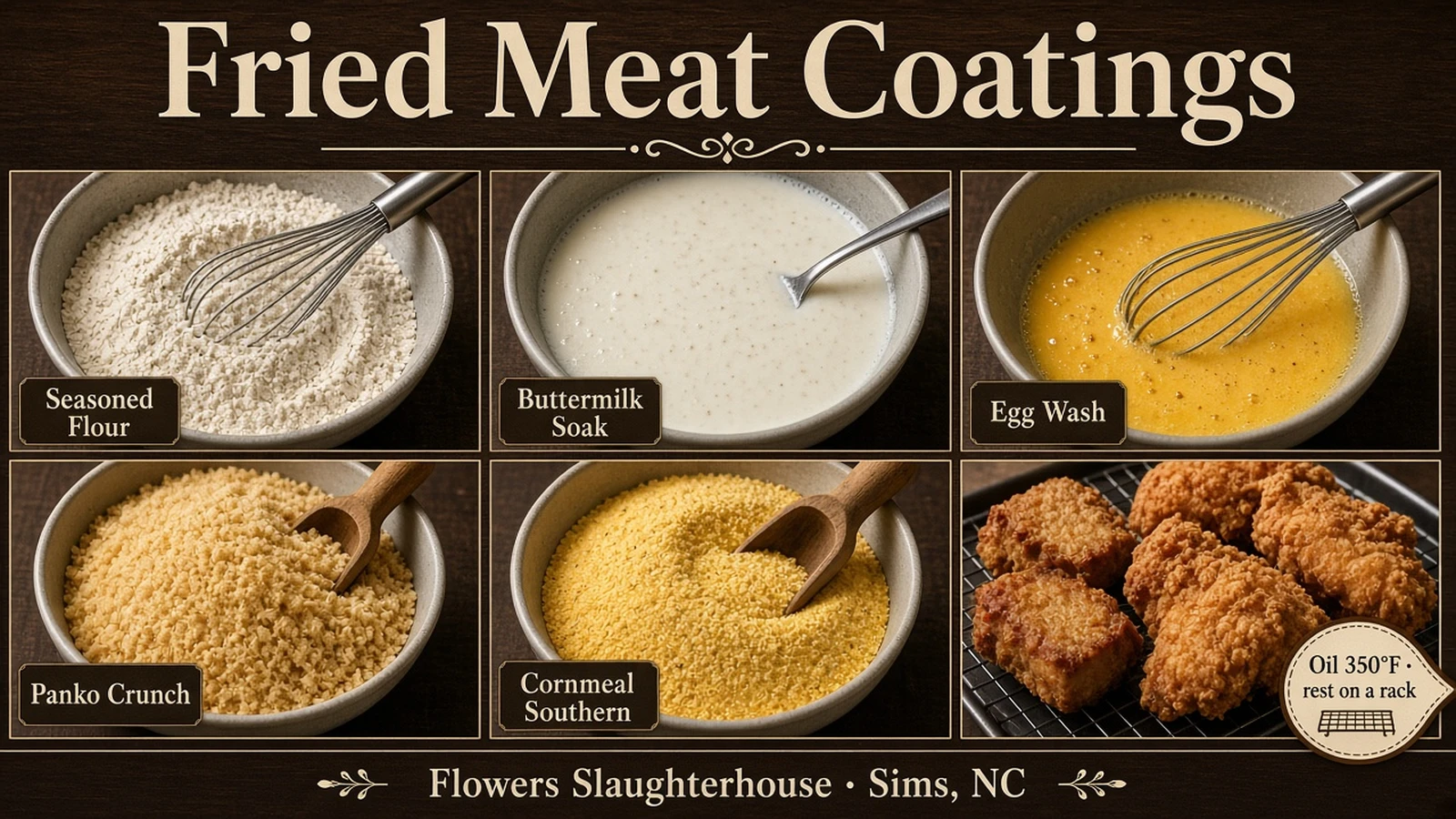
Fried chicken, fried pork chops, country-style cube steak and fried fish are as eastern North Carolina as it gets. Here's how eight common coatings behave in hot oil, which meat each suits, and how to fry safely.
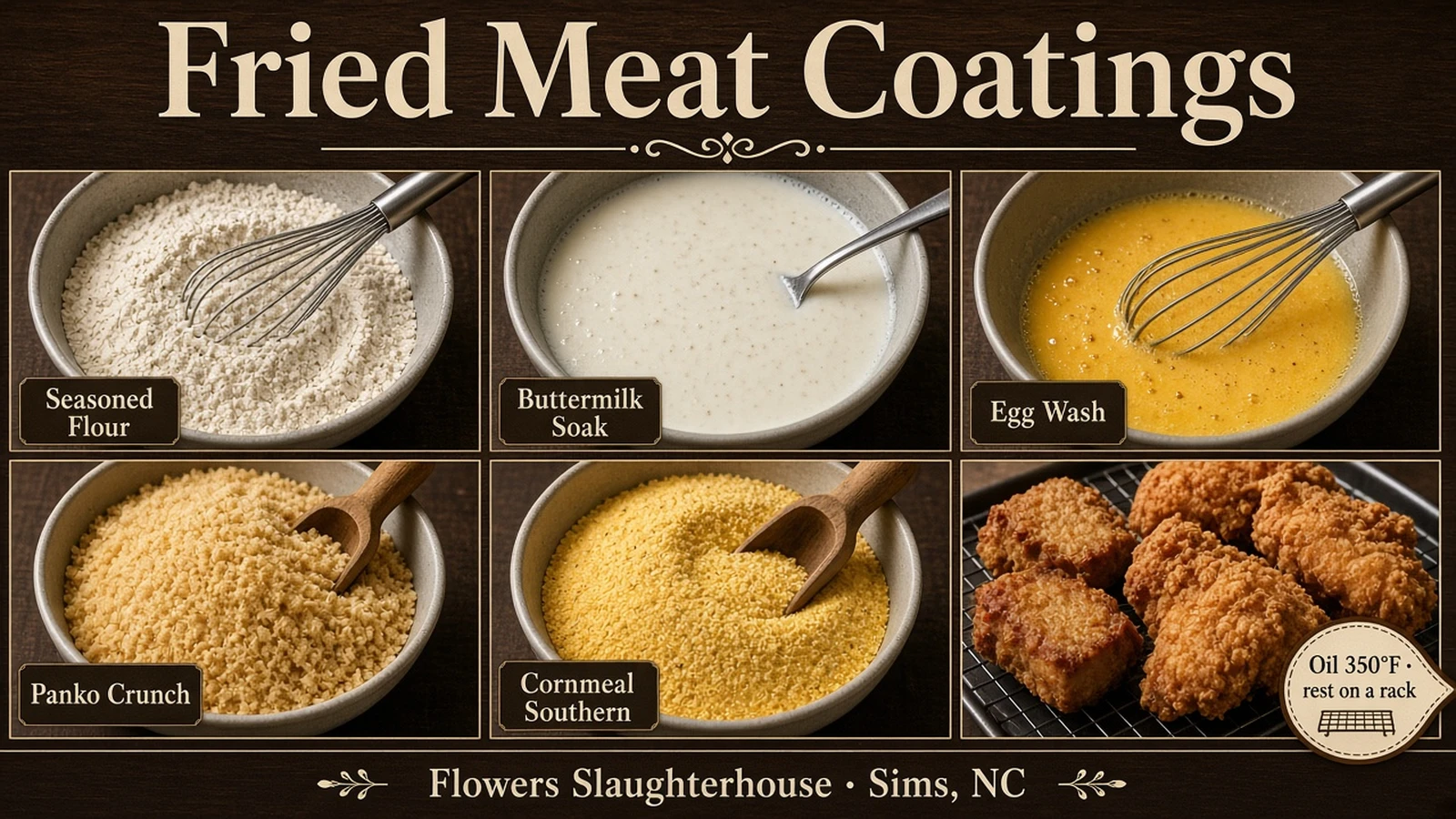
Coatings at a glance
The texture notes are what we've seen at our own fryers, not lab results, except where a source is cited.
| Coating | Texture | Browning | Best for |
|---|---|---|---|
| All-purpose flour | Craggy, sturdy, classic | Deep golden | Fried chicken, cube steak, pork chops |
| Cornstarch | Thin, glassy, very crisp | Pale | Wings, chicken bites, saucy dishes |
| 50/50 flour and cornstarch | Crisp but substantial | Golden | All-around fried chicken |
| Rice flour | Light, crisp, absorbs less oil [3] | Pale to light gold | Tempura, gluten-free frying |
| Seasoned double dip | Thick, shaggy, extra crunch | Deep golden | Bone-in chicken, chicken-fried steak |
| Panko | Very crunchy, airy | Golden | Cutlets, pork chops, fish |
| Tempura batter | Thin, lacy, delicate | Pale | Shrimp, fish, thin chicken strips |
| Beer batter | Puffy, crisp shell | Golden brown | Fish, onion rings, chicken tenders |
Dry dredges
All-purpose flour
The baseline. Season it well (salt, pepper, paprika, garlic powder), dredge the meat and let it rest on a rack for 10 to 15 minutes before frying. The flour hydrates from the meat's surface and sticks better, so less of it falls off in the oil. It gives the deep golden, craggy crust most people picture when they hear "fried chicken."
Cornstarch
Pure starch with no gluten, so it fries into a thin, hard, almost glassy shell. It doesn't brown much. It's the coating for wings that'll be tossed in sauce, because it stays crisp longer under a glaze. On its own it can taste a little bare. Season it hard.
50/50 flour and cornstarch
Our go-to for fried chicken at home. Cutting flour with cornstarch keeps the flavor and color of a flour crust but makes it lighter and crisper.
Rice flour
Rice flour has no gluten and soaks up less fat. A study in Bioscience, Biotechnology, and Biochemistry found that rice-flour tempura batter resisted oil absorption better than wheat flour and was better in overall quality and crispness, and that rice flours higher in amylose took up the least oil [3]. In practice it gives a light, crisp, pale crust, and it's a good choice for anyone avoiding wheat. (Check every other ingredient too.)
Wet-and-dry coatings
Seasoned double dip
Flour, then a wet dip (buttermilk, or egg beaten with milk and hot sauce), then flour again. The second layer of flour grabs onto the wet one and forms the thick, shaggy crust you see on restaurant fried chicken and on chicken-fried steak. Press the second coat on firmly and let the pieces sit before frying.
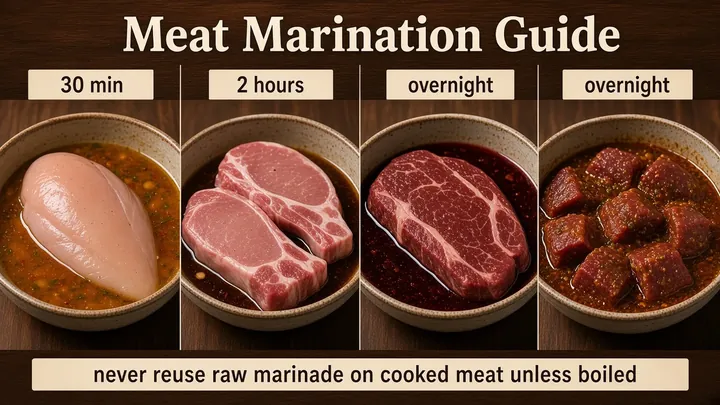
Buttermilk soaks count as marinating. Do it covered, in the refrigerator, for no more than 2 days for chicken [4]. Our marination time guide covers other meats.
Panko (standard breading)
Flour, then beaten egg, then panko. Panko is a coarse, flaky Japanese-style breadcrumb, and it gives the biggest crunch of anything on this list. It's ideal for thin, boneless pieces that cook quickly (cutlets, pork chops pounded thin, fish fillets), because the crumbs brown fast. On thick bone-in chicken the outside can get too dark before the inside is done.
Batters
Tempura batter
Flour (or rice flour, or a mix with cornstarch) whisked briefly into ice-cold water or sparkling water. Leave it lumpy. Overmixing builds gluten and makes it heavy. Dip and fry immediately. It makes a thin, lacy, pale shell that's perfect on shrimp, fish and thin chicken strips.
Beer batter
Flour, salt, a little baking powder and cold beer, mixed into a batter about as thick as pancake batter. The bubbles and baking powder puff it up into a crisp, golden shell. It's the classic for fried fish and onion rings. Like tempura, it softens as it sits, so serve it fast.
Which coating for which meat
- Bone-in chicken: flour, 50/50 or the double dip. These coatings can handle the longer fry time bone-in pieces need.
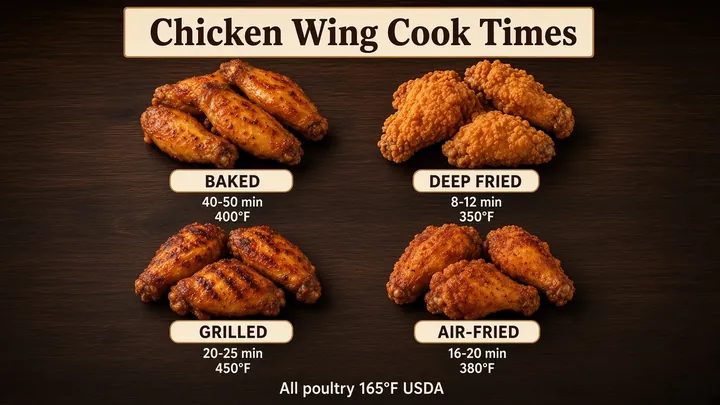
- Wings: cornstarch or 50/50, especially if they're going in sauce. See our chicken wing cook times.
- Boneless chicken, cutlets and pork chops: panko or a thin flour dredge.
- Cube steak and country-fried steak: seasoned flour or the double dip, served with gravy.
- Fish: cornmeal, beer batter, tempura or panko.
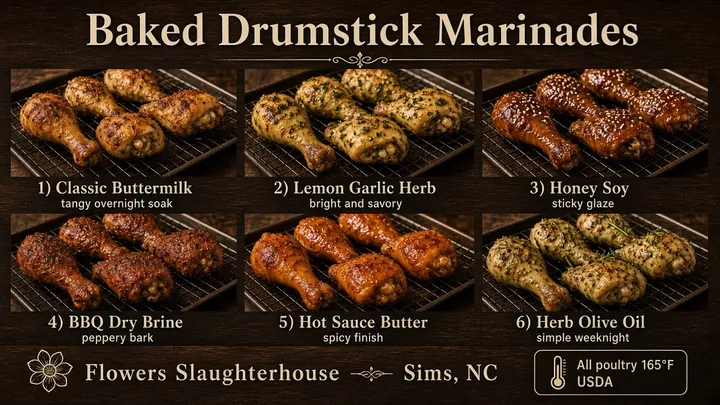
- Baked "oven-fried" chicken: panko or crushed cornflakes over buttermilk, baked on a rack. See our baked drumstick marinades.
Oil and temperature
FSIS approximate frying times [1]:
| Food | Oil temperature | Approximate time |
|---|---|---|
| Chicken pieces | 375°F | 13–20 minutes |
| Chicken fingers | 350°F | 6–8 minutes |
| Fish fillets | 320°F | 3–5 minutes |
| Shrimp | 320°F | 4–6 minutes |
Pick an oil with a high smoke point. FSIS lists the approximate smoke points as 450°F for peanut, safflower and soybean, 445°F for grapeseed, 435°F for canola, and 410°F for corn, olive, sesame and sunflower, and says all of these are safe for deep frying [1].
Use a frying thermometer. Oil temperature drops when you add cold, coated meat. Fry in small batches so it can recover. FSIS warns that overcrowding the basket causes undercooking and uneven cooking, and it can make the oil overflow [1].
About cast iron. Plenty of Southern kitchens fry in cast iron, and it holds heat well. FSIS's deep-frying guidance does suggest a deep, heavy skillet but recommends avoiding cast iron because it breaks down oil faster than other metals [1]. If you fry in cast iron, expect to change the oil more often.
Is it done? Check after it comes out
The crust browns long before thick, bone-in pieces are cooked through, and a dark crust doesn't mean a safe center.
- Take the piece out of the oil before checking. FSIS says a reading taken while the food is still submerged won't be accurate [1].
- Check the thickest part, away from the bone [5]. If it's under temperature, put it back in the oil [1].
- If the crust is getting too dark before the meat is done, lower the oil temperature, or finish bone-in chicken on a rack in a 325 to 350°F oven.
- Never partly fry chicken to finish later. FSIS says not to brown or partly cook chicken and refrigerate it to finish cooking later [4].
Keep the raw side separate
- Throw out leftover flour, egg and batter that touched raw meat. They've picked up whatever was on it.
- Use one hand for wet and one for dry to keep your fingers from turning into clubs of batter, and wash up after [4].
- Frozen breaded chicken can be raw. In a USDA study, 22 percent of participants thought a not-ready-to-eat frozen chicken entrée was cooked, partly cooked or weren't sure. Breading, browning and grill marks can make raw products look cooked, so read the label and use a thermometer [6].
- Raw stuffed, breaded chicken breasts shouldn't go in the air fryer, FSIS says. Follow the package directions [7].
Fryer safety
FSIS's deep-frying rules [1]:
- Keep water away from hot oil. Water turns to steam instantly and splatters.
- Never use water on a grease fire. Use a kitchen fire extinguisher or cover the pot with a metal lid, and call 911.
- Never leave hot oil unattended.
- Don't use plastic utensils in the fryer.
Reusing oil and storing leftovers
FSIS says you can reuse frying oil: strain it through cheesecloth or a sieve and store it in a sealed, light-proof container for up to 3 months, refrigerated for best quality. Throw it out if it's cloudy, foams or smells off. Don't pour oil down the drain [1].
Refrigerate fried leftovers within 2 hours [1]. Fried chicken keeps 3 to 4 days in the refrigerator or about 4 months frozen [4]. Reheat to 165°F on a rack in a hot oven or air fryer so the crust crisps up again [2].
Frequently asked questions
What is the crispiest coating for fried chicken?
Cornstarch and rice flour give the lightest, crispiest crusts, and panko gives the biggest crunch. For classic Southern fried chicken, a 50/50 mix of flour and cornstarch is crisp without losing flavor or color.
Why does my breading fall off when I fry?
Usually the meat was too wet, the coating didn't rest before frying, or the pieces were moved too soon. Pat the meat dry, let coated pieces sit 10 to 15 minutes, and don't turn them until the first side has set.
What temperature should oil be for frying chicken?
FSIS lists 375°F for chicken pieces (13 to 20 minutes) and 350°F for chicken fingers (6 to 8 minutes). Fry in small batches so the oil recovers, and check that the chicken reaches 165°F after taking it out of the oil.
Can I reuse frying oil?
Yes. Strain it, store it sealed and away from light for up to 3 months (refrigerated is best), and throw it out if it turns cloudy, foams or smells off.
Frying something from your own freezer?
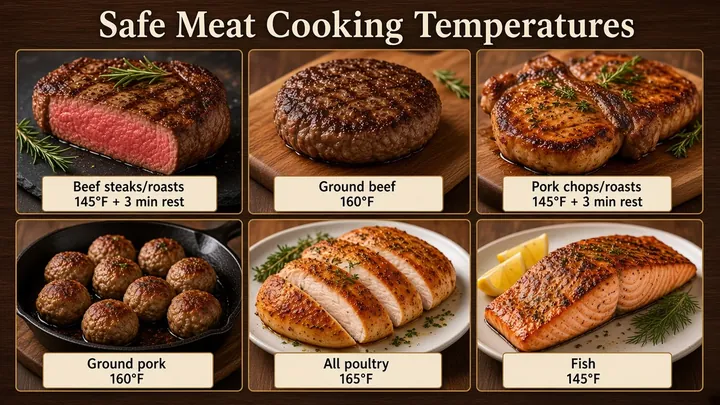
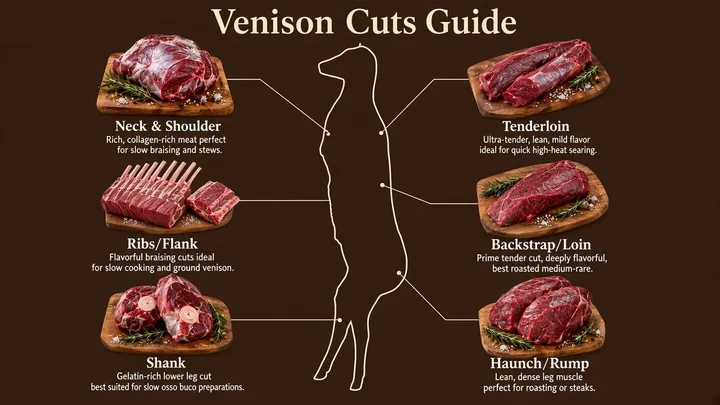
If you're bringing us a beef, cube steak is one of the options on the round section of our cut sheet. It's a natural for the flour dredge and gravy. Our beef cut sheet lists the options, or call or text 252-885-1892. For pork chops, see our pork cuts guide; for venison, our venison cuts guide; and for every species, our safe meat cooking temperatures chart.
Sources
- Deep Fat Frying and Food Safety — USDA Food Safety and Inspection Service
- Safe Minimum Internal Temperature Chart — USDA Food Safety and Inspection Service
- Influence of Physicochemical Properties of Rice Flour on Oil Uptake of Tempura Frying Batter (Nakamura and Ohtsubo, 2010) — Bioscience, Biotechnology, and Biochemistry
- Chicken from Farm to Table — USDA Food Safety and Inspection Service
- Food Thermometers — USDA Food Safety and Inspection Service
- Preparing Frozen Food — USDA Food Safety and Inspection Service
- Air Fryers and Food Safety — USDA Food Safety and Inspection Service