Deer season is a busy time at our plant in Sims. Every hunter who walks in wants to know what they'll get back and how to fill out the cut sheet. This guide covers the cuts, what each one is good for, and what to do between the shot and our door.

Venison cuts at a glance
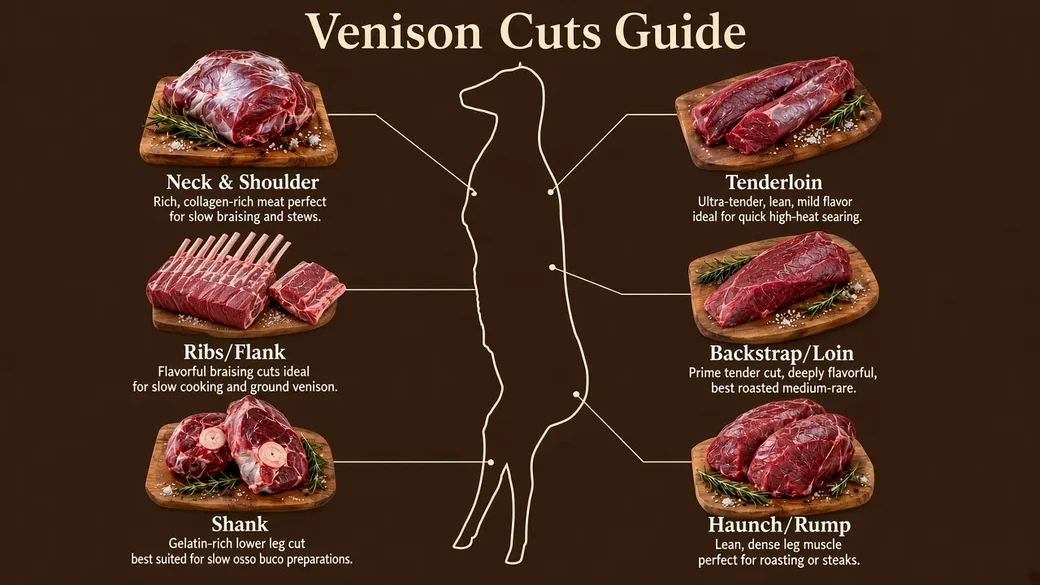
| Cut | Where it is | Best uses | How to cook |
|---|---|---|---|
| Backstrap (loin) | Along both sides of the spine, outside the ribs | Medallions, butterfly steaks, whole roast | Hot and fast: grill, pan-sear |
| Tenderloin | Inside the body cavity, under the spine | Small, very tender steaks | Hot and fast; don't overcook |
| Hindquarter (ham/haunch) | Rear leg: top round, bottom round, sirloin tip, eye | Steaks, roasts, jerky, cube steak, stew | Roast, grill marinated, slice thin; braise for tougher pieces |
| Shoulder (front quarter) | Front leg and blade | Roasts, stew, burger, sausage | Braise or slow-cook; grind |
| Neck | Neck | Neck roast, burger | Braise long; grind |
| Shanks | Lower legs | Braised shanks, burger | Low and slow in liquid, or grind |
| Ribs and flank | Rib cage and belly | Burger and sausage trim | Usually ground |
NDSU Extension describes the same breakdown when boning a deer. The shoulder is boned into a rolled roast and the shank goes to burger or sausage. The hind leg separates along natural seams into the sirtip, outside leg and inside leg for roasts, jerky or steaks. The loins are cut into boneless chops, and the tenderloin comes off the inside of the cavity [3]. Leftover clean meat on the ribs, flank and neck becomes sausage trim or ground venison [3].
Backstrap and tenderloin: the prime cuts
The backstrap runs along both sides of the backbone. It's the deer's version of a beef ribeye and strip together, with almost no fat. Have it cut into medallions or butterfly steaks. NDSU describes a butterfly steak as two steaks joined along one edge, which is a good way to get a bigger steak out of a small loin [3]. You can also leave it whole and roast it.
The tenderloins are the two small strips inside the cavity. Many hunters take them out the day of the hunt. Whether you do or not, tell us on the cut sheet.
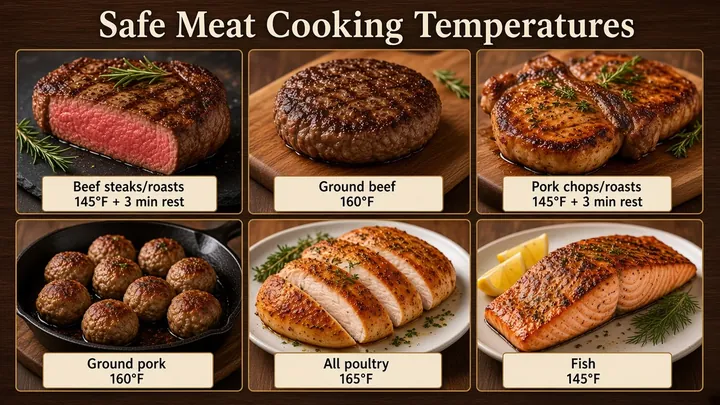
About doneness: venison has very little fat, so it dries out quickly once it's overcooked. Many hunters like backstrap pink. FoodSafety.gov lists venison at 160°F [1], which is higher than the 145°F used for beef steaks. That's the federal guidance. Use a thermometer so you hit the number without going past it.
Hindquarters: steaks, roasts and jerky
Each hindquarter has several large muscles. Each can be cut into round-style steaks, left as a roast, sliced for jerky, or run through a cuber for cube steak. If you want a lot of jerky, the hindquarter is the place to get it. Ask for it sliced to the thickness you like.
Shoulders, neck and shanks: burger, sausage and braises
The front end does most of the deer's walking, so it's full of connective tissue. Most hunters have it all ground. A boned, rolled shoulder roast or a neck roast cooked slowly with onions and stock is worth trying at least once. Braised whole shanks are good too.
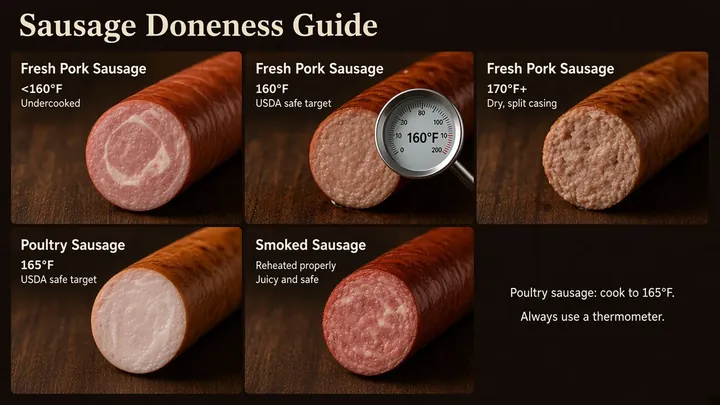
Burger and sausage: venison is very lean, so most people add fat (beef fat or pork) to burger and sausage. Ground venison and venison sausage are 160°F when cooked [1]. If the sausage has poultry in it, it needs 165°F. Our sausage doneness guide has the details.
How much meat will you get from a deer?
NDSU Extension's averages for whitetail [3]:
| Stage | Average whitetail weight | Lean boneless meat as % of that weight |
|---|---|---|
| Whole body | 148 lb | 51.7% |
| Field-dressed | 115 lb | 61.1% |
| Carcass (head, legs, hide off) | 96 lb | 71.6% |
NDSU's example: a whitetail that field-dresses at 150 pounds gives about 91.6 pounds of edible lean boneless meat [3]. Shot placement makes a big difference. Bloodshot meat around the wound has to be trimmed off, and a shoulder shot can cost you a lot of meat.
From the woods to our door: a deer drop-off checklist
Most of what decides whether venison tastes good happens before we ever see it. The NC Wildlife Resources Commission's guidance [2]:
- Field-dress as soon as you can. Getting the entrails out lets the carcass cool [2].
- Wear disposable gloves and use a sharp knife. Don't puncture the stomach, intestines or bladder [2].
- Wipe the cavity dry instead of rinsing it. NCWRC advises against rinsing with water because it can encourage bacteria [2].
- Cool it down. In warm weather, prop the cavity open or put bags of ice inside, and get the deer to refrigeration as soon as possible [2]. Early-season deer in eastern NC can be harvested in warm weather, so plan for this.
- Never haul it on the hood. Engine heat slows cooling. A covered truck bed, a hitch carrier with a tarp, or a trunk keeps the meat away from heat and road grime [2].
- Bag organs separately if you're keeping the heart, liver or kidneys [2].
- Call ahead and check our deer season hours. Have your harvest reporting information ready. Our glossary explains the harvest authorization number.
Chronic wasting disease (CWD) and out-of-state deer
North Carolina first detected CWD in March 2022 [4]. State rules say:
- You may not bring a whole deer carcass into North Carolina from another state or country. Allowed imports include meat that's fully boned out, caped hides with no skull or spinal column attached, cleaned skulls or antlers, and finished taxidermy, each labeled as the rules require [4].
- Non-edible parts of NC deer have to end up in a lined landfill, buried 3 feet deep and 300 feet from water, or lawfully left on the ground in the county where the deer was taken. That applies whether the hunter or a processor disposes of them [4].
NDSU Extension's precautions for hunters include not eating animals that look sick, wearing gloves, keeping handling of brain and spinal tissue to a minimum, and asking processors to handle each animal separately so meat doesn't get mixed [3]. Rules can change between seasons, so check NC Wildlife before you hunt.
Filling out the deer cut sheet
- Backstrap: medallions, butterfly steaks or whole roasts? How thick?
- Tenderloins: included, or already removed?
- Hindquarters: steaks, roasts, cube steak, jerky slices, or all burger?
- Front end: roast or grind?
- Burger and sausage: added fat, seasoning, links or bulk, package size.
- Organs and trophy: keeping the heart or liver? Caping for a mount?
Our deer page and cut sheets list what's available.
Frequently asked questions
What is the most tender cut of venison?
The tenderloin, then the backstrap. Both do best cooked quickly over high heat.
What temperature should venison be cooked to?
FoodSafety.gov lists 160°F for venison, wild or farm-raised [1].
How much meat do you get from a deer?
NDSU Extension estimates edible lean boneless meat at about 61% of field-dressed weight for whitetail, or about 92 pounds from a deer that field-dresses at 150 pounds [3]. Shot damage and trimming lower that number.
Should I rinse out the body cavity?
NC Wildlife advises against it. Wipe the cavity dry with paper towels instead [2].
Bring us your deer
When you've got one down, call or text 252-885-1892 and we'll tell you how to get it to us. Check our deer season page for hours. Flowers Slaughterhouse, 5154 St. Rose Church Rd, Sims, NC 27880.
Sources
- Cook to a Safe Minimum Internal Temperature — FoodSafety.gov (U.S. Department of Health and Human Services)
- Field Dressing and Transporting Wild Game — NC Wildlife Resources Commission
- Wild Side of the Menu No. 2: Field to Freezer — North Dakota State University Extension
- Statewide CWD Regulations — NC Wildlife Resources Commission