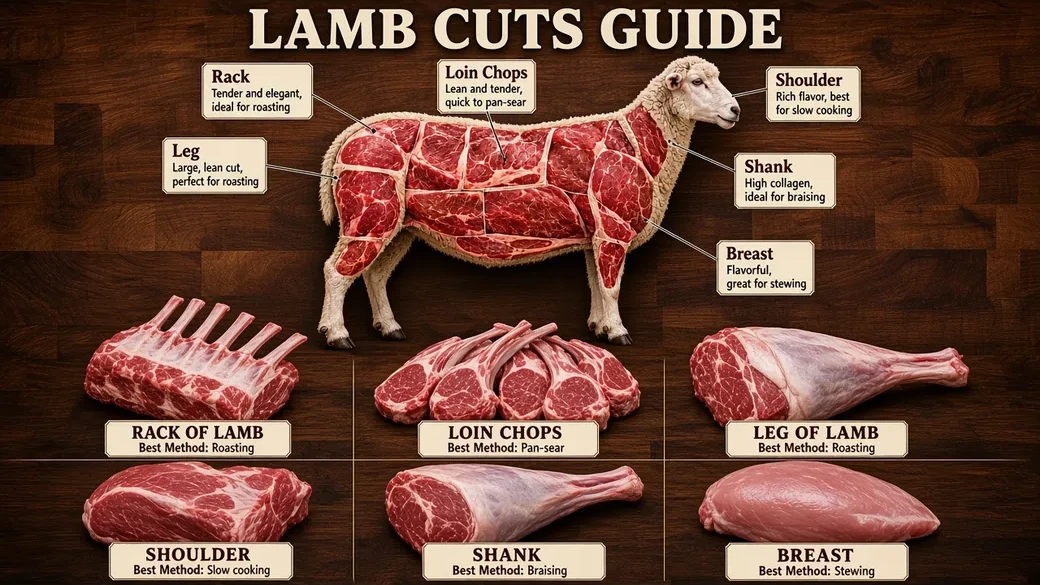
Lamb is a smaller part of our work than beef, hogs and deer, but we do get calls about it every year from families who keep a few sheep and from people planning a holiday meal. A lamb is small enough that each cut sheet choice makes a noticeable difference, so here's what's on the carcass and what to do with each cut.

Lamb cuts at a glance
| Primal | Popular cuts | How to cook | Notes |
|---|---|---|---|
| Shoulder | Shoulder roast, blade and arm chops, stew/kabob meat, ground lamb | Braise, slow-roast, smoke; chops can be grilled | More fat and flavor than the leg, and cheaper [3] |
| Rack (rib) | Rack of lamb, frenched rack, rib chops, crown roast | Roast, grill, sear | The prized cut; tender |
| Loin | Loin chops ("T-bone" chops), boneless loin | Grill, broil, pan-fry | Lean and tender; 3–4 oz chops [3] |
| Leg | Bone-in leg, boneless leg, leg steaks, sirloin chops, kabob meat | Roast whole, butterfly and grill, cube for kabobs | The leanest lamb cut [3] |
| Shank / breast | Fore- and hind shanks, breast, lamb ribs (Denver ribs) | Braise; ribs grill, roast or smoke | Shanks get very tender when slow-cooked [3] |
The rack: rib chops and rack of lamb
FSIS says the rack is the primal more commonly called the rib. It can be split along the backbone into two lamb rib roasts. Two of those roasts sewn into a circle make a crown roast [1]. The American Lamb Board says a rack typically has 8 chops and an American rack weighs about 2 pounds. A frenched rack has a few inches of meat trimmed off the bone ends [3]. (FSIS counts 9 full ribs in the primal [1]. How many chops you get depends on how it's trimmed.)
Cut sheet choice: keep the racks whole for roasting, or cut them into rib chops. Racks look great on a holiday table. Chops are easier for a weeknight.
The loin: little T-bones
Loin chops have a small T-shaped bone, like a tiny beef T-bone. The Lamb Board describes them as lean and tender, about 3 to 4 ounces each. Season or marinate them for 4 to 6 hours, then grill, broil or pan-fry [3]. FSIS says loin and rib chops are the most tender and most expensive chops [1].
The leg: your most versatile lamb cut
The Lamb Board calls the leg the leanest lamb cut and the boneless leg the most versatile. You can roast it whole, cut it into kabob meat or smaller roasts, or butterfly and grill it. A whole boneless leg typically weighs 7 to 8 pounds [3]. A bone-in leg has more flavor from the bone and makes a good centerpiece [3]. FSIS also points out that sirloin chops cut from the leg cost less than loin and rib chops but can be just as tender [1].
Shoulder, shank and breast: cook them slow
The Lamb Board says the shoulder carries a lot of weight, so it's a tough cut that needs to be cooked low and slow. It's fattier, richer and cheaper than the leg, and because of that fat it stays juicier and is easier to get right [3]. Shoulder chops (blade and arm) cook quicker and are a good value [3].
Shanks, front or hind, practically fall off the bone after a slow braise [3]. Lamb ribs (also called Denver ribs) are one of the cheapest lamb cuts and work well braised, grilled, or in place of pork baby backs in a BBQ recipe [3].
Lamb cooking temperatures
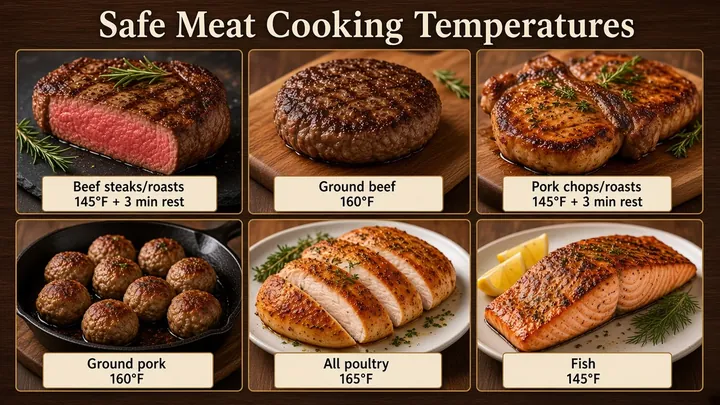
Safety (USDA FSIS): lamb steaks, chops and roasts are 145°F with at least a 3-minute rest. Ground lamb and organ meats are 160°F [1].
Doneness (American Lamb Board): the Lamb Board recommends taking lamb off the heat about 10°F below your target, because the temperature keeps rising as it rests [2].
| Preferred doneness | Pull temperature | Final temperature |
|---|---|---|
| Medium-rare | 135°F | 145°F (rest 3 minutes) |
| Medium | 150°F | 160°F |
| Well done | 160°F | 170°F |
Source: American Lamb Board [2].
Approximate lamb cooking times (FSIS)
Times below assume lamb starting at refrigerator temperature. Grills and ovens vary, so check with a thermometer [1].
| Cut | Size | Method | Approx. time |
|---|---|---|---|
| Leg, bone-in | 5–7 lb | Roast 325°F | 20–25 min/lb |
| Leg, boneless, rolled | 4–7 lb | Roast 325°F | 25–30 min/lb |
| Shoulder roast | 3–4 lb | Roast 325°F | 30–35 min/lb |
| Rib or loin chops | 1–1½ in thick | Broil/grill | 7–11 min |
| Kabob cubes | 1–1½ in | Broil/grill | 8–12 min |
| Ground lamb patties | 2 in thick | Broil/grill | 5–8 min (to 160°F) |
| Shanks | ¾–1 lb each | Simmer, covered with liquid | 1½–2 hours |
Source: USDA FSIS [1].
How much meat comes from a lamb?
FSIS says most lambs go to market at 6 to 8 months old, and a lamb of about 140 pounds gives roughly 46 to 49 pounds of edible lean retail cuts, semi-boneless [1]. After cooking, a pound of raw bone-in leg or roast gives about 8 to 9 ounces of meat to eat, and boneless or ground lamb about 10.5 ounces [1]. Keep that in mind when you plan a meal for a crowd.
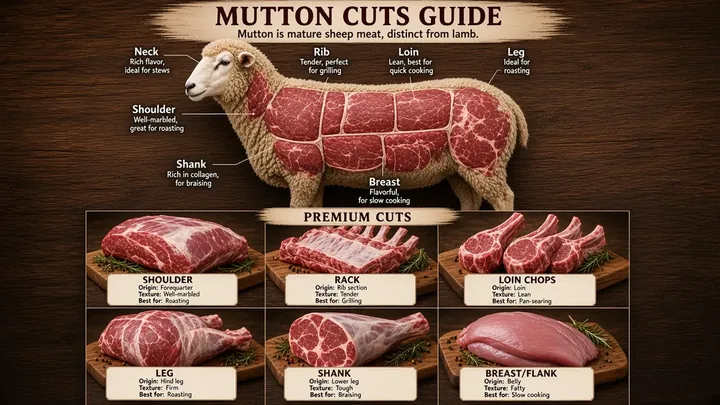
Lamb or mutton? FSIS says lamb usually comes from animals under a year old and mutton from older sheep. Mutton has a stronger flavor [1]. Older sheep do best with slow braising and grinding.
Goat is cut much the same way
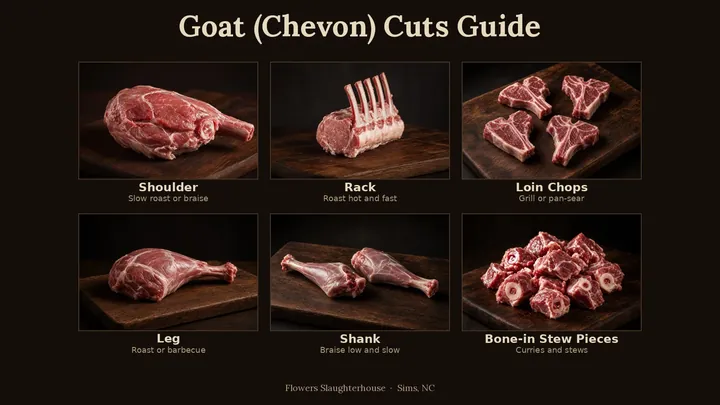
Goat (chevon) customers can use most of this guide. The carcass breaks down along similar lines, and FoodSafety.gov uses the same safe minimums for goat as for lamb: 145°F plus a 3-minute rest for steaks, roasts and chops, and 160°F for ground meat [5].
Filling out a lamb cut sheet
- Racks: whole (frenched or not) or cut into rib chops?
- Loin: loin chops, or a boneless loin roast?
- Legs: whole bone-in, boneless, leg steaks, or cubed for kabobs?
- Shoulder: roast, shoulder chops, stew meat or ground?
- Shanks, breast and ribs: keep them or grind them?
- Ground lamb: how much, and what package size?
See our misc species page and cut sheets, or our safe cooking temperatures chart for every species.
Frequently asked questions
What temperature should lamb be cooked to?
USDA's safe minimum for lamb chops, steaks and roasts is 145°F with at least a 3-minute rest. Ground lamb is 160°F [1] [4].
What is the most tender cut of lamb?
The rack (rib chops) and the loin. FSIS calls loin and rib chops the most tender and most expensive [1].
How many chops are in a rack of lamb?
The American Lamb Board says about 8 chops per rack, with an American rack weighing around 2 pounds [3].
What's the best lamb cut for slow cooking?
Shoulder and shanks. Both have connective tissue that breaks down with low, slow heat [3].
Bring us your lambs
If you're raising lambs for the freezer or a holiday meal, call or text 252-885-1892 and we'll go over the cut sheet with you and find a processing date. Flowers Slaughterhouse, 5154 St. Rose Church Rd, Sims, NC 27880.
Sources
- Lamb From Farm to Table — USDA Food Safety and Inspection Service
- Lamb Cooking Time & Temperature — American Lamb Board
- Cuts of Lamb — American Lamb Board
- Safe Minimum Internal Temperature Chart — USDA Food Safety and Inspection Service
- Cook to a Safe Minimum Internal Temperature — FoodSafety.gov (U.S. Department of Health and Human Services)