North Carolina raises a lot of chicken. FSIS lists it as one of six states that together raise about two-thirds of U.S. chickens [1]. Even so, most people have never cut up a whole bird. This guide goes through the parts in the order a butcher takes them off, explains what each part is good for, and covers the safety steps that matter most with poultry.

Chicken cuts at a glance
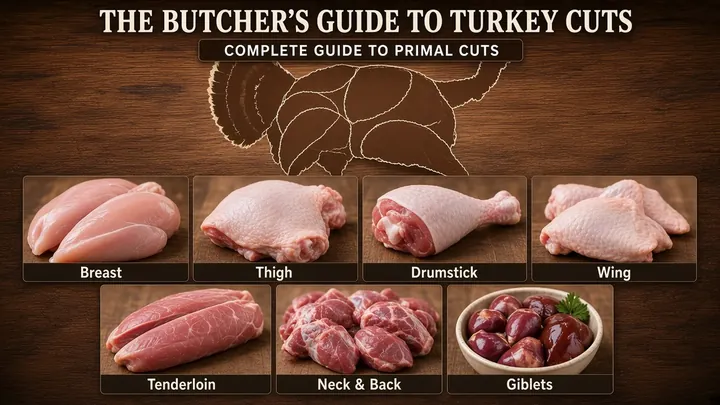
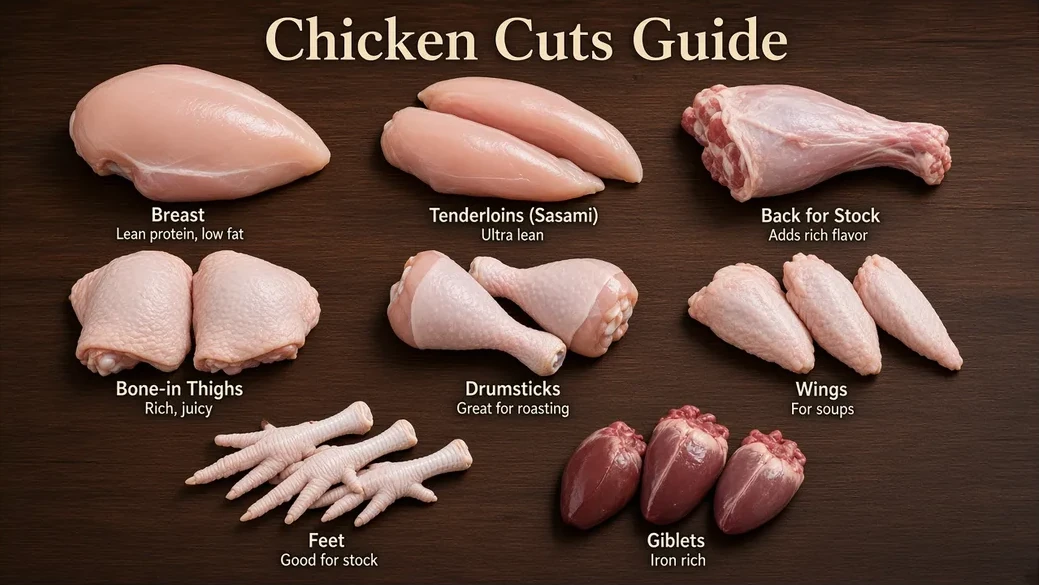
| Cut | What it is | Meat | Best ways to cook |
|---|---|---|---|
| Breast | Separated from the back at the shoulder joint, along the rib junction [2] | White, lean | Grill, roast, pan-sear, poach; easy to overcook |
| Tenderloin ("tender") | The small strip under each breast half | White, very tender | Pan-fry, bread and fry, grill on skewers |
| Wing drumette | The upper wing section (humerus) with its meat and skin [2] | White-ish, lots of skin | Fry, smoke, bake |
| Wing flat / tip | "Wing portion" is the wing with the drumette taken off [2]; the tip is often cut off | Skin and a little meat | Fry or bake; tips go in stock |
| Thigh | Disjointed at the hip; can include pelvic meat but not the pelvic bones [2] | Dark, juicy | Grill, braise, roast, smoke |
| Drumstick | Cut from the thigh at the knee and from the foot at the hock [2] | Dark | Fry, bake, grill, smoke |
| Leg / leg quarter | Leg = thigh plus drumstick; leg quarter also has part of the back attached [2] | Dark | Grill, roast, smoke; a good value |
| Back and neck | Back includes the pelvic bones and the vertebrae behind the shoulder; neck comes off at the shoulder joint [2] | Bony | Stock, broth, soup |
| Giblets | Hearts, gizzards and livers, in about equal numbers [2] | Organ | Fry, simmer, gravy, liver pâté |
| Feet | Below the hock | Mostly collagen | Stock and broth; braised dishes |
The cut names in that table follow the federal standards in 9 CFR 381.170, which set what a package labeled "breasts," "thighs" or "leg quarters" has to contain [2].
Breaking down a whole chicken, in order
If you buy whole birds or raise your own, cutting them up yourself saves money. A standard 8-piece cut gives you 2 breasts, 2 wings, 2 thighs and 2 drumsticks, plus the back for stock. Here's the order:
- Legs off. Pull the leg away from the body, slice through the skin, and pop the hip joint. Cut through the joint to free the whole leg, which includes the thigh and drumstick [2].
- Split the leg. Find the knee joint by the fat line and cut straight through it to separate the thigh from the drumstick [2].
- Wings off. Cut through the shoulder joint where the wing meets the breast. For party wings, split each one at the joints into drumette, flat and tip [2].
- Separate breast from back. Cut along each side where the rib cage meets the backbone [2].
- Split the breast. Cut along the breastbone for two halves. To bone them out, slide the knife along the bone and pull the tenderloin off separately.
- Save the back, neck and wing tips for broth.
Food-safety reminder: don't rinse raw chicken first. FSIS says washing raw poultry spreads bacteria to sinks, counters and other food, and rinsing doesn't kill bacteria. Only cooking does [1].
White meat and dark meat
Breasts and tenderloins are white meat. They're lean, they cook fast, and they dry out quickly once they go past done. Thighs and drumsticks are dark meat. They have more fat and connective tissue, so they stay juicy at higher temperatures and do well with smoking or braising. On a whole roasted bird, that's why the breast is often dry by the time the thighs are tender. Pull the breast pieces as soon as they reach temperature.
Safe cooking: 165°F for every cut
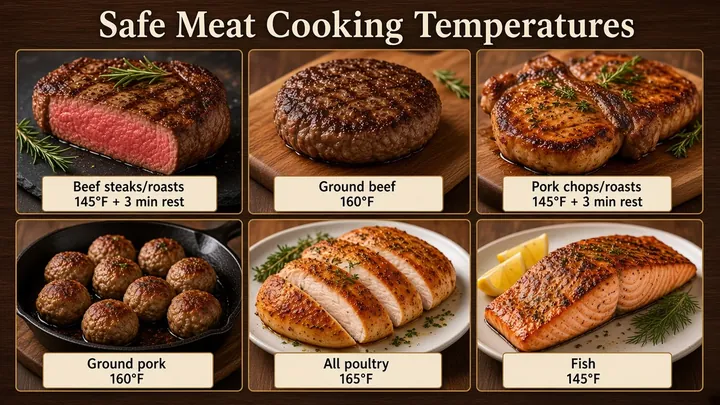
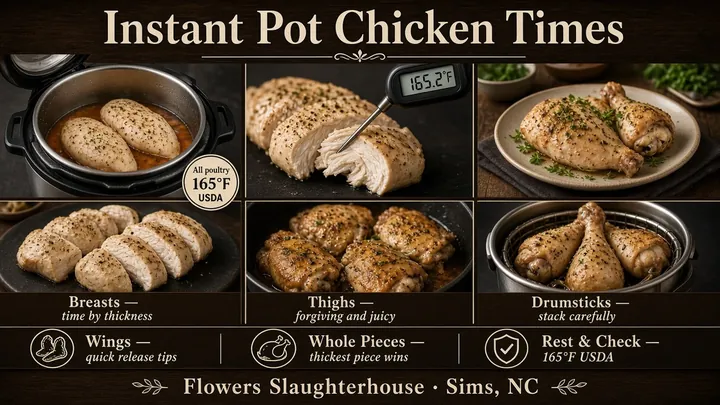
FSIS says to cook all poultry, including breasts, whole birds, legs, thighs, wings, ground poultry, giblets and stuffing, to 165°F (73.9°C) [3]. On a whole bird, check three places: the innermost part of the thigh, the innermost part of the wing, and the thickest part of the breast [1]. For thin pieces, put the probe in from the side so it reaches the center, and keep it off the bone [4].
Pink isn't always undercooked. FSIS says the color of cooked chicken doesn't tell you whether it's safe. Properly cooked chicken can stay pink, especially with smoking or grilling and in young birds [1]. Dark spots around the bone are also normal in young broilers and safe to eat [1].
Approximate chicken cooking times
From the FSIS chart [1]. Always confirm 165°F with a thermometer.
| Cut | Weight | Roast at 350°F | Grill |
|---|---|---|---|
| Whole broiler-fryer (unstuffed) | 3–4 lb | 1¼–1½ hours | 60–75 min (indirect) |
| Breast half, bone-in | 6–8 oz | 30–40 min | 10–15 min per side |
| Breast half, boneless | 4 oz | 20–30 min | 6–8 min per side |
| Legs or thighs | 4–8 oz | 40–50 min | 10–15 min per side |
| Drumsticks | 4 oz | 35–45 min | 8–12 min per side |
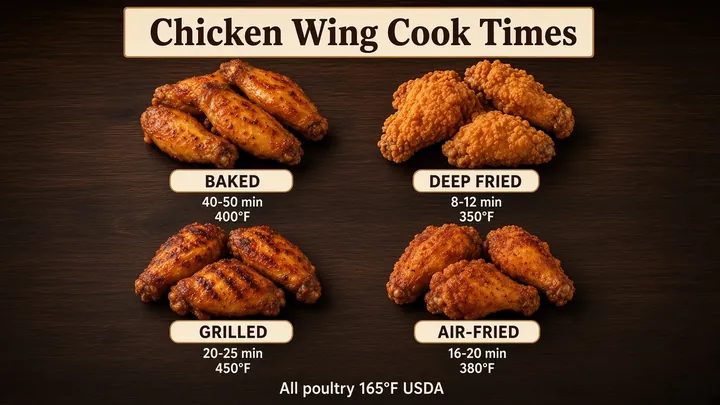
| Wings or wingettes | 2–3 oz | 30–40 min | 8–12 min per side |
Which chicken for which job?
FSIS defines these classes of chicken [1]:
- Broiler-fryer: young and tender, under 10 weeks, 2½–4½ lb dressed. Cook it any way you like.
- Roaster: a young bird of 5 pounds or more. Usually roasted whole.
- Rock Cornish game hen: a small young chicken, 2 pounds or less. Usually stuffed and roasted whole [2].
- Stewing/baking hen: a mature laying hen, 10 months to 1½ years old. Less tender, so stew or braise it.
- Rooster: coarse skin and tough dark meat. Needs long, moist cooking.
If you're processing spent laying hens from a backyard flock, cook them like a stewing hen. Slow and wet makes great chicken and dumplings and broth. They won't fry like a broiler.
Storing chicken
FSIS guidance [1]:
| Product | Refrigerator (40°F or below) | Freezer (0°F; quality only) |
|---|---|---|
| Whole chicken, fresh | 1–2 days | 1 year |
| Chicken parts, fresh | 1–2 days | 9 months |
| Giblets or ground chicken | 1–2 days | 3–4 months |
| Cooked chicken, leftover | 3–4 days | 4 months |
Thaw chicken in the refrigerator, in cold water (changing the water every 30 minutes), or in the microwave. Never thaw it on the counter [1]. FSIS also says not to cook frozen chicken in a slow cooker [1].
Frequently asked questions
What temperature should chicken be cooked to?
165°F for every part of the bird, plus ground chicken and giblets [3].
What's the difference between a chicken leg and a leg quarter?
A leg is the thigh and drumstick together. A leg quarter is the thigh and drumstick with part of the back still attached [2].
What are giblets?
Under federal standards, giblets are hearts, gizzards and livers in about equal numbers [2]. FSIS says a green liver shouldn't be eaten, though the rest of the bird is fine [1].
Should I wash chicken before cooking?
No. FSIS says washing spreads bacteria around your kitchen and doesn't kill them. Cooking to 165°F does [1].
Raising birds? Talk to us
If you keep a flock and want to talk about processing, call or text 252-885-1892, or see our chicken page. Our safe cooking temperatures chart covers every species. Flowers Slaughterhouse, 5154 St. Rose Church Rd, Sims, NC.
Sources
- Chicken from Farm to Table — USDA Food Safety and Inspection Service
- 9 CFR 381.170 — Standards for kinds and classes, and for cuts of raw poultry — Electronic Code of Federal Regulations (eCFR)
- Safe Minimum Internal Temperature Chart — USDA Food Safety and Inspection Service
- Food Thermometers — USDA Food Safety and Inspection Service