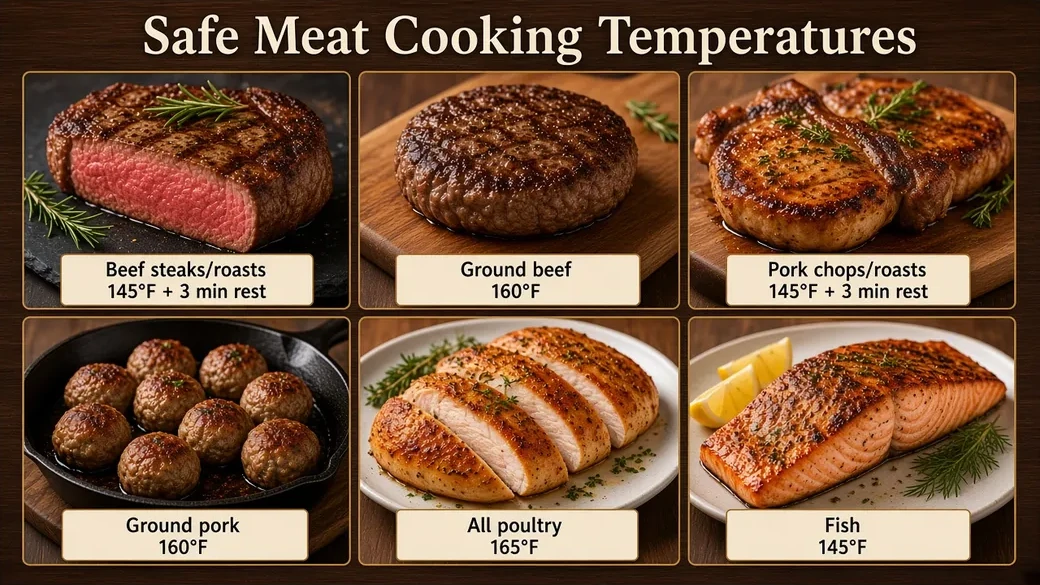
- 145°F + 3-minute rest: whole cuts of beef, pork, veal and lamb (steaks, chops, roasts)
- 160°F: ground meats and fresh sausage made from them
- 165°F: all poultry, whole or ground, plus leftovers and casseroles
Hunters, take note: FoodSafety.gov puts venison and rabbit at 160°F, wild or farm-raised [2].
We print this chart for the wall in our cutting room, and we hand it to customers more than anything else we have. Here it is laid out by species, with the reason ground meat and whole cuts get different numbers.

USDA safe minimum internal temperature chart
Temperatures below come from the USDA FSIS chart [1] and FoodSafety.gov [2]. Measure with a food thermometer before you take the food off the heat.
| Species | Whole cuts (steaks, chops, roasts) | Ground meat & fresh sausage |
|---|---|---|
| Beef | 145°F (63°C) + 3-min rest | 160°F (71°C) |
| Pork | 145°F (63°C) + 3-min rest | 160°F (71°C) |
| Lamb | 145°F (63°C) + 3-min rest | 160°F (71°C) |
| Veal | 145°F (63°C) + 3-min rest | 160°F (71°C) |
| Goat | 145°F (63°C) + 3-min rest | 160°F (71°C) |
| Bison | 145°F (63°C) + 3-min rest | 160°F (71°C) |
| Venison & rabbit (wild or farm-raised) | 160°F (71°C) | 160°F (71°C) |
| Chicken, turkey & other poultry (all parts, ground, giblets, sausage, stuffing) | 165°F (74°C) | 165°F (74°C) |
| Raw ham (fresh or smoked, uncooked) | 145°F (63°C) + 3-min rest | — |
| Fully cooked ham, reheated | 140°F (60°C) if packaged in a USDA-inspected plant; 165°F (74°C) otherwise | — |
| Leftovers & casseroles | 165°F (74°C) | 165°F (74°C) |
Goat, bison, venison and rabbit come from the FoodSafety.gov chart [2]. Everything else appears on both.
Why ground meat needs a higher number than a steak
On a whole steak or roast, bacteria mostly live on the outside, and searing the outside takes care of them. Grinding spreads that outside surface all through the meat. That's why the center of a hamburger has to get hotter than the center of a steak.
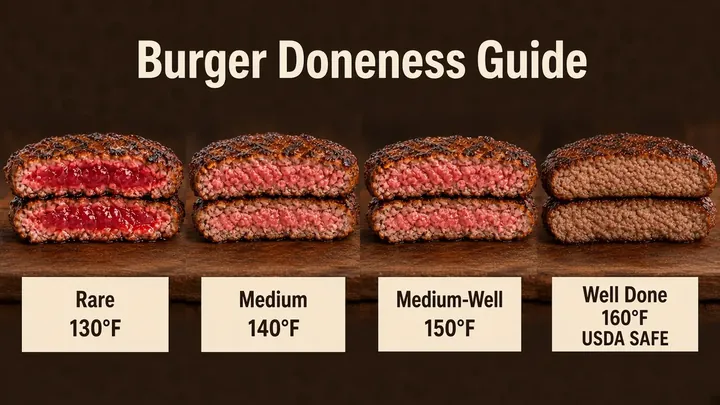
FSIS has a full page on this. In 1997 it began telling consumers to use a thermometer on ground beef patties instead of going by color, and it cites Kansas State University research showing patties can turn brown well before reaching 160°F [8]. It also notes the reverse. Some lean patties stay pink above 160°F and are still safe [8]. You can't judge it by color either way, so use a thermometer.
The same rule covers organ meats. FSIS says to cook beef and lamb heart, kidney, liver and tongue to 160°F [4] [5].
What the 3-minute rest does
The 145°F number for whole cuts comes with a rest time of at least 3 minutes [1]. FoodSafety.gov says the rest gives the innermost parts and juices time to become fully and safely cooked [2]. The rest is part of the safety step, not something you can skip. Ground meat and poultry don't have a rest time on the chart, so they have to reach their number on the heat.
Pork: 145°F is safe
A lot of folks around here grew up cooking pork chops until they were gray. Current guidance doesn't call for that. The National Pork Board puts the safe temperature for fresh whole-muscle pork (chops, loin, tenderloin, roasts) at 145°F with a 3-minute rest, the same as beef [9]. Ground pork is still 160°F [9].
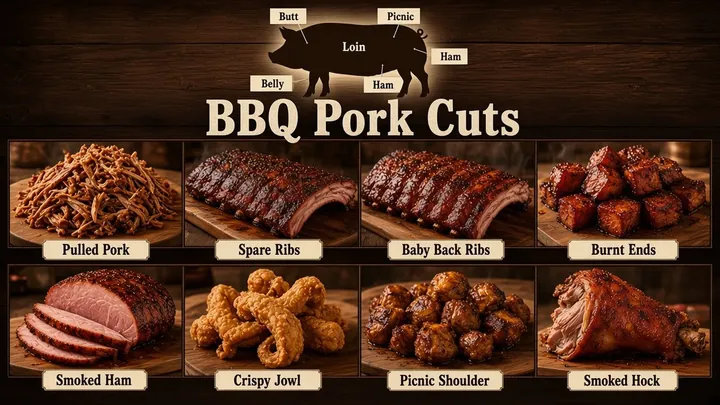
Barbecue cuts are their own case. The Pork Board says ribs and shoulder are safe at 145°F but "best enjoyed" at 180°F, because they need more heat to break down connective tissue [9]. That's a tenderness target, not a safety one. Our BBQ pork cuts guide covers pulled-pork temperatures.
Poultry: 165°F everywhere you check
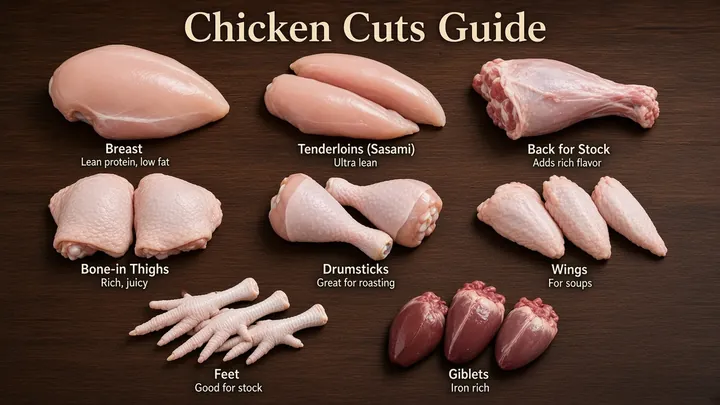
FSIS says to cook all poultry to 165°F: breasts, whole birds, legs, thighs, wings, ground poultry, giblets and stuffing [1]. On a whole bird, check three places: the innermost part of the thigh, the innermost part of the wing, and the thickest part of the breast [6].
FSIS also says pink chicken isn't automatically undercooked. Fully cooked chicken can stay pink, especially in young birds or meat that's been smoked or grilled [6]. The thermometer tells you whether it's done. See our chicken cuts guide for more.
Sausage: depends on what's in the casing
FSIS splits uncooked sausage by meat [7]:
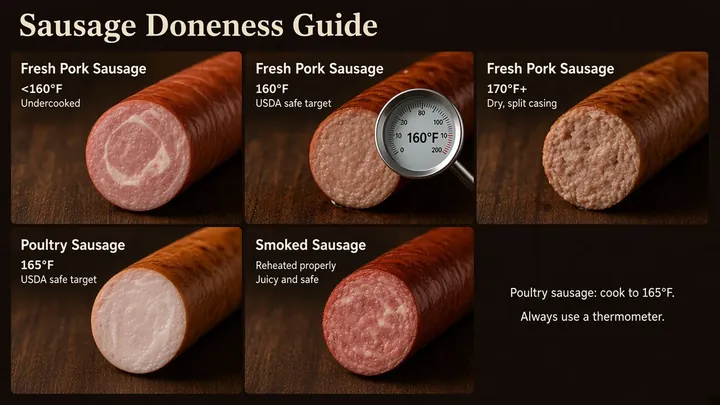
- Fresh sausage made with beef, pork, lamb or veal: 160°F
- Fresh sausage made with turkey or chicken: 165°F
Read the label before you cook. Fresh and uncooked smoked links need full cooking. Cooked and dry sausages are ready to eat [7]. Our sausage doneness guide covers how to cook links through without splitting them.
Venison and other wild game
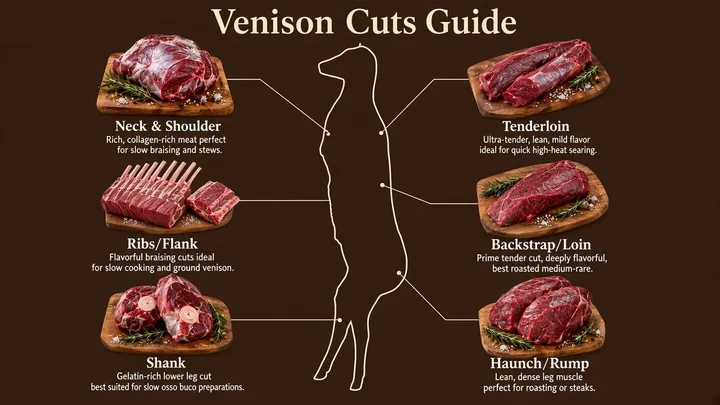
FoodSafety.gov lists venison and rabbit at 160°F, wild or farm-raised [2]. Many deer hunters cook backstrap rarer than that. If you're following the federal chart, though, venison is 160°F, and deer sausage and burger are 160°F as well. Our venison cuts guide covers the cuts and how to drop off a deer.
How to take an accurate reading
FSIS says most food thermometers are accurate within 2 to 4°F, but only if you put the probe in the right place [3].
- Find the thickest part and keep the tip away from bone, fat and gristle [3].
- Go in from the side on thin foods like burgers, chops, sausages and boneless breasts, so the sensing area sits in the center [3].
- Check more than one spot on big or uneven pieces like roasts and whole birds [3].
- Check each piece. Pieces of different sizes get done at different times [3].
- Calibrate it. A glass of ice water should read 32°F [3].
- Wash the probe with hot, soapy water between raw and cooked foods [3].
Don't partly cook it and finish later
FSIS warns against browning or partly cooking meat or poultry, refrigerating it and finishing it later, because any bacteria present won't have been killed [4] [6]. Par-cooking right before it goes on a hot grill is fine. Par-cooking the night before is not.
Frequently asked questions
What is the safe internal temperature for pork?
145°F with a 3-minute rest for fresh chops, roasts, loin and tenderloin. Ground pork needs 160°F [1] [9].
Is ground beef safe at 155°F?
USDA's guidance for home cooks is 160°F for all ground meats [1]. FSIS mentions that the FDA Food Code lets restaurants serve ground beef held at 155°F for 15 seconds, but at home the number is 160°F [8].
What temperature should venison be cooked to?
FoodSafety.gov lists 160°F for venison and rabbit, wild or farm-raised [2].
Do I need to rest chicken?
USDA's chart doesn't list a rest time for poultry. It needs to reach 165°F on the heat [1]. FSIS microwave directions do call for standing time: 10 minutes for bone-in chicken, 5 for boneless breasts [6].
Print it, pin it, ask us
Feel free to print this chart for your kitchen, your hunting camp or your church fish-fry trailer. If you've got a beef, hog or deer coming to the plant and want to talk through the cut sheet, call or text 252-885-1892, or see our cut sheets. We're Flowers Slaughterhouse, 5154 St. Rose Church Rd, Sims, NC.
Sources
- Safe Minimum Internal Temperature Chart — USDA Food Safety and Inspection Service
- Cook to a Safe Minimum Internal Temperature — FoodSafety.gov (U.S. Department of Health and Human Services)
- Food Thermometers — USDA Food Safety and Inspection Service
- Beef From Farm to Table — USDA Food Safety and Inspection Service
- Lamb From Farm to Table — USDA Food Safety and Inspection Service
- Chicken from Farm to Table — USDA Food Safety and Inspection Service
- Sausages and Food Safety — USDA Food Safety and Inspection Service
- Color of Cooked Ground Beef as It Relates to Doneness — USDA Food Safety and Inspection Service
- Pork Cooking Temperature — National Pork Board
More in Doneness & Food Safety · Beef & Veal articles · Pork articles