We cut a lot of steaks for freezer customers in eastern North Carolina. The question we hear most at pickup isn't about the cut. It's "how do I keep from ruining it?" This guide gives you the chart we'd give a friend, the one food-safety number that matters, and how to rest a steak properly.

Steak doneness chart (final temperatures after resting)
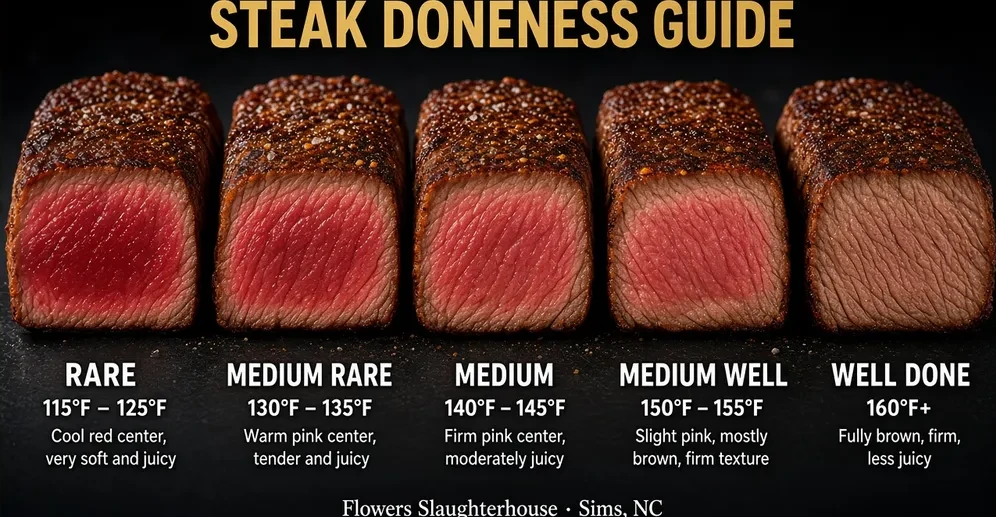
The doneness levels below come from Certified Angus Beef's published chart [2]. The "pull at" column follows its rule of removing steaks about 5°F early. The last column shows which levels meet USDA's 145°F safe minimum [1].
| Doneness | Pull from heat at | Final temp after rest | What the center looks like | Meets USDA 145°F + 3 min? |
|---|---|---|---|---|
| Rare | 120°F (49°C) | 125°F (52°C) | Cool red center | No |
| Medium-rare | 130°F (54°C) | 135°F (57°C) | Warm red center | No |
| Medium | 140°F (60°C) | 145°F (63°C) | Warm pink center | Yes |
| Medium-well | 145°F (63°C) | 150°F (66°C) | Slightly pink center | Yes |
| Well done | 155°F (68°C) | 160°F (71°C) | Little or no pink | Yes |
Something to know: doneness labels aren't the same everywhere. The beef checkoff's site, Beef. It's What's For Dinner, calls 145°F medium-rare, 160°F medium and 170°F well done [3]. Certified Angus Beef calls 145°F medium [2]. So when a recipe says "medium-rare," look for the number it uses. The number tells you more than the word.
The food-safety line: 145°F and a 3-minute rest
USDA's Food Safety and Inspection Service (FSIS) says to cook beef, pork, veal and lamb steaks, chops and roasts to 145°F (62.8°C), checked with a food thermometer before you take the meat off the heat, and then let them rest at least 3 minutes [1]. FSIS adds that you can cook meat hotter than that if you like it that way [5].
Plenty of people eat rare and medium-rare steaks. Just know those are below the USDA minimum. If you're cooking for someone pregnant, very young, older or with a weakened immune system, go by the USDA number.
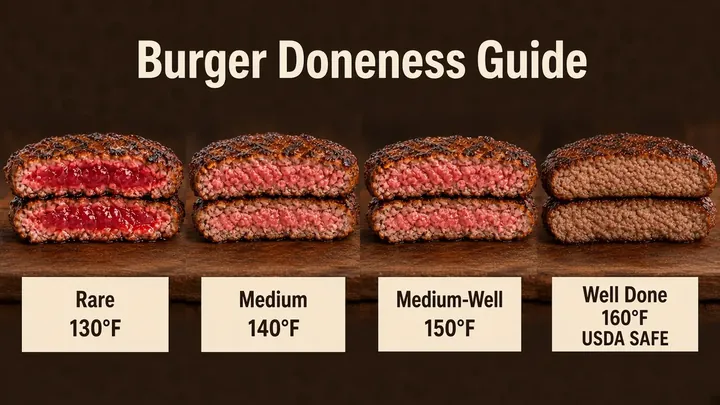
Ground beef is different. Grinding mixes surface bacteria all through the meat, so hamburger and other ground beef mixtures need 160°F [5]. Color won't tell you when a patty is done. FSIS cites research showing some patties turn brown well before they reach 160°F [7]. Burgers get their own rule, and "rare" isn't on the chart for them.
How to check a steak's temperature
A $15 instant-read thermometer helps more than any rub or marinade. FSIS says most food thermometers read within 2 to 4°F, but only when the probe is in the right spot [4].
- Go in from the side. For a steak half an inch thick or more, slide the probe in sideways so the tip sits in the center of the thickest part [3].
- Stay off the bone and the fat. Bone and fat give a false reading. Keep the tip in lean meat [4].
- Start checking early. Thin steaks can go from medium-rare to medium in under a minute on a hot grill.
- Pull it 5°F short of your target and move it to a clean plate or board [2].
- Rest it. At least 3 minutes for safety [1]. Most steaks are better after about 5.
- Check your thermometer now and then. A glass of ice water should read 32°F. If yours doesn't, adjust it or replace it [4].
Why resting matters (and how long)
Heat keeps moving from the hot outside of a steak toward the cooler center after you take it off the grill. That's carryover cooking. Certified Angus Beef tells cooks to pull steaks about 5°F before the target because the temperature keeps rising during the rest [2].
Roasts carry over more. The beef checkoff says a roast's temperature will keep rising 5°F to 15°F after it leaves the oven, and it recommends 15 to 20 minutes of standing time [3]. That's why its roasting chart has you pull a ribeye roast at 135°F for medium-rare [6].
Here's roughly how long to rest:
| Cut | Rest time | Expected rise |
|---|---|---|
| Steak under 1 inch | 3 minutes minimum | A few degrees |
| Thick steak (1½–2 inches) | 5–10 minutes | About 5°F |
| Roast (rib, tenderloin, sirloin tip) | 15–20 minutes | 5–15°F [3] |
Rest it on a board, uncovered or loosely tented with foil. Wrapping it tight steams the crust.
Cut, thickness and grade change how a steak cooks
The chart stays the same no matter what you're cooking. How fast you get there changes with the steak.
- Thickness. FSIS gives a ¾-inch steak about 4–5 minutes per side on a grill or under the broiler [5]. A 1½-inch ribeye takes much longer and usually needs a hot side and a cooler side on the grill. Ask for steaks cut thick on your cut sheet and it's much easier to land on the temperature you want.
- Bone-in vs. boneless. Meat right next to the bone cooks slower. Take your reading away from the bone [4].
- Marbling. USDA says marbling makes beef more tender, flavorful and juicy [5]. Well-marbled ribeyes handle medium better than lean cuts like sirloin or round, which dry out fast past medium.
- Frozen steaks. FSIS says you can cook frozen beef without thawing it first. Expect it to take about 50% longer [5]. If you thaw it, do it in the refrigerator, never on the counter.
Matching doneness to the cut
From the cutting table, here's what we'd tell you:
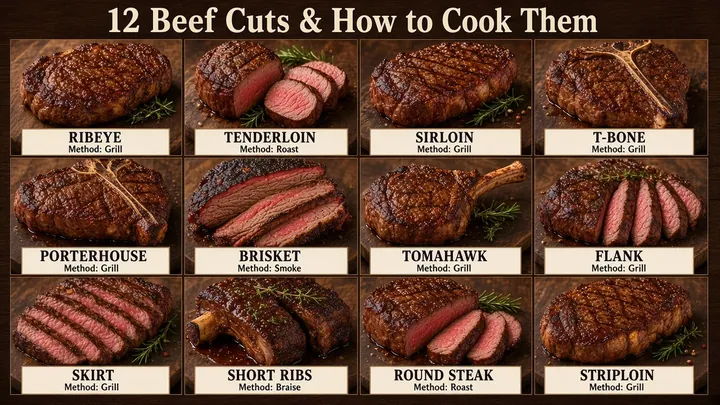
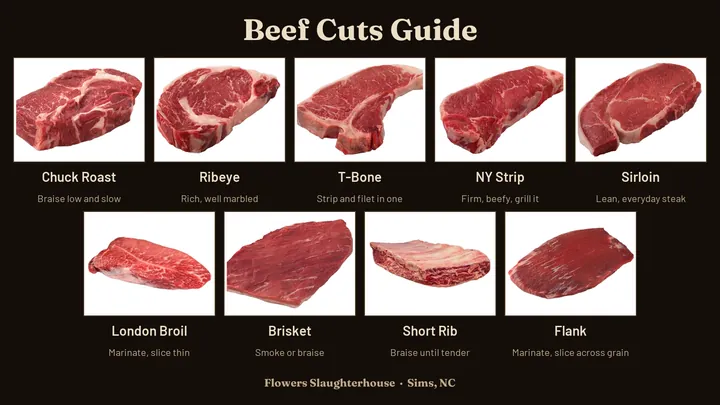
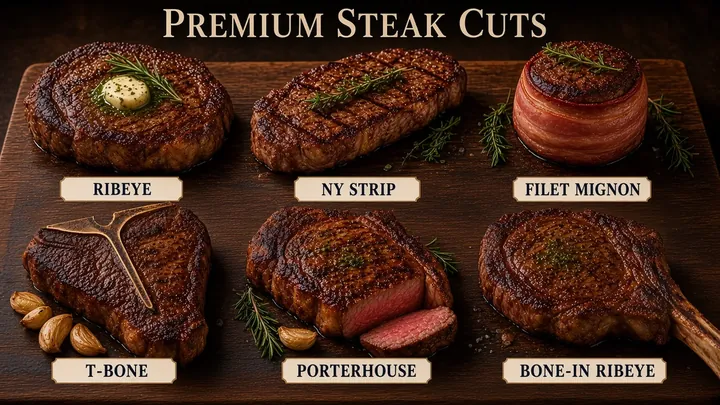
- Ribeye, strip, T-bone, porterhouse: These have the most give. Medium-rare to medium is where most people end up.
- Tenderloin (filet): Very lean and very tender. Don't take it past medium.
- Sirloin and flat iron: Medium is a safe bet. Slice thin across the grain.
- Flank and skirt: Cook fast and hot, then slice thin across the grain. Past medium they get chewy.
- Chuck and round steaks: These usually do better with braising or marinating than with a fast grill. FSIS notes chuck and round are less tender and generally need moist heat [5].
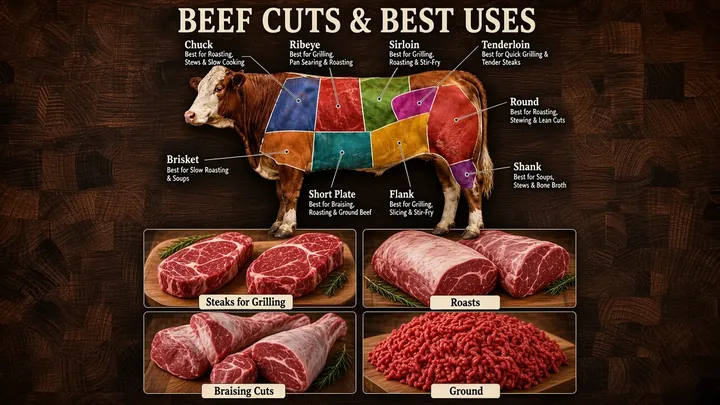
If you're filling out a beef cut sheet, this is a good time to choose steak thickness and decide which primals go to steaks and which go to roasts or ground beef. Our beef cuts and uses guide goes through it one primal at a time.
Frequently asked questions
What temperature is medium-rare steak?
Certified Angus Beef lists medium-rare at a final 135°F (57°C), pulled from the heat around 130°F [2]. The beef checkoff's site uses 145°F for medium-rare [3]. USDA's safe minimum for steaks is 145°F with a 3-minute rest [1].
How long should a steak rest?
At least 3 minutes, which is USDA's guidance for steaks, chops and roasts [1]. Thick steaks do well with 5 to 10 minutes. Roasts need 15 to 20 minutes because their temperature can rise 5 to 15°F after they come out of the oven [3].
Is the 145°F rule the same for burgers?
No. Ground beef needs 160°F [5], and you need a thermometer to know when you're there. FSIS reports that ground beef can turn brown before it's safely cooked [7].
Can I use the finger or "poke" test instead of a thermometer?
You can, but FSIS says a food thermometer is the only reliable way to know meat has reached a safe internal temperature [4]. A thermometer also keeps you from overcooking a good steak.
Get steaks cut the way you cook
Every steak in this guide comes off the cutting table at a plant like ours, cut to the thickness someone wrote on a cut sheet. If you're getting a beef processed and want steaks thick enough to cook right, call or text us at 252-885-1892. Look over the cut sheets or book a processing date. We're at 5154 St. Rose Church Rd in Sims.
Sources
- Safe Minimum Internal Temperature Chart — USDA Food Safety and Inspection Service
- Degree of Doneness — Certified Angus Beef
- Determining Doneness — Beef. It's What's For Dinner. (Cattlemen's Beef Board / NCBA)
- Food Thermometers — USDA Food Safety and Inspection Service
- Beef From Farm to Table — USDA Food Safety and Inspection Service
- Oven Roasting Guidelines — Beef. It's What's For Dinner. (Cattlemen's Beef Board / NCBA)
- Color of Cooked Ground Beef as It Relates to Doneness — USDA Food Safety and Inspection Service