Goose is a holiday bird for a lot of families and a big part of the season for waterfowl hunters. Farm geese and wild geese cook so differently that we've split this guide in two after the anatomy section.

Goose anatomy and what each cut is for
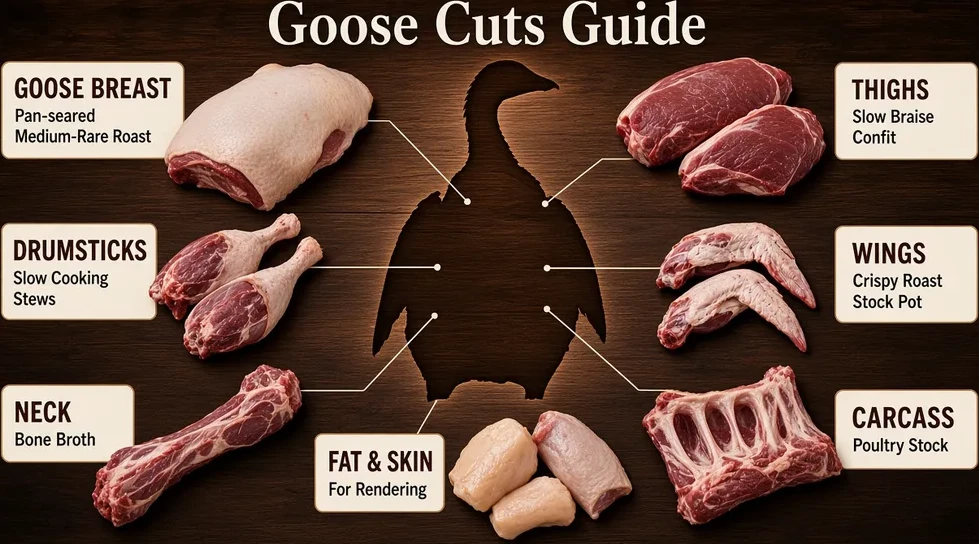
| Cut | What it is | Best use |
|---|---|---|
| Breast | The big muscle on each side of the keel bone | Roast on the bone. Sear skin-side down. On wild geese, marinate and grill, or slice for stir-fry |
| Legs and thighs | Hard-working dark meat with lots of connective tissue | Braise, confit, smoke, or slow-cook until tender |
| Drumsticks | Lower leg, full of tendons | Braise or pull for soup and casseroles |
| Wings | Bony, with a little rich meat | Roast with the bird, or use for stock |
| Neck and backbone | Mostly bone and skin | Stock and gravy |
| Giblets | Heart, gizzard and liver | Simmer the heart and gizzard for gravy. Sauté the liver |
| Fat | The layer under the skin | Render and save for cooking |
Because geese fly, their breast meat is darker and more strongly flavored than chicken or turkey breast. FSIS points out that, since all the meat on a goose is dark, it tastes stronger than chicken breast and even chicken leg meat [1].
Farm-raised goose
What the labels mean
FSIS terms for domestic geese [1]:
- Young goose or gosling: either sex, tender. A gosling weighs about 8 pounds. A young goose weighs 12 to 14 pounds.
- Mature or old goose: tougher meat, usually a spent breeder, mostly used in processed products.
- Gander: a male goose.
Domestic geese spend their first six weeks under cover, then 14 to 20 weeks on the range eating grass and some grain. California and South Dakota raise most of them [1]. Geese aren't sold in big numbers, so most stores keep them frozen. Fresh birds show up around the holidays [1].
How much to buy: about 1 to 1½ pounds of raw whole goose per person. Raw boneless meat gives about 3 servings per pound after cooking [1]. A goose has a big frame and not much meat for its weight, so don't skimp.
The fat
Like ducks, geese have a fat layer under the skin that keeps them afloat. FSIS says to prick the skin all over before roasting or smoking so the fat can render out. The goose isn't done until that layer has melted [1]. Set the bird on a rack so it isn't sitting in its fat, and spoon or pour the fat off as it builds up. Strain it, refrigerate it, and use it for potatoes and greens.
Cooking times
FSIS's planning chart for goose [1]:
| Goose | Roast | Grill (direct) | Smoke (indirect, with drip pan) | Braise |
|---|---|---|---|---|
| Whole young goose, 8–12 lb | 2½–3 hours (unstuffed) | Not suitable | 2–2½ hours | Not preferred |
| Young goose, cut up | 2 hours | 35–40 minutes | 2 hours | 2 hours |
If you stuff the goose, add 15 to 30 minutes. The center of the stuffing has to reach 165°F as well [1] [6]. These times are only for planning. Check a whole goose in three places: the innermost thigh, the innermost wing and the thickest part of the breast. All three need 165°F [1].
The breast and legs cook at different speeds
On a whole goose, the breast is done well before the legs are tender. Two ways to handle it:
- Roast whole, then finish the legs. Carve off the breast when it reaches 165°F and let it rest. Put the legs back in the oven, or braise them, until the meat pulls away from the bone.
- Cut it up first. Roast or sear the breasts and braise the legs separately. FSIS times a cut-up young goose at about 2 hours roasted or braised [1].
Wild goose
A wild goose is a different bird in the kitchen. It's lean, works hard and could be one year old or ten.
In the field
North Dakota State University Extension's game bird guide recommends [4]:
- Field dress promptly. Take out the entrails and crop as soon as you can.
- Cool the birds fast. Above 40°F is "meat's worst enemy." Don't pile warm birds together, and don't carry them in a closed trunk.
- Wear gloves when you clean birds, and don't harvest a bird that looks sick.
- Save the heart and liver on ice if you want giblets.
If you leave geese with anyone else to clean, process or store, federal law requires a tag signed by the hunter with your address, the number and species of birds and the date they were killed [5].
How to breast out and leg a wild goose
Most hunters don't pluck every goose. They take the breast and legs and leave the rest.
- Lay the goose on its back. Pluck or pull back the skin and feathers over the breast until the whole breast is exposed.
- Find the keel (the ridge of the breastbone) and slice down along one side of it, keeping the knife against the bone.
- Work the knife down along the ribs and wishbone and lift the breast off in one piece. Repeat on the other side.
- Pull back the skin over each leg, push the leg out to pop the hip joint, and cut through the joint to remove the leg and thigh.
- Trim off fat, silver skin, bloodshot meat and any shot, and rinse the pieces in cold water.
- Chill or freeze right away, in meal-size packages with as much air pressed out as possible.
Cooking wild goose
NDSU Extension's goose tips [3]:
- Wild goose is lean and tends to be dry. Use it in soups and stews, bake it in oven bags, or marinate it before cooking as a fillet or stir-fry.
- Use tongs, not a fork, to keep the juices in, and let the meat rest covered for five minutes before slicing against the grain.
- Try a buttermilk or yogurt marinade for skinless wild poultry: 2 to 6 hours in the refrigerator.
- Goose can stand in for chicken, turkey or duck in most recipes.
NDSU's game bird guide adds that young birds take dry heat, older birds do better braised or stewed, and trimming off fat cuts down a strong taste [4]. Legs from an old gander can take hours of braising. They make excellent pulled meat for soup, gumbo or casseroles.
Thawing and storage
- Thawing (FSIS): in the refrigerator, a whole goose takes 1 to 2 days or more and parts about a day. In cold water, a goose takes 4 to 6 hours. Keep it sealed and change the water every 30 minutes [1].
- Fresh goose and giblets: 1 to 2 days in the refrigerator. In the freezer, about 6 months for best quality [1]. NDSU says properly wrapped wild game birds also keep up to six months for best quality [3].
- Cooked goose, gumbo and stews: 3 to 4 days refrigerated, 2 to 3 months frozen [1].
- Never partly cook ahead. Don't brown or partly cook goose to finish later [1].
Frequently asked questions
What temperature should goose be cooked to?
165°F for every part, wild or farm-raised. On a whole goose, check the innermost thigh, the innermost wing and the thickest part of the breast.
How long does it take to roast a goose?
FSIS plans an 8- to 12-pound whole young goose at about 2½ to 3 hours unstuffed, and 15 to 30 minutes more if stuffed. A cut-up goose roasts in about 2 hours. Always confirm with a thermometer.
What's the best way to cook a wild goose?
Breast it out, marinate the breasts and cook them quickly, or use them in stew. Braise the legs slowly until tender. Wild goose is lean and dries out if you roast it like a farm bird.
Is goose meat white or dark?
USDA counts it as poultry, but all the meat on a goose is dark, breast included, because geese fly. That's why it tastes richer than chicken or turkey.
Bringing in birds?
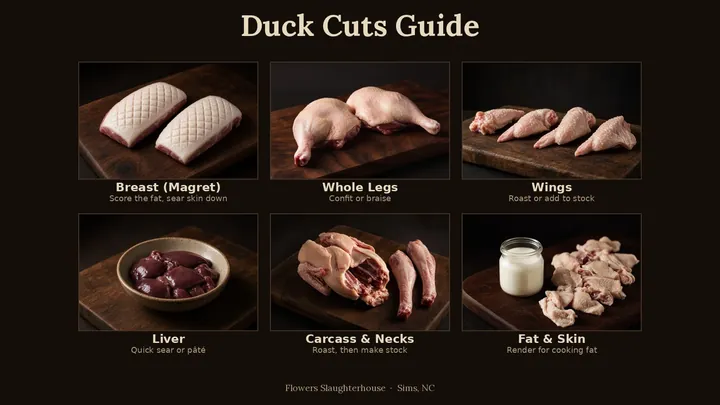
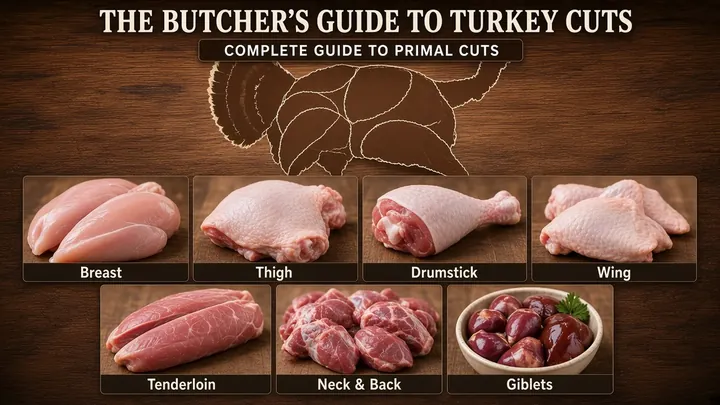
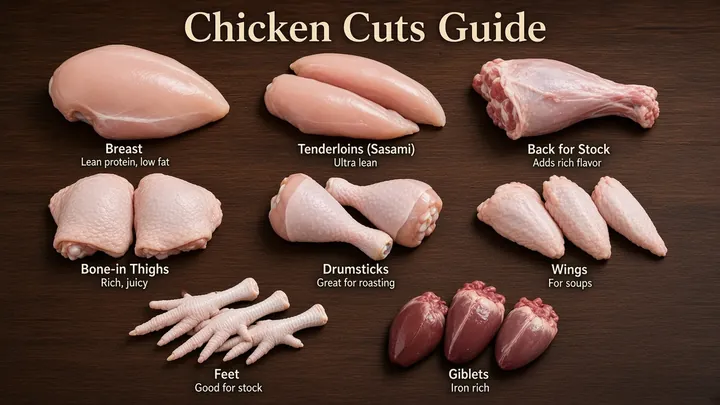
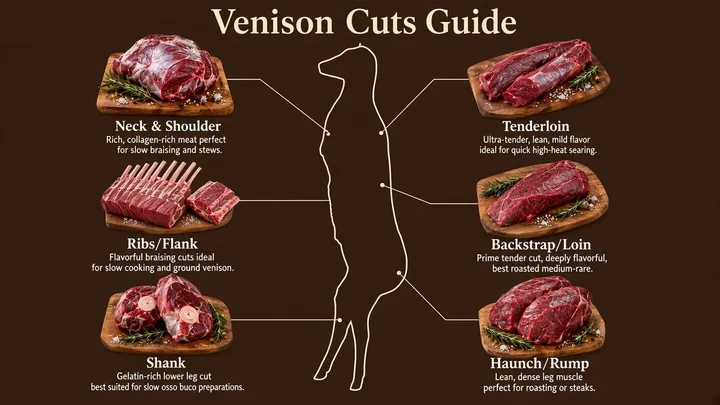
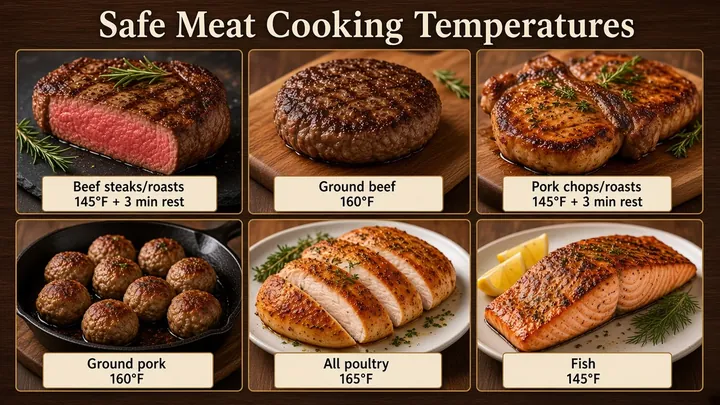
We cut beef, pork and deer every week. Our poultry services are still being finalized, and we don't list waterfowl as a regular service, so call or text 252-885-1892 before you bring geese in, or check our poultry page and misc species page for what we currently take. For hunters, our deer processing page and venison cuts guide cover deer drop-off. For other birds, see our duck cuts guide, turkey cuts guide and chicken cuts guide. For every species in one place, see the safe meat cooking temperatures chart.
Sources
- Duck and Goose from Farm to Table — USDA Food Safety and Inspection Service
- Safe Minimum Internal Temperature Chart — USDA Food Safety and Inspection Service
- Pinchin' Pennie$ in the Kitchen: Tips and Recipes for Preparing Goose — North Dakota State University Extension
- A Pocket Guide to Care and Handling of Game Birds from Field to Table — North Dakota State University Extension
- 50 CFR 20.36 Tagging Requirement — Electronic Code of Federal Regulations
- Food Thermometers — USDA Food Safety and Inspection Service