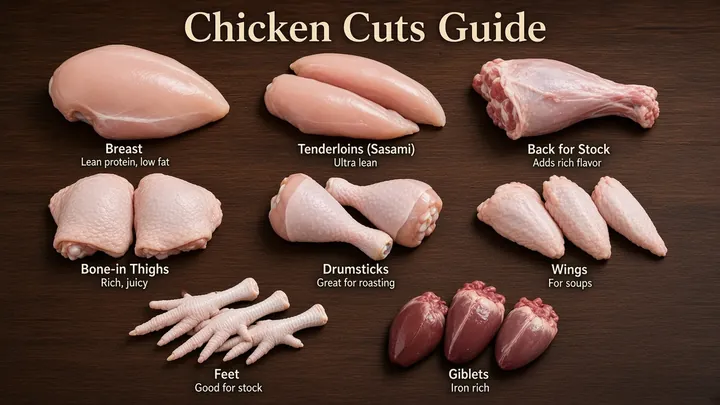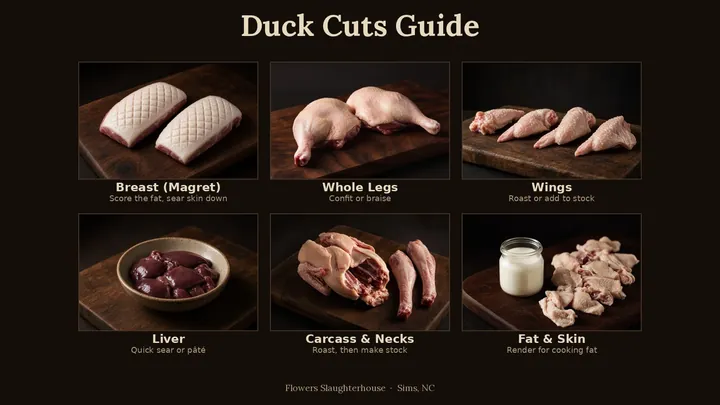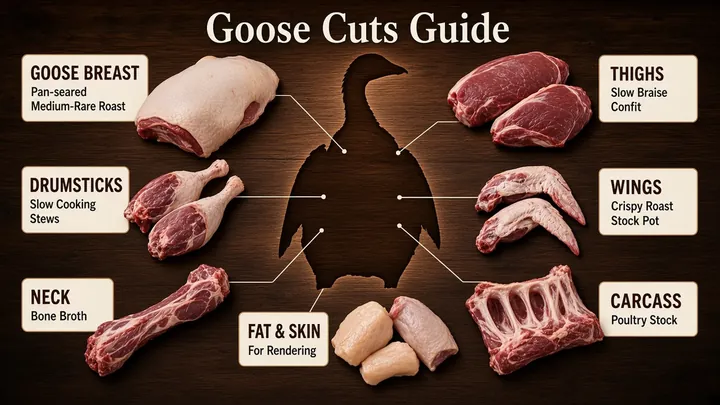
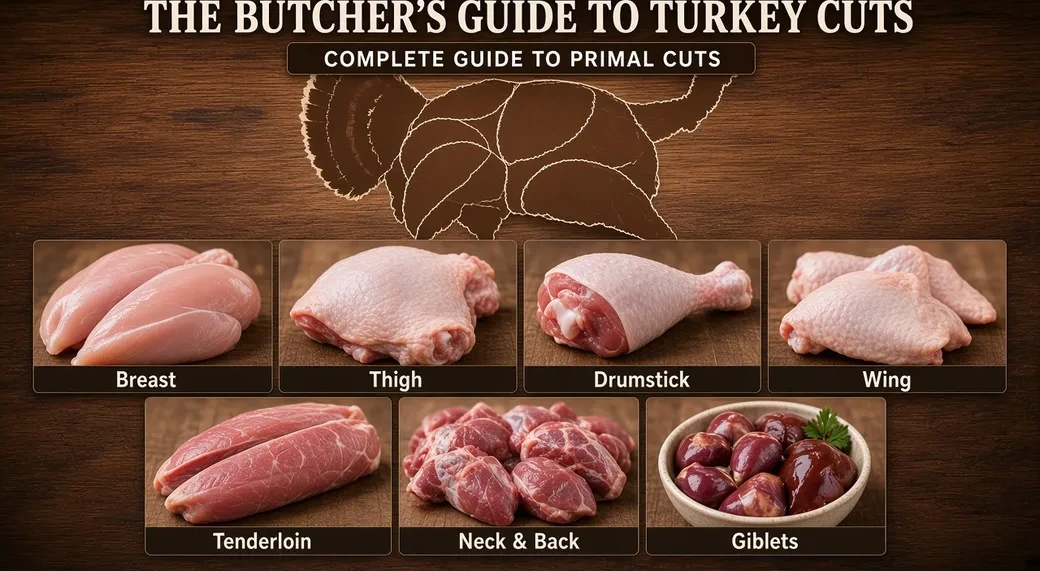
Turkey is the food people call the USDA Meat and Poultry Hotline about more than any other [3]. Most of those calls come in November. This guide covers each cut on the bird, what it's good for, how long it takes and how to handle a whole holiday turkey from the freezer to the carving board. We cut meat for a living, so we've also included how to break a bird down yourself.

Turkey cuts at a glance
The cooking methods below come from the National Turkey Federation's cut-and-cook chart [4].
| Cut | White or dark | Good ways to cook it |
|---|---|---|
| Bone-in breast | White | Roast, smoke, grill, fry, slow cooker |
| Boneless breast | White | Roast, smoke, grill, fry, slow cooker |
| Tenderloin | White | Grill, roast, sauté, smoke |
| Cutlets | White | Sauté, fry, grill, roast, slow cooker |
| Bone-in thigh | Dark | Roast, grill, smoke, slow cooker |
| Boneless thigh | Dark | Roast, grill, slow cooker |
| Drumstick (leg) | Dark | Roast, smoke, grill, fry, slow cooker |
| Wing / drumette | Dark | Roast, smoke, grill, fry, slow cooker |
| Ground turkey | Mixed | Sauté, grill, roast |
| Neck, back, giblets | — | Simmer for stock and gravy |
White meat: breast, tenderloin and cutlets
Breast. The biggest piece on the bird and the leanest. You can buy or cut it bone-in (a "turkey breast" roast), boneless, or as a half breast. It dries out first, so it's the part that sets your timing on a whole bird. FSIS roasting times at 325°F [3]:
| Breast | Weight | Time (unstuffed) |
|---|---|---|
| Half breast | 2–3 lb | 50–60 minutes |
| Whole breast | 4–6 lb | 1½–2¼ hours |
| Whole breast | 6–8 lb | 2¼–3¼ hours |
Tenderloin. The small strip of muscle on the underside of each breast half, like the chicken tender. It's quick: the Turkey Federation lists 8-ounce tenderloins at 15–20 minutes on a medium grill [5]. You can slice tenderloins into medallions and cook them like cutlets [2].
Cutlets. Thin slices of breast. A couple of minutes per side in a hot pan [2]. Pound them even for the best results.
Dark meat: thighs, drumsticks and wings
Dark meat works harder on a live bird. It has more fat and connective tissue, which is why it stays juicy and takes well to long cooking.
- Thighs are the meatiest dark cut. Roast them bone-in, or bone them for the grill.
- Drumsticks are the lower leg. They have tough tendons running through them, so they're best roasted, smoked or braised until tender.
- Wings split into drumette, flat and tip, the same as a chicken wing. Turkey wings are big enough to smoke or braise like a small roast.
FSIS roasting times at 325°F [3]:
| Part | Size | Time |
|---|---|---|
| Drumsticks | ¾–1 lb each | 2–2¼ hours |
| Thighs | ¾–1 lb each | 1¾–2 hours |
| Wings, drumettes | 6–8 oz each | 1¾–2¼ hours |
Ground turkey, neck, back and giblets
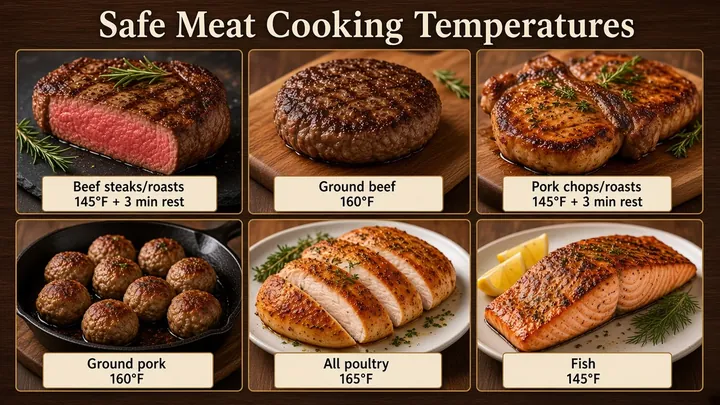
- Ground turkey is usually a mix of white and dark meat. It needs 165°F, the same as all ground poultry, which is higher than ground beef's 160°F [1].
- Neck and back have more bone than meat, but they make the best stock and gravy base.
- Giblets are the neck, gizzard, heart and liver that come packed in the cavity. FSIS's traditional method is to simmer the neck, gizzard and heart in water, then add the liver near the end, since it cooks faster [3]. Giblets must reach 165°F too [1].
Turkey nutrition by cut
The National Turkey Federation's numbers for 3 ounces of cooked, skinless turkey, based on USDA nutrient data [6]:
| Cut | Calories | Fat | Protein |
|---|---|---|---|
| Tenderloin | 110 | 2 g | 24 g |
| Drumstick | 120 | 2 g | 25 g |
| Breast | 125 | 2 g | 26 g |
| Wing / drumette | 125 | 2 g | 26 g |
| Whole turkey (mixed) | 135 | 3 g | 25 g |
| Thigh | 140 | 5 g | 24 g |
| Ground turkey, 93% lean | 180 | 10 g | 22 g |
| Ground turkey, 85% lean | 210 | 14 g | 22 g |
Most of the fat on a turkey is in the skin. Leave it on while roasting to protect the meat and take it off at the table if you want.
The whole holiday bird
Hen or tom, fresh or frozen?
"Hen" or "tom" on the label just tells you size. Toms are bigger, and FSIS says both should be equally tender [3]. A "fresh" label means the turkey has never been below 26°F. A turkey held at 0°F or below has to be labeled "frozen" [3].
Thawing
Never thaw a turkey on the counter. FSIS gives three safe ways [3]:
- Refrigerator: about 1 day for every 4–5 pounds. A 20-pound bird needs 4 to 5 days. Start early.
- Cold water: keep the bird in its sealed wrapper or a leak-proof bag, submerge it and change the water every 30 minutes. Cook it as soon as it's thawed.
- Microwave: only if it fits, and cook it immediately after.
Roasting times
FSIS times for a whole turkey at 325°F [3]:
| Weight | Unstuffed | Stuffed |
|---|---|---|
| 8–12 lb | 2¾–3 hours | 3–3½ hours |
| 12–14 lb | 3–3¾ hours | 3½–4 hours |
| 14–18 lb | 3¾–4¼ hours | 4–4¼ hours |
| 18–20 lb | 4¼–4½ hours | 4¼–4¾ hours |
| 20–24 lb | 4½–5 hours | 4¾–5¼ hours |
Set the oven no lower than 325°F, put the bird breast-side up on a rack in a shallow pan, and tent the breast loosely with foil for part of the time if it browns too fast [3]. The times are only for planning. The thermometer decides when it's done.
Where to put the thermometer
Check three places: the innermost part of the thigh, the innermost part of the wing, and the thickest part of the breast. All three need to read 165°F [3]. Keep the probe off the bone, which gives a false reading [7].
Stuffing
FSIS recommends cooking stuffing in a separate dish. If you do stuff the bird, the center of the stuffing has to reach 165°F as well. Let the turkey stand 20 minutes before you take the stuffing out and carve [3].
"Is my turkey still pink?"
Smoked and grilled turkeys are often pink right under the skin, even when fully cooked. FSIS says that if the turkey has reached 165°F in the thigh, wing and breast, it's safe. The pink comes from a heat-stable pigment, not undercooking [3].
Never partly cook it ahead
FSIS warns not to brown or partly cook a turkey and finish it later. It's only safe to partly cook a turkey if it goes straight onto a hot grill to finish [3].
How to break down a whole turkey
Buying a whole bird and cutting it up yourself is usually cheaper than buying parts. It also cooks more evenly, because the breast and legs can each come off the heat when they're done.
- Pull the neck and giblet bag out of both cavities. Pat the bird dry.
- Pull a leg away from the body and slice through the skin between the leg and breast. Bend the leg back until the hip joint pops, then cut through the joint to take off the whole leg. Repeat on the other side.
- Find the joint between the thigh and drumstick (there's a line of fat over it) and cut straight through it to separate them.
- Pull each wing out, find the shoulder joint and cut through it. Split the wing into drumette, flat and tip if you like.
- Cut along both sides of the backbone with heavy shears to remove the back. Save it with the neck for stock.
- Leave the breast on the bone as a roast, or run your knife along the breastbone and down the ribs to take each breast half off. The tenderloin is the loose strip underneath each half.
Keep raw turkey and its juices away from everything else on the counter. Wash your hands, board and knife with hot, soapy water when you're done.
Storing turkey and leftovers
FSIS storage times [3]:
| Item | Refrigerator | Freezer (best quality) |
|---|---|---|
| Fresh whole turkey | 1–2 days | 12 months |
| Fresh turkey parts | 1–2 days | 9 months |
| Ground turkey, giblets | 1–2 days | 3–4 months |
| Cooked turkey | 3–4 days | 4 months |
| Broth, gravy | 3–4 days | 2–3 months |
Get leftovers in the refrigerator within 2 hours, carved off the bone and in shallow containers. Reheat to 165°F [1].
Frequently asked questions
What temperature should turkey be cooked to?
165°F for every part of the bird, including ground turkey, giblets and stuffing. Check the innermost thigh, the innermost wing and the thickest part of the breast. Many cooks take thighs and drumsticks to 170–175°F because dark meat gets more tender there.
How long does it take to thaw a turkey?
In the refrigerator, about one day for every 4 to 5 pounds. In cold water, change the water every 30 minutes and cook the turkey as soon as it's thawed. Never thaw it on the counter.
What's the difference between white and dark turkey meat?
White meat (breast, tenderloin) is leaner and cooks faster. Dark meat (thighs, drumsticks, wings) has more fat and connective tissue, so it stays juicy and does well with longer cooking.
What are turkey giblets?
The neck, gizzard, heart and liver packed inside the bird. Simmer them for gravy or stock, and cook them to 165°F like the rest of the turkey.
Raising birds? Give us a call
We cut beef, pork and deer every week, and we're glad to answer questions about any meat that ends up in your freezer. If you raise turkeys or other poultry and want to talk about processing, call or text 252-885-1892 or check our chicken and poultry page for what we currently offer. For chicken, see our chicken cuts guide. For every species in one place, see our safe meat cooking temperatures chart.
Sources
- Safe Minimum Internal Temperature Chart — USDA Food Safety and Inspection Service
- Today's Turkey: Cooking Tips (PDF) — National Turkey Federation
- Turkey from Farm to Table — USDA Food Safety and Inspection Service
- How to Cook the Perfect Turkey — National Turkey Federation
- Today's Turkey: Grilling Tips (PDF) — National Turkey Federation
- Today's Turkey: Turkey Cuts and Nutrition (PDF) — National Turkey Federation
- Food Thermometers — USDA Food Safety and Inspection Service