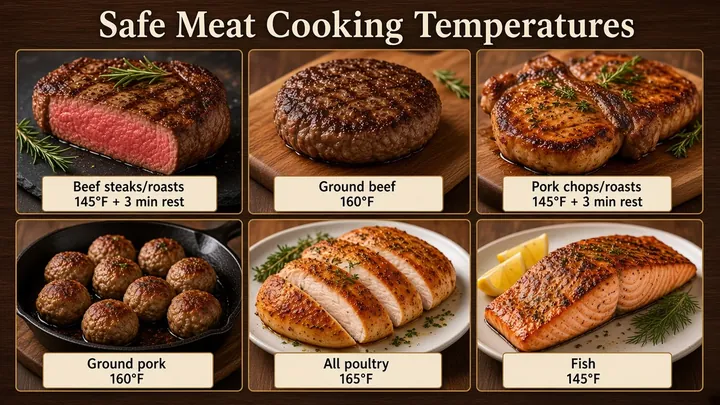
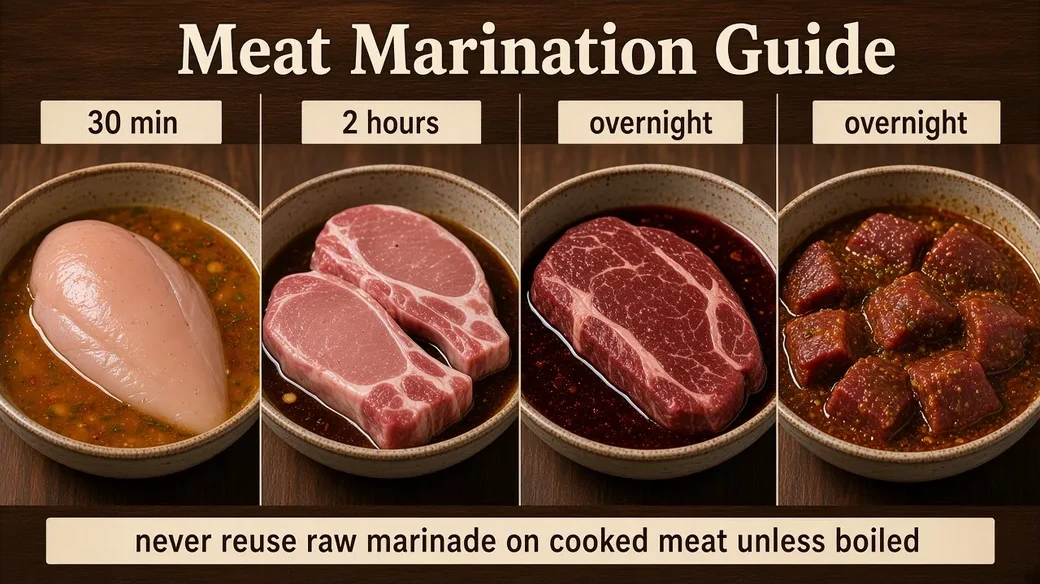
Those USDA numbers are safety limits, not targets. A chop that sat in lemon juice for five days is safe, but you won't like it. This guide gives you the times that actually taste right, cut by cut, and explains what goes wrong when meat sits too long.

Marinating times at a glance
| Meat | Good marinating time | USDA refrigerator limit |
|---|---|---|
| Tender beef steaks (ribeye, strip, filet, top sirloin) | 15 minutes to 2 hours, for flavor [1] | 5 days [4] |
| Tougher beef (flank, skirt, chuck, round) | 6 to 24 hours, to tenderize [1] | 5 days |
| Pork chops, tenderloin, kabobs | 2 hours to overnight (our rule of thumb) | 5 days [5] |
| Lamb chops, legs, roasts | 2 hours to overnight (our rule of thumb) | 5 days [6] |
| Lamb cubes, stew meat | 2 to 12 hours (our rule of thumb) | 2 days [6] |
| Chicken | 2 to 24 hours [3] | 2 days [7] |
| Seafood | 15 to 60 minutes [3] | No separate USDA line; we'd cook it the same day |
"Our rule of thumb" means those times come from what works at our own grills, not from a published standard. Use the short end with a sharp, acidic marinade and the long end with a mild one.
What a marinade actually does
A marinade is usually three things: an acid (vinegar, citrus, wine, yogurt or buttermilk), an oil, and flavorings like garlic, herbs, salt, sugar or soy sauce [3]. The beef checkoff splits marinades into two jobs. A flavoring marinade goes on tender cuts for a short time. A tenderizing marinade goes on less tender cuts for longer [1].
Here's the part most people don't know: marinades work almost entirely on the surface. America's Test Kitchen soaked beef short ribs in red wine for up to 18 hours and found the wine had moved in less than 1 millimeter [8]. That's why marinades do their best work on thin cuts like flank steak, skirt steak, chicken breasts, chops and kabob cubes, and why a thick roast is better off with a dry rub.
Over-marinating: why longer isn't better
Acids and enzymes keep working for as long as the meat sits in them, and they work from the outside in.
- Acid. Citrus, vinegar, wine and yogurt weaken the proteins on the surface. Left too long, they turn the outside layer mushy instead of tender [8]. The beef checkoff warns that steak left in marinade too long "could get mealy, have a softened texture and be overly seasoned" [2].
- Enzymes. Fresh pineapple (bromelain) and papaya (papain) break down protein fast, and the effect is mushiness, not true tenderness [8]. Keep pineapple marinades short, and don't let them go overnight.
- Salt. A very salty marinade, like straight soy sauce, can make thin meat taste cured if it sits all day. The checkoff lists "using too much salt" as a common mistake [2].
Chicken breast as an example: 15 to 30 minutes gives you flavor on the outside only. Two to six hours is where most cooks are happiest. In our experience, past 8 hours in a strongly acidic marinade the surface starts to turn soft and chalky. A mild yogurt or buttermilk marinade can go longer, up to the 24 hours Utah State Extension allows for chicken [3].
Cut by cut
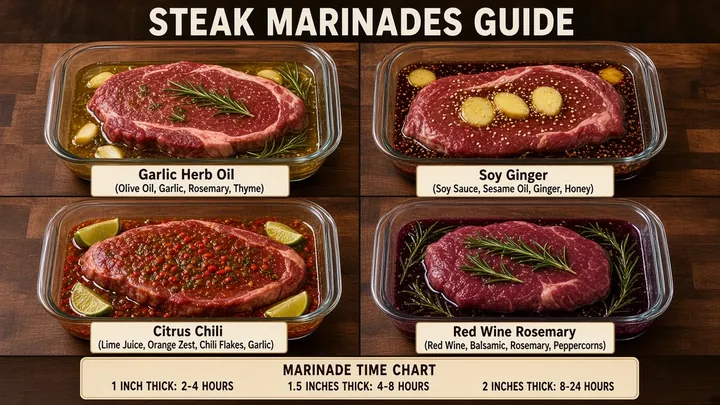
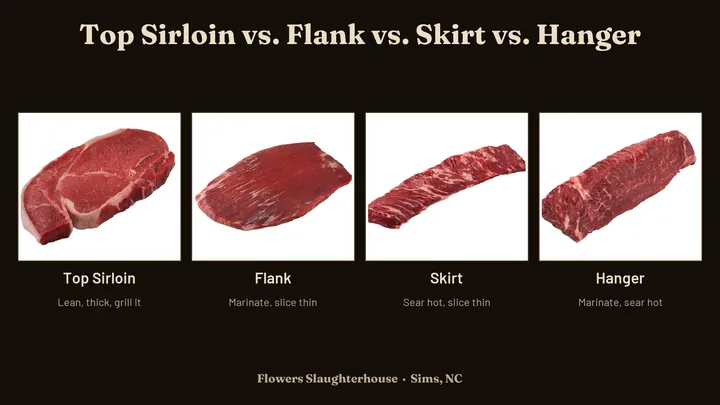
Beef. Tender steaks (ribeye, strip, filet, top sirloin) don't need tenderizing. Give them 15 minutes to 2 hours for flavor, or skip the marinade and season with salt and pepper. Flank, skirt, chuck and round steaks benefit from a tenderizing marinade for 6 to 24 hours [1]. Our steak marinades guide has nine formulas, and the top sirloin, flank, skirt and hanger guide covers the four cuts people marinate most.
Pork. USDA notes that today's hogs carry much less fat than they used to [5], so loin chops and tenderloin dry out if they're overcooked, and a marinade helps. A couple of hours to overnight is plenty. Pork shoulder for pulled pork doesn't need a marinade at all. Its fat and long cook do the work. See our pork cuts guide.
Lamb. USDA allows up to 5 days for lamb roasts, steaks and chops, but only 2 days for lamb cubes and stew meat [6]. For kabobs, a few hours in lemon, garlic and oregano is the classic. Our lamb chop sauces guide covers what to serve with them.
Chicken. Marinate chicken 2 to 24 hours [3] and never more than 2 days [7]. Bone-in thighs can handle the longer end. Thin cutlets and tenders want the shorter end. For how we handle birds, see our chicken processing page.
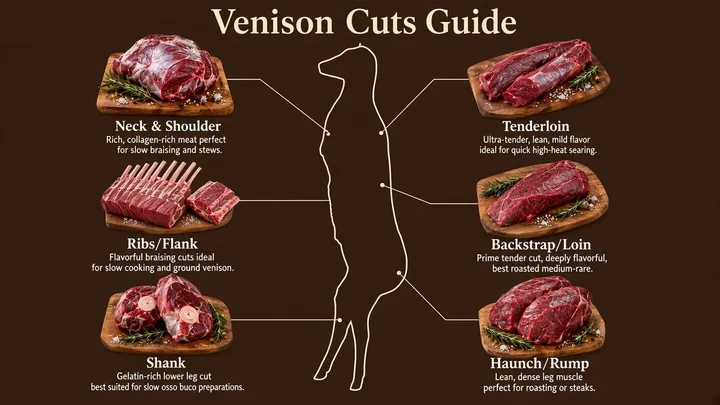
Venison. USDA doesn't publish a separate marinating limit for deer. We handle deer steaks the way we'd handle lean beef: a short flavor marinade for tender backstrap and tenderloin, and a few hours to overnight for round steaks from the hindquarter. Deer has almost no marbling, so a marinade with a little oil helps. See our venison cuts guide.
Seafood. Fish and shrimp only need 15 to 60 minutes [3]. Acid starts to firm and "cook" delicate fish quickly, so add citrus close to cooking time.
Food safety rules for marinades
- Marinate in the refrigerator, never on the counter. Utah State Extension notes that some older recipes call for marinating at room temperature and says not to follow them [3]. Bacteria multiply fastest between 40°F and 140°F, and perishable food shouldn't sit out more than 2 hours, or 1 hour above 90°F [9].
- Use glass, food-safe plastic or a zip-top bag. Acid can react with metal containers [3]. Put the bag on the bottom shelf so it can't drip onto anything below.
- Set some aside before the meat goes in if you want extra for basting or a sauce [1].
- Don't reuse marinade that touched raw meat unless you boil it. USDA says to boil used marinade before brushing it on cooked meat and to discard any uncooked leftover marinade [4]. For chicken it specifies a full boil [7]. The beef checkoff spells it out as a full rolling boil for at least one minute [1].
- Don't put cooked meat back on the plate that held it raw [3].
- Be careful with injected or needled meat. If you inject a marinade or use a needle-style tenderizer, anything on the surface gets pushed inside. USDA says mechanically tenderized beef should be cooked to at least 145°F with a 3-minute rest [10].
- Cook to the safe temperature. A marinade doesn't change it: 145°F plus a 3-minute rest for beef, pork, lamb and veal steaks, chops and roasts, 160°F for ground meat and 165°F for all poultry [11]. Our safe meat cooking temperatures chart has every species in one place.
How to marinate meat safely
- Mix the marinade in a bowl. Pour off and refrigerate a portion if you want it for basting or serving later.
- Put the meat in a zip-top bag or a glass or plastic dish. Plan on ¼ to ½ cup of marinade for every pound of meat.
- Pour the marinade over, press out the air, seal and label the bag with the time it went in.
- Refrigerate it on the bottom shelf and turn the bag once or twice so every side gets coated.
- Take the meat out when the time is up, let the excess drip off, and pat it dry with a paper towel so it browns instead of steaming.
- Throw out the used marinade, or bring it to a full rolling boil for at least one minute before using it as a sauce.
- Cook to the USDA safe minimum temperature, checked with a food thermometer, and rest whole cuts at least 3 minutes.
The ¼ to ½ cup per pound and the pat-dry step come from the beef checkoff's marinade tips [1].
Can you freeze meat in a marinade?
You can freeze a marinade by itself, and you can freeze meat. The beef checkoff lists freezing beef in its marinade as a common mistake [2]. Meat keeps marinating while it thaws, and an acidic marinade can soften the surface. We'd freeze the meat plain and marinate it after it thaws in the refrigerator.
Frequently asked questions
How long should you marinate meat?
For flavor, 15 minutes to 2 hours. To tenderize tough beef cuts like flank, skirt or round, 6 to 24 hours. Chicken does well in 2 to 24 hours and seafood in 15 to 60 minutes. Always marinate in the refrigerator.
Can you marinate meat too long?
Yes. Acidic and enzyme-based marinades keep breaking down the surface of the meat, and after too long it turns mushy or mealy instead of tender. USDA's refrigerator limits (5 days for beef, pork and whole lamb cuts, 2 days for chicken) are about safety, not quality.
Can I reuse marinade that touched raw meat?
Only if you boil it first. Bring it to a full rolling boil for at least a minute before brushing it on cooked meat or serving it as a sauce. Otherwise throw it out. The easier way is to set some marinade aside before the raw meat goes in.
Is it safe to marinate meat at room temperature?
No. Marinate in the refrigerator. Perishable meat shouldn't sit out more than 2 hours, or 1 hour when it's above 90°F.
Got a freezer full of meat?
We cut beef, pork and deer every week and lambs as custom work, and we're glad to help you plan a cut sheet around how you like to cook. If you marinate a lot, ask for thinner steaks and more kabob meat, because marinades work best on thin cuts. Call or text 252-885-1892, see our cut sheets, or read about beef, pork and deer processing.
Sources
- Become a Beef Expert (Marinade Quick Tips) — Beef. It's What's For Dinner. (Cattlemen's Beef Board / NCBA)
- Tangy Lime Marinade (marinating FAQs) — Beef. It's What's For Dinner. (Cattlemen's Beef Board / NCBA)
- Try a Little Tenderness: Marinate — Utah State University Extension
- Beef From Farm to Table — USDA Food Safety and Inspection Service
- Fresh Pork From Farm to Table — USDA Food Safety and Inspection Service
- Lamb From Farm to Table — USDA Food Safety and Inspection Service
- Chicken From Farm to Table — USDA Food Safety and Inspection Service
- Marinating Myths — America's Test Kitchen
- "Danger Zone" (40°F – 140°F) — USDA Food Safety and Inspection Service
- Mechanically Tenderized Beef — USDA Food Safety and Inspection Service
- Safe Minimum Internal Temperature Chart — USDA Food Safety and Inspection Service
More in Sauces & Marinades · Beef & Veal articles · Pork articles