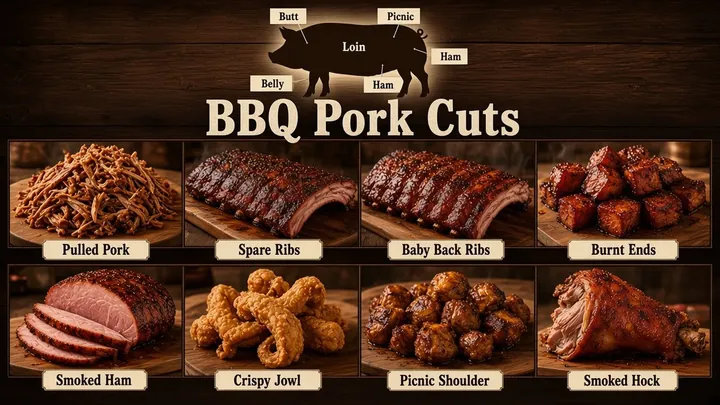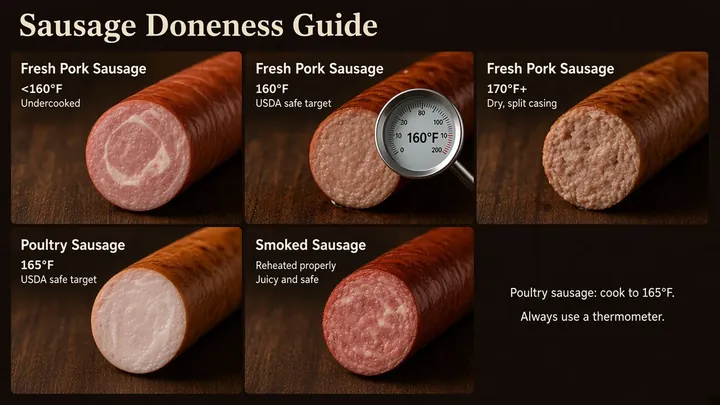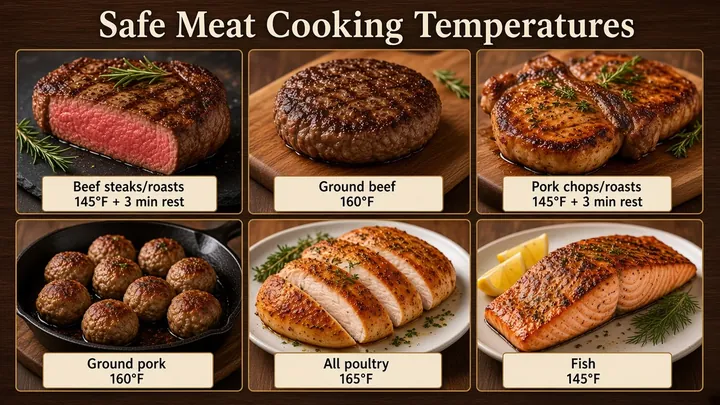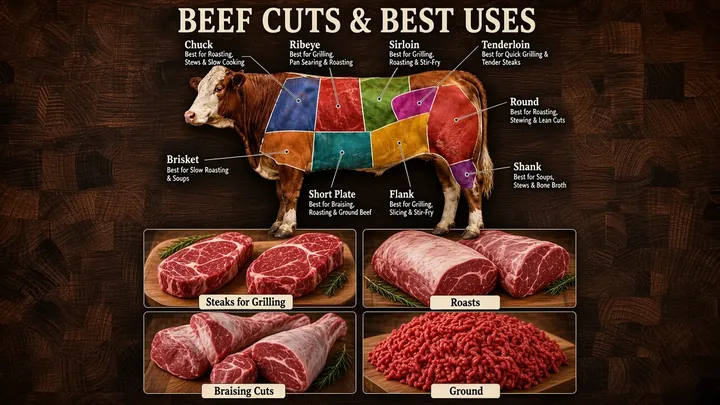
We cut hogs every week for families, farms and pig-pickin' hosts in eastern North Carolina. This is the full map we'd walk you through at the counter: where each cut sits on the hog, what it's good for, how long it takes to cook and what to ask for on your cut sheet. If you're only cooking for barbecue, our BBQ pork cuts guide goes deeper on butts, ribs and whole hogs. This page covers the whole animal.

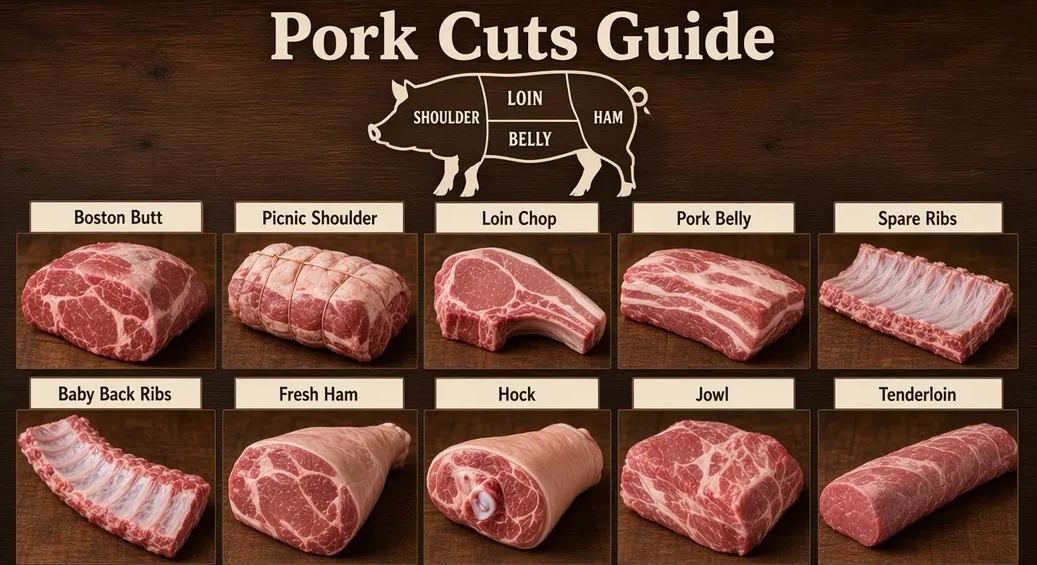
Pork cuts at a glance
| Primal | Where it is | Main retail cuts | Best ways to cook |
|---|---|---|---|
| Shoulder | Front of the hog, neck to front leg | Boston butt, picnic, blade steaks, hocks, ground pork and sausage [1] | Smoke, braise, slow roast |
| Loin | Along the back, shoulder to hip | Chops, loin roast, tenderloin, rib roast, sirloin roast, baby back and country-style ribs [1] | Grill, roast, pan-sear |
| Side (belly) | Underside, below the loin | Spareribs, St. Louis ribs, belly, bacon [1] | Smoke, slow roast, cure |
| Leg | Back leg | Fresh ham, cured or smoked ham [1] | Roast, bake, smoke |
Then there are the extras that don't fit neatly into a primal: jowls, hocks, feet, tails and organs. We cover those near the end.
The shoulder: Boston butt, picnic and hocks
The shoulder works hard, so it has plenty of fat and connective tissue. That makes it the most forgiving part of the hog for long cooking. The shoulder is usually split in two:
- Boston butt (also called pork butt or shoulder butt) is the upper part. It's the classic pulled-pork roast. It can also be cut into blade steaks [1]. From the cutting table: blade steaks have more fat and connective tissue than chops, so they do best grilled low and slow or braised.
- Picnic is the lower part, down toward the front leg. It has more bone and skin. Roast it, smoke it or have it cured and smoked [1].
- Front hocks are the joint below the picnic. They're mostly skin, bone and collagen, which is why they're good for seasoning greens and beans [1].
A lot of shoulder meat also goes into ground pork and sausage, because the fat-to-lean ratio is about right for it [1].
FSIS lists a 3- to 6-pound Boston butt at about 45 minutes per pound in a 350°F oven, or 2 to 2½ hours braised [1]. Those times get you to safe. For pulled pork you keep going well past that. See the BBQ guide for pulled-pork temperatures.
The loin: chops, roasts and tenderloin
The loin runs along the back from the shoulder to the hip. It's lean and tender, and it's where pork chops come from. The National Pork Board says the loin runs "from the pig's hip to its shoulder" and that chops are the most popular cut of pork [2].
Pork chops, front to back
Chops have a lot of names. The Pork Board's buying guide sorts them like this [2]:
| Chop | Where on the loin | What you'll see |
|---|---|---|
| Blade chop | Shoulder end | Thicker, more marbled, may have blade bone. Often butterflied and sold as country-style ribs |
| Ribeye chop (rib chop) | Rib section | Some back and rib bone |
| New York chop (center-cut, top loin) | Center loin | Boneless. A 1¼-inch top loin chop is also called an "America's Cut" |
| Porterhouse chop (loin chop) | Lower back, behind the rib chops | T-bone shape with a piece of tenderloin |
| Sirloin chop | Hip end | Often includes part of the hip bone |
The Pork Board's point is worth repeating: whatever the name, they all cook the same, and how long they take depends on thickness, which can run from ½ inch to 2 inches [2]. Bone-in chops tend to have more flavor and dry out less [2].
FSIS cooking times for loin chops [1]:
| Chop thickness | Grill or broil (total) | Skillet (total) |
|---|---|---|
| ¼ inch | — | 3–4 min |
| ¾ inch | 8–9 min | 7–8 min |
| 1½ inches | 12–16 min | — |
Pull at 145°F and rest 3 minutes either way.
Loin roast vs. tenderloin
People mix these up all the time. They're different cuts.
- Pork loin roast is a wide, 2- to 4-pound piece from between the shoulder and the leg, sold bone-in or boneless [3]. Roast it dry. The Pork Board says not to braise or stew a loin roast because it tends to fall apart and get tough in moist heat [3]. FSIS puts a 2- to 5-pound loin roast at about 20 minutes per pound at 350°F [1].
- Pork tenderloin is a small, long muscle under the loin, usually ¾ to 1½ pounds [4]. It's the leanest, most tender cut on the hog. Roast it hot (425–450°F) for 20 to 27 minutes total, or grill it for about 20 minutes [1].
On a custom hog, there are only two tenderloins, one on each side. If you ask for bone-in porterhouse chops, part of the tenderloin stays in those chops. You can't have both a whole tenderloin and porterhouse chops off the same section.
Rib roast, crown roast and back ribs
- Pork rib roast (rack of pork, sometimes labeled center-cut loin) comes from the rib end of the loin. It's the pork version of a standing beef rib roast [5].
- Crown roast is a rib roast tied in a circle [5]. FSIS lists a 10-pound crown roast at about 12 minutes per pound at 350°F [1]. Order it ahead. It uses a lot of loin.
- Baby back ribs (loin back ribs) come from the blade and center part of the loin [6]. If you want them, the chops from that section come off boneless.
- Country-style ribs come from where the loin meets the shoulder. They're meaty and eaten with a knife and fork [6].
The side: belly, spareribs and bacon
Below the loin is the side. Most of it ends up as bacon and spareribs.
- Spareribs come from the belly side. They're bigger and meatier than baby backs. St. Louis ribs are spareribs trimmed square [6].
- Pork belly is the boneless piece left after the loin and spareribs come off [7]. Fresh, it's best cooked slowly, by braising, roasting or smoking. Cured, salted and usually smoked, it becomes bacon [7].
- Side meat is what a lot of folks in eastern North Carolina call salt-cured or fresh belly used for seasoning. If you want some of the belly kept back for that instead of all bacon, write it on the cut sheet.
The leg: fresh ham and cured ham
The back leg is the ham. FSIS lists ham as either fresh, or smoked and cured [1].
- Fresh ham is raw, uncured leg meat. It roasts like a big pork roast and comes out light-colored, not pink. FSIS cooking times at 350°F: a whole bone-in fresh ham (18–20 lb) takes about 15 minutes per pound; a bone-in half (5–8 lb) takes 22–25 minutes per pound [1]. Cook to 145°F and rest.
- Cured and smoked ham is the pink holiday ham. The Pork Board's rule: bake a fully cooked ham at 325°F for about 10 minutes per pound, or about 20 minutes per pound if it's only partially cooked [8].
- Reheating cooked ham: FSIS says to reheat cooked hams packaged in USDA-inspected plants to 140°F, and all others to 165°F [9].
A big ham can also be cut into smaller ham roasts and ham steaks, or boned out for sausage or ground pork. Say so on your sheet.
Nose to tail: jowl, hocks, feet and organs
A whole hog has more than the four primals.
- Jowl is the cheek. It's usually cured like bacon.
- Hocks (front and back) and feet (trotters) are mostly skin and collagen. Good for stock, beans and greens.
- Ears, tail and neck bones go in the pot too.
- Organ and variety meats like liver, heart, kidney and tongue need 160°F [1]. FSIS keeps them in the fridge only 1 to 2 days, versus 3 to 5 days for fresh cuts [1].
- Chitterlings (large intestine) can carry Yersinia enterocolitica, so FSIS has separate handling advice for them [1]. Keep them away from kids and other food while you clean them.
Tell us up front which of these you want back. If the sheet doesn't say, most of them won't come home with you.
Pork safe cooking temperatures
| What you're cooking | Safe minimum | Rest |
|---|---|---|
| Chops, steaks, roasts, tenderloin, fresh or uncooked smoked ham | 145°F | 3 minutes [9] [1] |
| Ground pork, patties, fresh sausage | 160°F | No rest time listed [9] [10] |
| Organ and variety meats | 160°F | — [1] |
| Cooked ham, reheated | 140°F (USDA-plant packaged) or 165°F (all others) | — [9] |
Pink pork can be done. FSIS says pork that has reached 145°F throughout can still be pink in the center and be safe. Cooking method and added ingredients can keep it pink [1]. Go by the thermometer, not the color. More in our safe meat cooking temperatures chart and sausage doneness guide.
How much of each cut comes off a hog
UW–Madison Extension estimates a hog's retail cut-out by primal at roughly ham 25%, loin 25%, side/belly 21%, picnic 11% and Boston butt 10% [11]. In its worked example, a 250-pound live hog comes home as about 125 pounds of retail cuts [11]. Boneless cuts yield less than bone-in. The BBQ pork cuts guide walks through the math step by step.
Filling out a pork cut sheet
The pork cut sheet asks about each primal in turn. Here's how we'd think through it:
- Shoulder: Whole butts for smoking, butts cut into smaller roasts, blade steaks, or all of it into sausage? Picnics fresh or ground?
- Loin: Chops or roasts, or some of each? Pick a chop thickness (¾ to 1 inch is the everyday range; 1¼ to 1½ inches for the grill). Bone-in or boneless? Do you want baby backs (which makes those chops boneless) and whole tenderloins?
- Side: Spareribs whole or St. Louis trimmed? Belly as bacon, fresh belly or side meat?
- Ham: Fresh or cured? Whole, halves, roasts or steaks?
- Extras: Hocks, feet, jowls, neck bones, organs, fat for lard. Write down everything you want back.
- Ground and sausage: How much trim goes to plain ground pork vs. fresh or hot sausage.
Not sure on something? Leave it blank and we'll call you.
Storing pork from the freezer
FSIS times for fresh pork roasts, steaks, chops and ribs: 3 to 5 days in the refrigerator, 4 to 6 months in the freezer for best quality [1]. Frozen pork stays safe indefinitely. The time limit is about quality. Thaw it in the refrigerator, in cold water in a leak-proof bag, or in the microwave, never on the counter. You can cook frozen pork without thawing it, but plan on about 50% more time. Don't put frozen pork in a slow cooker [1].
Frequently asked questions
What are the four primal cuts of pork?
Shoulder, loin, side (belly) and leg (ham). FSIS uses those four, and nearly every retail cut comes from one of them.
What's the difference between pork loin and pork tenderloin?
A pork loin roast is a wide 2- to 4-pound cut from along the back. A tenderloin is a small, long muscle that usually weighs about a pound. They cook differently: tenderloin is done in about 20 to 27 minutes in a hot oven, and a loin roast takes about 20 minutes per pound at 350°F.
Which pork chop is best?
They all cook the same way. The difference is bone, fat and thickness. Blade chops are the most marbled, porterhouse chops include some tenderloin, and boneless New York chops are the leanest and most uniform. Thickness matters more than the name.
What temperature is pork done?
USDA says 145°F with a 3-minute rest for chops, roasts, tenderloin and fresh ham, and 160°F for ground pork and organ meats. Pork can still be a little pink at 145°F and be safe.
Bring us your hog
Whether you're raising one hog for the freezer or a few for customers, we'll cut it the way your family eats. Call or text 252-885-1892, fill out the pork cut sheet, or read more on our pork processing page. All of our cut sheets are on the cut sheets page. We're at 5154 St. Rose Church Rd in Sims.
Sources
- Fresh Pork From Farm to Table — USDA Food Safety and Inspection Service
- Pork Chops — National Pork Board
- Pork Loin Roast — National Pork Board
- Pork Tenderloin — National Pork Board
- Pork Rib Roast — National Pork Board
- Pork Ribs — National Pork Board
- Pork Belly — National Pork Board
- Ham — National Pork Board
- Safe Minimum Internal Temperature Chart — USDA Food Safety and Inspection Service
- Ground Pork — National Pork Board
- How much meat should a hog yield? — University of Wisconsin–Madison Extension