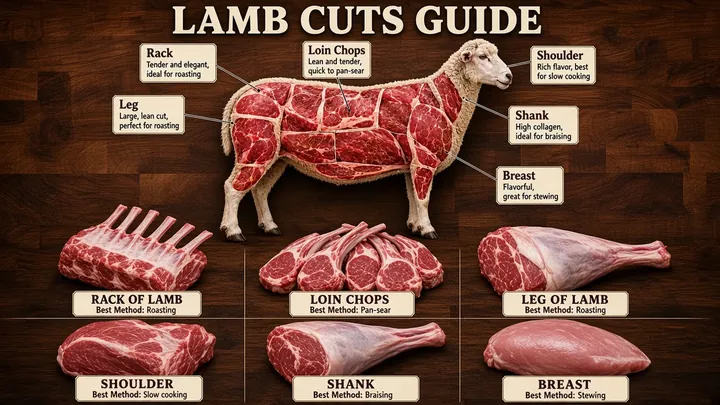
If you raise sheep, mutton is what you get from cull ewes, old rams and wethers that stayed on the farm too long. Plenty of people grew up on it, and plenty of families still cook it for curries, stews and holiday meals. This guide is for them, and for anyone who just bought a cull ewe and wants to know what to put on the cut sheet. For young sheep, see our lamb cuts guide, which covers chops and rack of lamb in detail.

Lamb, hogget, yearling mutton, mutton: what the names mean
USDA's carcass standards sort sheep by maturity [1]:
| Class | Rib bones | Lean | Front leg joint |
|---|---|---|---|
| Lamb | Slightly wide, moderately flat | Light red, fine texture | "Break joint" on both trotters |
| Yearling mutton | Moderately wide, tend to be flat | Slightly dark red, slightly coarse | Break joints or spool joints |
| Mutton | Wide, flat | Dark red, coarse | Always spool joints on both front trotters |
USDA's rule is simple: a carcass with spool joints on both front trotters can't be graded as lamb, and mutton always has them [1]. In plain terms, a young sheep's front foot comes off at a ridged "break joint" where the bone is still growing. On an older sheep that joint has hardened, so the foot comes off at the smooth, round "spool" joint instead. That's how a grader can tell lamb from mutton without paperwork.
You'll also hear hogget, a term used in Australia and the U.K. for sheep between lamb and mutton. Meat Standards Australia tests lamb, hogget and mutton separately [5].
Why mutton tastes different
Texas A&M's AgriLife "Path to the Plate" program puts it plainly: meat from yearlings or older sheep is mutton, and it has stronger, bolder flavors. Some people are turned off by the aroma, and some prefer it [4]. A 1977 USDA farm bulletin went further, calling mutton's flavor "very intense" and noting it was seldom sold as retail cuts in the U.S. [2]. That's changed. Texas A&M notes that demand for lamb and mutton is growing, driven by ethnic consumers and millennials [4].
Much of that "muttony" flavor lives in the fat. Meat Standards Australia's advice is to trim the fat heavily from older animals if you want to tone the flavor down [5]. Keep it on if you like the taste.
Which mutton cuts can take dry heat?
Australia's meat grading program had consumers score lamb and mutton cuts after grilling and roasting. A score under 50 counts as an unsatisfactory eating experience [5]. We've added the usual U.S. names in parentheses.
| Cut | Lamb, grilled | Lamb, roasted | Mutton, grilled | Mutton, roasted |
|---|---|---|---|---|
| Loin | 66 | 68 | 60 | 54 |
| Knuckle (sirloin tip) | 70 | 65 | 54 | 59 |
| Rump (sirloin) | 65 | 68 | 56 | 56 |
| Silverside (bottom round) | 60 | 60 | 50 | Unsatisfactory |
| Topside (top round) | 52 | 59 | 50 | Unsatisfactory |
What it means in the kitchen: of the cuts tested, only the mutton loin held up well on the grill, and even then it was less consistent than lamb [5]. The knuckle and rump can make a decent roast. The big round muscles of the leg (silverside and topside) shouldn't be roasted on a mature sheep. Dice them, braise them or grind them.
Mutton cuts, front to back
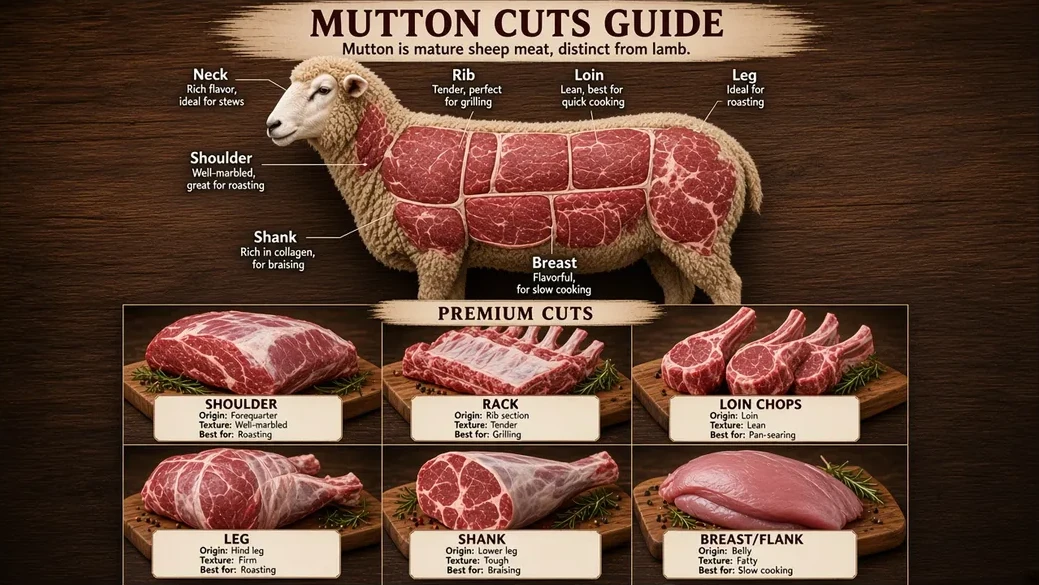
The primals match lamb [3]. Here's how we'd use each on a mature sheep.
| Cut | Where | What to do with it |
|---|---|---|
| Neck | Front of the shoulder | Slices or bone-in pieces for curry, stew and stock |
| Shoulder | Front quarter | Slow roast until it pulls, braise, or cube bone-in for curry |
| Shanks | Front and back legs | Braise until the meat falls off the bone |
| Breast and riblets | Underside | Braise, then crisp in a hot oven. Or grind |
| Rack | Rib section | Roast, or cut into chops and cook hot and fast. Expect more chew than lamb |
| Loin chops / saddle | Behind the rack | The best grilling cut on a mutton. Don't go past medium |
| Leg, whole | Back leg | Long, slow roast or pot roast, sliced thin |
| Leg, boned | Back leg | Knuckle and rump for roasting. Round muscles for kebab marinades, stew or grind |
| Stew and curry meat | Shoulder, neck, leg trim | Simmer covered in liquid until tender |
| Ground mutton | All trim | Sausage, kofta, meatballs, shepherd's pie, cooked to 160°F |
| Bones | Everywhere | Broth and soup |
The rule behind it comes from meat science, not tradition. Muscles an animal uses constantly have more connective tissue, and long, low, moist cooking breaks that tissue down. Muscles that do little work, like the loin along the spine, have almost none, and they suit pan frying, grilling or roasting [5]. An older animal has more of that connective tissue everywhere, so more of the carcass belongs in the slow column.
Cooking times and temperatures
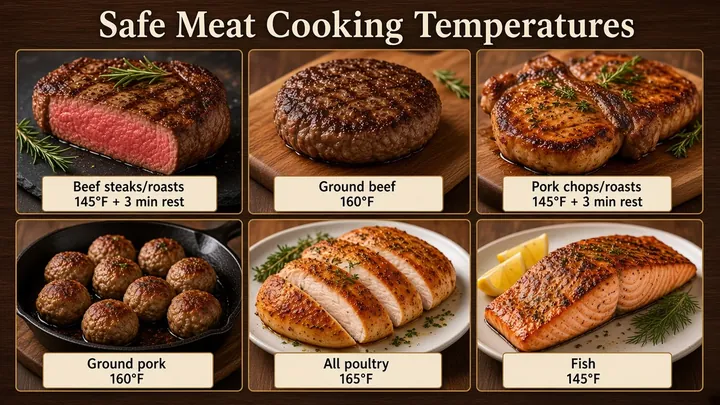
FSIS doesn't publish a separate mutton chart. Its lamb fact sheet covers sheep of every class [3], and Washington State University's sheep and goat processing guide uses the same numbers [6]:
- Steaks, chops and roasts: 145°F, then rest at least 3 minutes [7].
- Ground mutton, sausage patties and meatloaf: 160°F.
- Heart, kidney, liver and tongue: 160°F [3].
For braised cuts, 145°F is the safety line, not the finish line. Mutton shoulder and shank are safe long before they're tender. FSIS's lamb chart gives 1½ to 2 hours for simmered shanks, stew meat and rolled breast [3]. On mutton, plan for longer and cook until a fork slides in easily.
Storage follows lamb: refrigerate roasts, steaks and chops 3 to 5 days and ground meat or stew 1 to 2 days. For best quality, use frozen roasts and chops within 6 to 9 months and ground within 3 to 4 months [3].
Tips for cooking mutton
- Trim the outside fat if you want a milder flavor [5]. Texas A&M warns that lamb fat flares easily over an open flame [4]. Watch the grill with mutton too.
- Lean on spice and acid. Curry, cumin, garlic, rosemary, tomato, yogurt marinades and vinegar-based barbecue sauce all stand up to mutton.
- Go low and slow on everything except the loin.
- Use the bones. Mutton broth is rich and makes a great base for soups and rice.
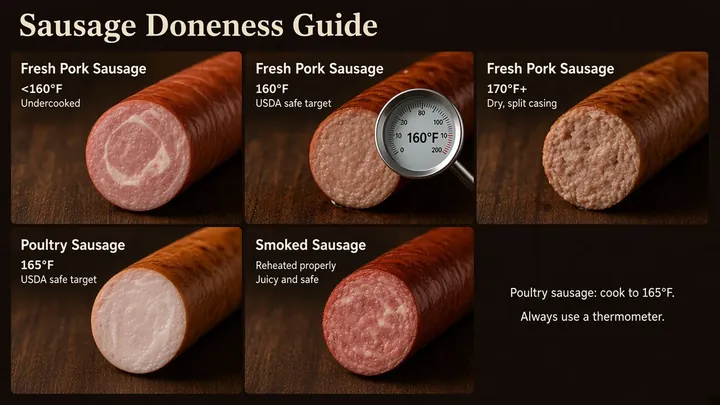
- Think about the grinder. Mutton makes good sausage, especially mixed with a little pork fat if you like it juicier. Fresh sausage needs 160°F; see our sausage doneness guide.
Filling out a cut sheet for a mature sheep
A mature ewe has the same cuts as a lamb, just bigger and tougher. Practical choices:
- Keep: loin chops, a couple of shoulder roasts and the shanks.
- Cube: neck and extra shoulder, bone-in if you're making curry.
- Grind: breast, flank and the leg's round muscles, unless you want a pot roast.
- Ask about bones for broth, and say whether you want organs back.
- Ask about aging. Washington State's guide notes that a few days of chilled aging can help tenderness [6]. Ask what's possible for your animal.
Use our lamb and goat cut sheet. It works for mature sheep too.
Frequently asked questions
What is the difference between lamb and mutton?
Age. Lamb comes from young sheep, usually under about a year. Mutton comes from older sheep, roughly over two years, with yearling mutton in between. Mutton is darker, coarser and stronger in flavor.
What is the best cut of mutton?
The loin is the most tender and the only cut that grills well. For flavor, many cooks pick the shoulder or neck, slow-cooked or in curry.
How do you make mutton less gamey?
Trim off the outside fat, where most of the strong flavor lives. Then use a marinade with acid and bold spices and cook tough cuts low and slow.
What temperature should mutton be cooked to?
The same as lamb: 145°F with a 3-minute rest for chops, steaks and roasts, and 160°F for ground mutton and organ meats. Braised cuts need to go well past that to get tender.
Bring us your sheep
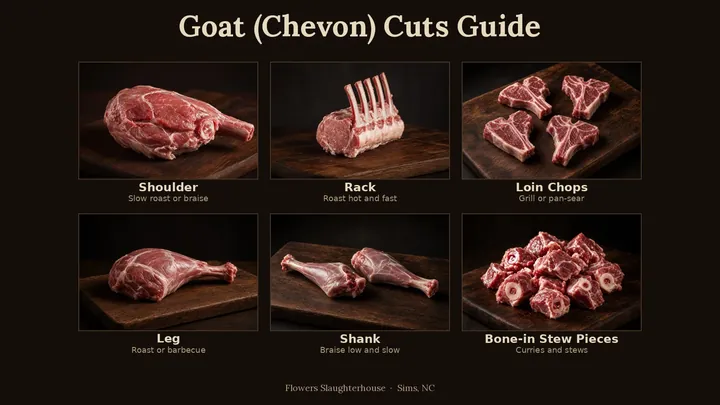
We process lamb and sheep as custom work. The meat is cut to your sheet and returned to you, not sold. Call before you bring anything other than beef, pork or deer so we can set a date. Call or text 252-885-1892, see our lamb, sheep and specialty page, or fill out the lamb and goat cut sheet. For goat, see our goat (chevon) cuts guide. For every species in one place, see the safe meat cooking temperatures chart.
Sources
- Standards for Grades of Lamb, Yearling Mutton, and Mutton Carcasses (PDF) — USDA Agricultural Marketing Service
- Farmers' Bulletin 2264: Lamb Slaughtering, Cutting, Preserving, and Cooking on the Farm (1977) — U.S. Department of Agriculture, via Project Gutenberg
- Lamb From Farm to Table — USDA Food Safety and Inspection Service
- Sheep — Path to the Plate, Texas A&M AgriLife
- The Effect of Cut and Cooking Method on Sheepmeat Eating Quality (PDF) — Meat Standards Australia, Meat & Livestock Australia
- Home Processing Sheep and Goat Meat (PDF) — Washington State University Extension
- Safe Minimum Internal Temperature Chart — USDA Food Safety and Inspection Service