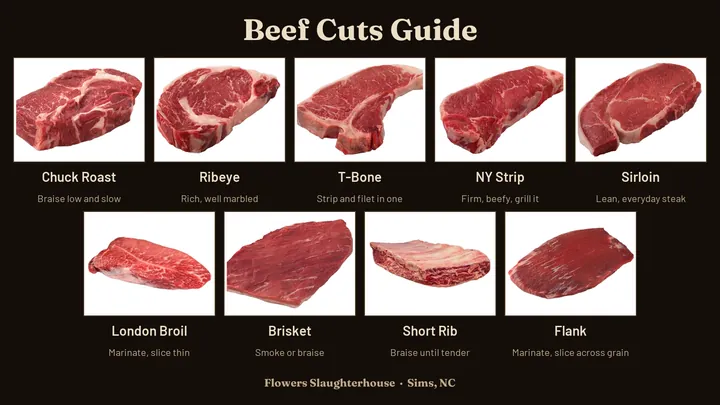
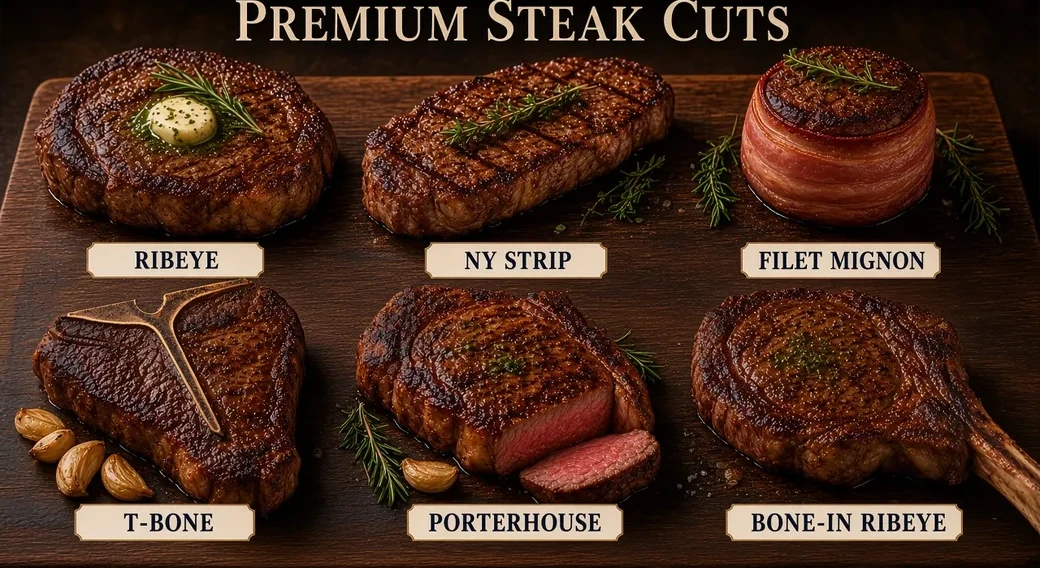
We cut these steaks off sides of beef every week. This guide covers what each premium steak is, where it comes from, how it eats, how to cook it, and the one cut-sheet decision that trips people up: you can't get filets and porterhouses from the same short loin.

Premium steaks at a glance
| Steak | Where it's from | Also called | What it's like | Best cooking |
|---|---|---|---|---|
| Ribeye | Rib | Ribeye roll steak, Delmonico (varies by region) | Generous marbling, rich and juicy [2] | Grill, cast iron |
| Bone-in ribeye / cowboy / tomahawk | Rib | Rib steak | Ribeye with the rib bone left on | Grill, reverse sear |
| Strip | Short loin | New York strip, Kansas City strip, top loin, shell steak [3] | Tender, lean, firm bite, big beef flavor | Grill, broil, cast iron |
| Filet mignon | Tenderloin | Tenderloin steak | The most tender steak, lean and buttery [4] | Pan-sear and oven, grill |
| T-bone | Short loin | Loin T-bone | Strip on one side, smaller piece of tenderloin on the other [5] | Grill, broil |
| Porterhouse | Short loin (rear) | King steak | Like a T-bone but with a bigger tenderloin; often enough for two [6] | Grill, broil |
| Top sirloin | Sirloin | Sirloin butt steak, center-cut sirloin | Leaner, firmer, good value [7] | Grill, skillet, kabobs |
| Flat iron | Chuck (top blade) | Top blade steak | Very tender, well marbled [8] | Grill, skillet |
Ribeye: the marbling steak
The ribeye comes from the rib primal, the front part of the back behind the shoulder. The beef checkoff calls it "rich, juicy and full-flavored with generous marbling throughout" [2]. That marbling is the white fat inside the muscle, and USDA says it is what makes beef more tender, flavorful and juicy [9].
A ribeye has two main parts: the large center "eye" and the curved ribeye cap around the top, which many people think is the best bite on the whole steer.
Bone-in versions:
- Bone-in ribeye (rib steak) keeps the rib bone attached.
- Cowboy steak is a thick bone-in ribeye with a short piece of bone.
- Tomahawk is a bone-in ribeye with the long rib bone left on and scraped clean. It's the same meat as a cowboy steak. You're paying for the look and the thickness.
Cut-sheet note: the rib section can go to ribeye steaks or a standing rib roast (prime rib). Not both. If you want a holiday roast, set aside a few ribs for it and steak the rest.
Strip steak: the steakhouse classic
The strip comes from the short loin, behind the rib. FSIS points out that the same boneless top loin steak is sold as strip steak, Kansas City steak, N.Y. strip, hotel-cut strip, ambassador steak or club sirloin steak, depending on the store [9]. The beef checkoff describes it as "tender, lean and perfect for grilling" [3].
Compared to a ribeye, a strip has less internal fat, a tighter grain and a strip of fat along one edge. Score that fat cap so it doesn't curl the steak on the grill.
Filet mignon: the most tender
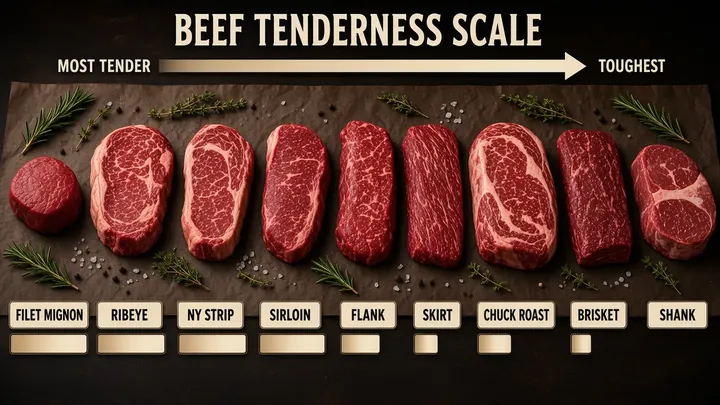
Filet mignon is a steak cut from the tenderloin, a long, narrow muscle tucked under the backbone. The beef checkoff calls it "the most tender steak, lean yet succulent, with a fine buttery texture," cut from the least-exercised muscle on the animal [4]. Research agrees: in the national survey of retail and restaurant steaks, tenderloin had the lowest shear-force values (the lab measure of toughness) in both settings [10].
The trade-off is flavor. A filet is mild because it's so lean. That's why it's often wrapped in bacon or served with a sauce. Keep it at medium or below. It has no fat to cover for overcooking.
A whole tenderloin can also be roasted whole or cut into a center-cut Chateaubriand roast [1].
T-bone vs. porterhouse
Both steaks are cut across the short loin with the T-shaped backbone still in. One side of the bone is strip, the other is tenderloin. The difference is how much tenderloin is on the steak:
- T-bone steaks come from the front of the short loin, where the tenderloin is narrow. The beef checkoff describes the T-bone as smaller than the porterhouse, with the same tenderness and flavor [5].
- Porterhouse steaks come from the rear of the short loin, where the tenderloin is thicker. Its butcher's note says the porterhouse is set apart from the T-bone "by its larger Tenderloin muscle" [6].
They're different industry items, too: IMPS/NAMP 1173 for porterhouse and 1174 for T-bone [6] [5].
Cooking tip: the tenderloin side cooks faster than the strip side. On the grill, keep the tenderloin side toward the cooler part of the fire.
The one-loin rule for your cut sheet
Each side of beef has one short loin and one tenderloin. If we cut the short loin into T-bones and porterhouses, the tenderloin stays on those steaks. If you want whole filets mignon and boneless strip steaks, we take the tenderloin out first and you won't get T-bones or porterhouses from that side.
Neither choice wastes meat. It's the same muscles cut two ways. A lot of families split it: T-bones and porterhouses from one side, strips and filets from the other. Write it on your beef cut sheet, or call and we'll walk through it.
Value steaks that eat like premium
- Top sirloin comes from the sirloin, behind the short loin. The beef checkoff calls it flavorful, versatile and juicy, good as a steak or cut into kabobs [7]. It's leaner and firmer than a strip. Slice it thin.
- Flat iron comes from the top blade in the chuck. The beef checkoff says the top blade holds "the second most tender muscle" in the animal, but the connective tissue running through it has to come out to keep it tender [8]. That's butcher work. Ask for flat irons on your sheet if you want them.
For a full ranking from the most tender cut to the toughest, see our beef tenderness scale.
Prime, Choice and Select: what the grade means
- Inspection is required. Grading is optional. A plant pays for USDA grading [9].
- Grades you'll see at retail are Prime, Choice and Select. Prime (about 2% of graded beef) has the most marbling and is the most tender and flavorful, and it's also higher in fat. Most graded beef in supermarkets is Choice or Select [9].
- Ungraded beef is still inspected for wholesomeness. FSIS notes its quality may be higher or lower than the grades found in stores [9]. Custom-processed beef from a local farm usually isn't graded. How it eats depends on the animal and how it was finished.
- Grade isn't everything. In the national tenderness survey, USDA grade didn't significantly change shear force or consumer ratings for the restaurant steaks that were tested [10].
Aging adds tenderness and flavor. Commercial aging is done under controlled temperature and humidity and takes 10 days to 6 weeks. USDA does not recommend aging beef in a home refrigerator [9].
How to cook a premium steak
- Cut it thick. 1 to 1½ inches gives you a good crust before the center overcooks. A ¾-inch steak takes about 4–5 minutes per side on a grill or broiler [9].
- Go straight from fridge to fire. The beef checkoff's grilling charts assume the steak goes on cold, and it doesn't recommend letting steaks sit out at room temperature [11].
- Season and sear hot. Salt and pepper is enough for a ribeye or strip.
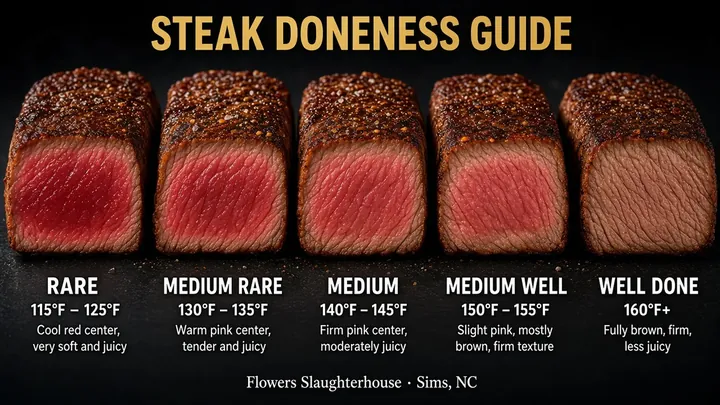
- Use a thermometer. Pull about 5°F short of where you want to end up and let it rest [12].
- Know the safety line. USDA's safe minimum for beef steaks is 145°F with a 3-minute rest [13]. Many people eat steaks rarer than that. Know the difference, especially when serving someone pregnant, young, older or immune-compromised.
Our steak doneness guide has the full chart and resting times.
Frequently asked questions
What's the difference between a T-bone and a porterhouse?
Both have strip on one side of the bone and tenderloin on the other. A porterhouse is cut from the rear of the short loin and has a larger piece of tenderloin. A T-bone comes from farther forward and has a smaller one.
What is the most tender steak?
Filet mignon, cut from the tenderloin. National survey testing shows tenderloin steaks have the lowest shear force of the retail and restaurant steaks studied. The flat iron, from the top blade, is the next most tender muscle.
Is Prime always better than Choice?
Prime has the most marbling, which usually means more tenderness, flavor and juiciness. But thickness, aging and cooking matter a lot. Most custom-processed beef isn't graded at all, and a well-finished animal can eat as well as graded beef.
Can I get filet mignon and T-bones from the same beef?
From the same side, no. The tenderloin is either left on the T-bones and porterhouses or taken out whole for filets. Many people choose T-bones on one side and strips and filets on the other.
Get the steaks you want
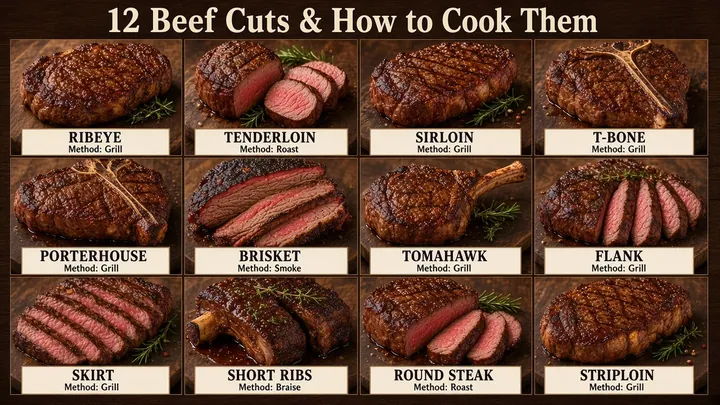
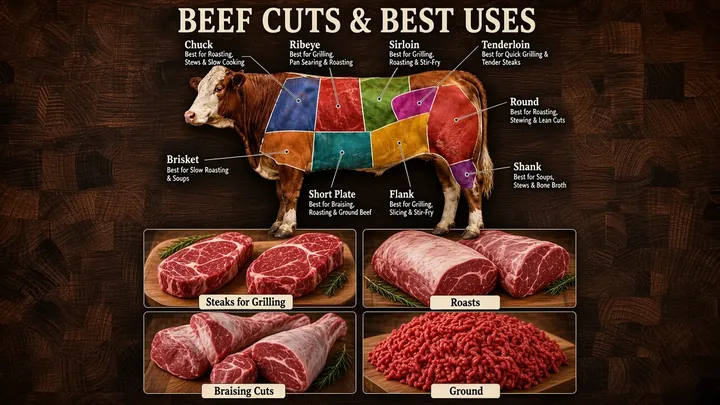
The best steak starts on the cut sheet: the right thickness, bone-in or boneless, filets or porterhouses. If you're bringing us a beef, call or text 252-885-1892, fill out the beef cut sheet, or read more about beef processing. Our beef cuts and uses guide covers the rest of the animal, and 12 beef cuts and how to cook them covers the everyday cuts.
Sources
- Loin Primal — Beef. It's What's For Dinner. (Cattlemen's Beef Board / NCBA)
- Ribeye Steak — Beef. It's What's For Dinner. (Cattlemen's Beef Board / NCBA)
- Strip Steak, Boneless — Beef. It's What's For Dinner. (Cattlemen's Beef Board / NCBA)
- Tenderloin Steak (Filet Mignon) — Beef. It's What's For Dinner. (Cattlemen's Beef Board / NCBA)
- T-Bone Steak — Beef. It's What's For Dinner. (Cattlemen's Beef Board / NCBA)
- Porterhouse Steak — Beef. It's What's For Dinner. (Cattlemen's Beef Board / NCBA)
- Top Sirloin Steak — Beef. It's What's For Dinner. (Cattlemen's Beef Board / NCBA)
- Top Blade — Beef. It's What's For Dinner. (Cattlemen's Beef Board / NCBA)
- Beef From Farm to Table — USDA Food Safety and Inspection Service
- National Beef Tenderness Survey – 2021 — Beef Research (Beef Checkoff), Texas A&M University
- Grilling Basics — Beef. It's What's For Dinner. (Cattlemen's Beef Board / NCBA)
- Degree of Doneness — Certified Angus Beef
- Safe Minimum Internal Temperature Chart — USDA Food Safety and Inspection Service