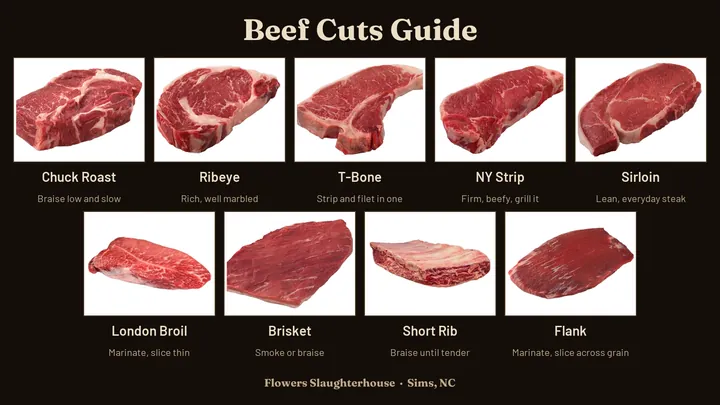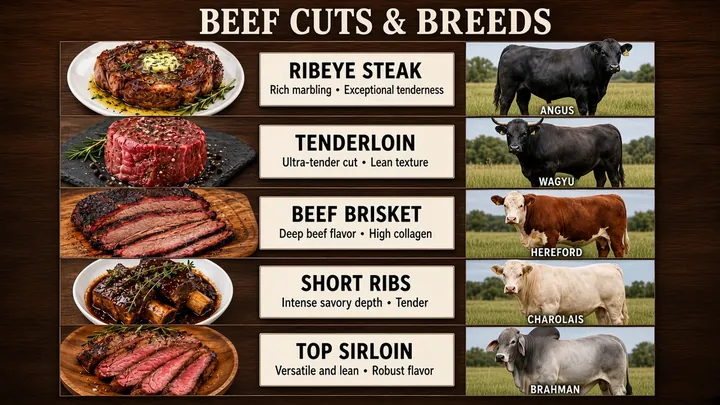
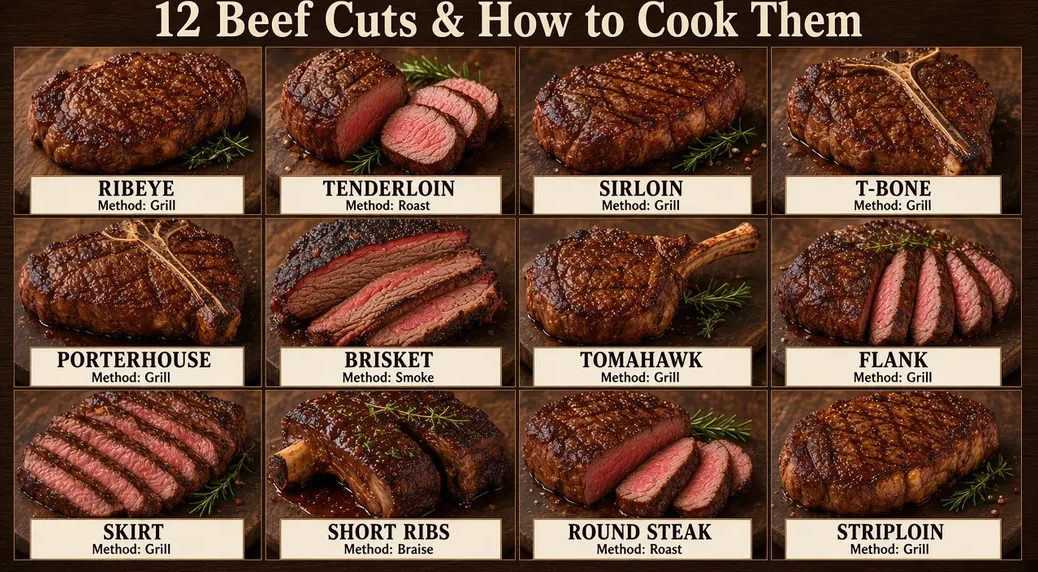
These are the 12 cuts we get asked about most at the plant. For each one, you'll find where it comes from, the best way to cook it, the temperature to aim for and a tip from the cutting table.

Quick reference: 12 beef cuts
| # | Cut | Primal | Best method | Pull temperature |
|---|---|---|---|---|
| 1 | Ribeye | Rib | Grill or cast iron | 130°F for medium-rare, 140°F for medium [2] |
| 2 | Tenderloin (filet) | Loin | Sear, then oven; roast whole | 130°F for medium-rare [2] |
| 3 | Top sirloin | Sirloin | Grill, skillet, kabobs | 130–140°F [2] |
| 4 | T-bone | Short loin | Grill, two-zone fire | 130–140°F [2] |
| 5 | Porterhouse | Short loin | Grill or broil | 130–140°F [2] |
| 6 | Strip | Short loin | Grill or cast iron | 130–140°F [2] |
| 7 | Tomahawk | Rib | Reverse sear | 125–130°F before the final sear |
| 8 | Flank | Flank | Marinate, grill hot, slice thin | 130–140°F [2] |
| 9 | Skirt | Short plate | Marinate, sear very hot, slice thin | 130–140°F [2] |
| 10 | Brisket | Brisket | Smoke or braise low and slow | Probe-tender, usually 195°F+ |
| 11 | Short ribs | Chuck / plate | Braise or smoke | Fork-tender |
| 12 | Round roast | Round | Roast and slice thin, or braise | 130–140°F if roasted [2] |
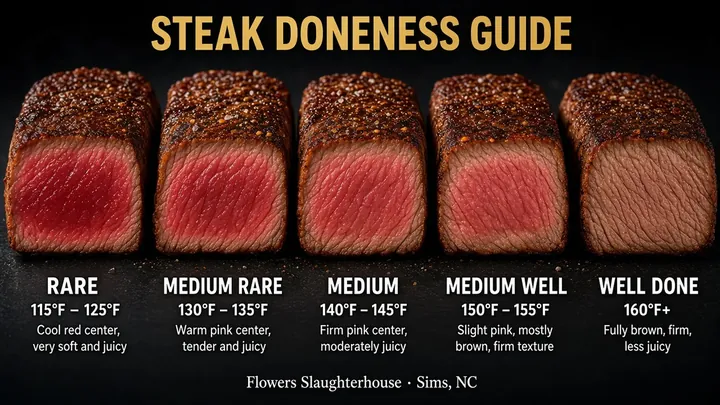
Pull temperatures are where you take the meat off the heat. It will climb about 5°F while it rests [2]. USDA's safe minimum for whole beef cuts is 145°F with a 3-minute rest [3]. Medium-rare finishes below that number. If you're cooking for someone who is pregnant, very young, older or immune-compromised, cook to the USDA minimum. Our steak doneness guide has the full chart.
The steaks
1. Ribeye
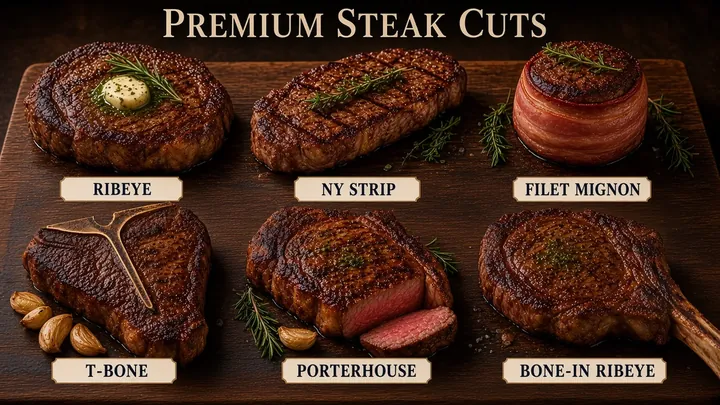
Where: the rib primal, behind the shoulder. What it's like: "rich, juicy and full-flavored with generous marbling throughout" [4].
How to cook: a hot grill or a cast-iron skillet. Get a hard sear on both sides, then move it to lower heat if it's thick. The marbling keeps a ribeye juicy even at medium.
Tip: ask for 1¼ to 1½ inches on your cut sheet. Thin ribeyes overcook before they brown.
2. Tenderloin (filet mignon)
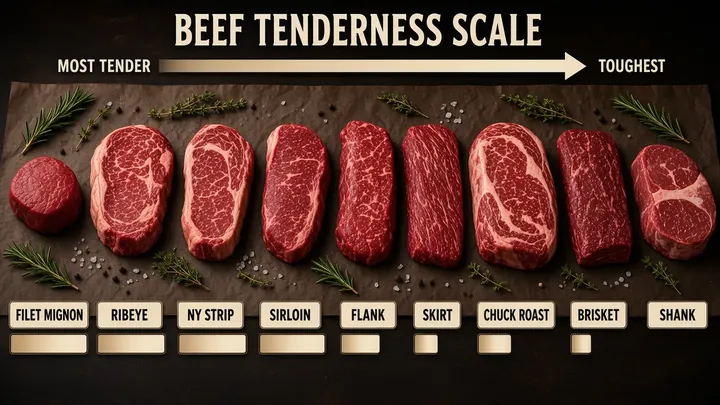
Where: the long muscle under the backbone in the loin. What it's like: the most tender steak, lean with a fine, buttery texture [5].
How to cook: sear filets in a hot pan and finish them in the oven. A whole tenderloin (4–6 pounds) roasts at 425°F in about 45 to 60 minutes total [1].
Tip: it's very lean, so don't go past medium. Tie a whole tenderloin with twine so the thin tail end doesn't overcook.
3. Top sirloin
Where: the top of the sirloin, behind the short loin. What it's like: flavorful, versatile and juicy, good as a steak or cut into kabobs [6].
How to cook: grill or pan-sear to medium-rare or medium. Cube it for kabobs.
Tip: sirloin is leaner than ribeye or strip, so it dries out sooner past medium. Slice it across the grain.
4. T-bone
Where: the front of the short loin, cut with the T-shaped bone in. What it's like: strip on one side, a small piece of tenderloin on the other. Smaller than a porterhouse, with the same tenderness [7].
How to cook: grill or broil. FSIS lists a ¾-inch steak at about 4–5 minutes per side on a grill or broiler [1].
Tip: the tenderloin side cooks faster. Keep it toward the cooler side of the grill.
5. Porterhouse
Where: the rear of the short loin. What it's like: a T-bone with a larger tenderloin [8]. Often big enough for two.
How to cook: same as a T-bone. A thick porterhouse does well on a two-zone grill: sear over the hot side, then finish over indirect heat.
Tip: carve the strip and filet off the bone, slice each, and serve both on a board.
6. Strip (New York strip)
Where: the short loin, cut boneless from the top loin. What it's like: "tender, lean and perfect for grilling" [9]. FSIS notes the same steak is sold as strip, Kansas City, N.Y. strip, hotel-cut strip, ambassador or club sirloin steak [1].
How to cook: grill or cast iron, like a ribeye.
Tip: score the fat cap along the edge every inch or so so the steak stays flat.
7. Tomahawk
Where: the rib. A tomahawk is a thick, bone-in ribeye with the long rib bone left on and cleaned. What it's like: a ribeye, just thicker and with a handle.
How to cook: reverse sear. Cook it over indirect heat (or in a 250–275°F oven) until the center is about 10°F below your target, then sear it hard over direct heat. Thick bone-in steaks cook unevenly with direct heat alone. Check the temperature in the center, away from the bone, because bone gives a false reading [10].
Tip: you're paying for bone weight. A thick cowboy steak (shorter bone) eats the same.
The lean, coarse cuts
8. Flank steak
Where: the flank, below the loin. What it's like: lean and boneless with "lots of intense beef flavor." The beef checkoff says it's best marinated and grilled, or sliced thin and stir-fried [11].
How to cook: marinate in the refrigerator, then grill hot and fast. FSIS says beef can marinate in the refrigerator for up to 5 days. Boil used marinade before brushing it on cooked meat, or throw it out [1].
Tip: slice thin, across the grain. The beef checkoff says it matters even more on thin, coarse cuts like flank [11].
9. Skirt steak
Where: the short plate, under the rib. There are two: outside and inside skirt. What it's like: "robust flavor." The beef checkoff says to marinate it and grill it hot for fajitas, or use it in stir-fry [12].
How to cook: the hottest fire you can make, a few minutes per side. It's thin, so it cooks fast.
Tip: cut the long skirt into 5- or 6-inch pieces before cooking, then slice each one across the grain. The grain runs across the width of a skirt, not the length.
The low-and-slow cuts
10. Brisket
Where: the breast, below the chuck. What it's like: tough because it's a working muscle, and "an ideal cut for cooking low and slow — on the barbecue or in a slow-cooker" [13]. A whole brisket has two parts: the leaner flat and the fattier point.
How to cook:
- Smoke it. The beef checkoff says large, less tender cuts can need 12 hours or more in the smoker [14]. It's done when it's probe-tender: a probe slides into the thickest part of the flat with little resistance.
- Braise it. FSIS lists a 3- to 4-pound brisket braised at 325°F for about 1½ to 2½ hours [1]. Larger pieces take longer.
Why the high temperature: Texas A&M's meat science program explains that brisket is full of collagen, which only converts to gelatin at a higher internal temperature, about 185 to 195°F. Stop short of that and brisket stays tough [15]. Most briskets turn probe-tender somewhere in the high 190s to low 200s.
Tip: rest it wrapped for at least an hour, then slice the flat across the grain about as thick as a pencil.
11. Short ribs
Where: chuck short ribs come from the shoulder end of the ribs, and plate short ribs come from the short plate. What it's like: "known for their richness and meatiness," and "flavorful, moist and tender when slow-cooked" [16].
How to cook: braise them. FSIS lists short ribs (4 inches long, 2 inches thick) braised at 325°F for 1½ to 2½ hours [1]. The beef checkoff's braising method: brown the beef, sauté aromatics, deglaze, then cover and cook low until fork-tender, without lifting the lid [17]. Short ribs also smoke well.
Tip: on your cut sheet, choose English-cut (one bone per piece, for braising) or flanken (thin strips across the bones, for grilling Korean-style).
12. Round roast
Where: the round, the back leg. The beef checkoff says round cuts are lean and inexpensive, and because those muscles are used for movement, the beef is less tender [18]. Common roasts are bottom round, top round, eye of round and sirloin tip.
How to cook: a bottom round roast is best for "roasting or slow-cooking and slicing thin" [19]. FSIS lists a 2½- to 4-pound round or rump roast at 325°F for about 30 to 35 minutes per pound [1]. Roast it to medium-rare, rest it, and slice it paper-thin for roast beef sandwiches. Or braise it as pot roast.
Tip: a round roast cooked past medium gets dry and tough. If you like your roast well-done, braise it instead.
Five rules that work for every cut
- Use a thermometer. FSIS says it's the only reliable way to know meat is done [10].
- Go from fridge to heat. The beef checkoff doesn't recommend letting steaks sit out at room temperature before grilling [20].
- Rest it. At least 3 minutes for steaks [3]. Longer for roasts and brisket.
- Slice across the grain. It makes the biggest difference on flank, skirt, brisket and round.
- Cooking from frozen? FSIS says it's safe in the oven, on the stove or on the grill, with about 50% more time. Don't use a slow cooker for frozen beef [1].
Frequently asked questions
What is the best cut of beef for grilling?
Ribeye, strip, T-bone, porterhouse, top sirloin and tenderloin all grill well over high heat. Flank and skirt grill well too if you marinate them and slice them thin across the grain.
What beef cuts are best for slow cooking?
Brisket, short ribs, chuck roast and shanks. They're full of connective tissue that breaks down into gelatin with long, low cooking. Round roasts can be braised too.
What temperature should brisket be cooked to?
Brisket isn't about a safety number. It passes USDA's 145°F long before it's tender. It's done when it's probe-tender, usually in the high 190s to low 200s, after the collagen has had time to break down.
Do I need to rest beef after cooking?
Yes. USDA calls for at least 3 minutes for steaks and roasts. Thick steaks do better with 5 to 10 minutes, and large roasts and brisket longer.
Get these cuts from your own beef
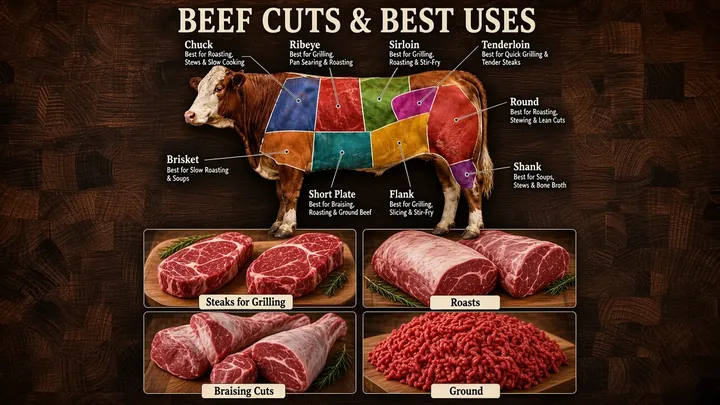
Every one of these 12 cuts can come off a single beef. Which ones you get, and how thick, is up to your cut sheet. For example, the short loin becomes either T-bones and porterhouses or strips and filets, and the rib becomes either ribeyes or a standing rib roast. Our beef cuts and uses guide walks through each primal, the premium steak cuts guide goes deeper on the steakhouse steaks, the burger doneness guide covers ground beef, and the beef tenderness scale ranks them. When you're ready, call or text 252-885-1892, fill out the beef cut sheet, or book a processing date.
Sources
- Beef From Farm to Table — USDA Food Safety and Inspection Service
- Degree of Doneness — Certified Angus Beef
- Safe Minimum Internal Temperature Chart — USDA Food Safety and Inspection Service
- Ribeye Steak — Beef. It's What's For Dinner. (Cattlemen's Beef Board / NCBA)
- Tenderloin Steak (Filet Mignon) — Beef. It's What's For Dinner. (Cattlemen's Beef Board / NCBA)
- Top Sirloin Steak — Beef. It's What's For Dinner. (Cattlemen's Beef Board / NCBA)
- T-Bone Steak — Beef. It's What's For Dinner. (Cattlemen's Beef Board / NCBA)
- Porterhouse Steak — Beef. It's What's For Dinner. (Cattlemen's Beef Board / NCBA)
- Strip Steak, Boneless — Beef. It's What's For Dinner. (Cattlemen's Beef Board / NCBA)
- Food Thermometers — USDA Food Safety and Inspection Service
- Flank Steak — Beef. It's What's For Dinner. (Cattlemen's Beef Board / NCBA)
- Outside Skirt — Beef. It's What's For Dinner. (Cattlemen's Beef Board / NCBA)
- Brisket — Beef. It's What's For Dinner. (Cattlemen's Beef Board / NCBA)
- Smoking Basics — Beef. It's What's For Dinner. (Cattlemen's Beef Board / NCBA)
- Barbecue Science — Texas A&M AgriLife, Department of Animal Science, Meat Science
- Chuck Short Ribs — Beef. It's What's For Dinner. (Cattlemen's Beef Board / NCBA)
- Braising Basics — Beef. It's What's For Dinner. (Cattlemen's Beef Board / NCBA)
- Round Primal — Beef. It's What's For Dinner. (Cattlemen's Beef Board / NCBA)
- Bottom Round Roast — Beef. It's What's For Dinner. (Cattlemen's Beef Board / NCBA)
- Grilling Basics — Beef. It's What's For Dinner. (Cattlemen's Beef Board / NCBA)