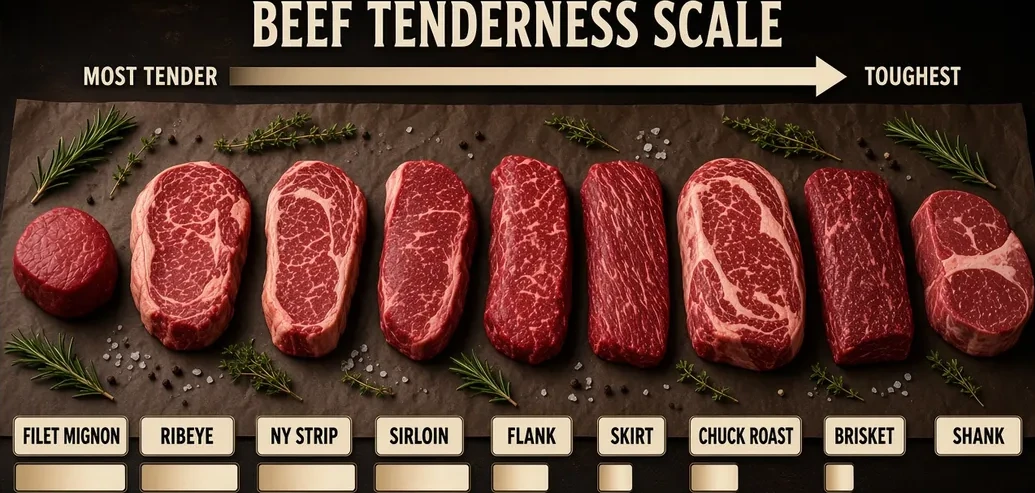
But "tough" isn't the end of the story. A brisket that's chewy at 160°F can be fall-apart tender at 200°F. This guide ranks the common cuts, explains what research says about them, and shows how to cook each group so it eats tender.

The beef tenderness scale
This ranking draws on a Texas A&M study that measured Warner-Bratzler shear force (the standard lab test of how hard cooked meat is to cut) on 40 different beef muscles and sorted them into four groups: very tender, tender, intermediate and tough [2]. We've translated the muscle names into the cuts you'd see at the counter. The muscle names in parentheses are the anatomical names researchers use.
| Tenderness | Retail cuts (main muscle) | How to cook |
|---|---|---|
| Very tender | Tenderloin / filet mignon (psoas major); ribeye cap (spinalis); flat iron and top blade (infraspinatus); outside skirt (diaphragm); chuck short rib and Denver steak area (serratus ventralis) | Fast, dry heat: grill, sear, broil |
| Tender | Strip steak (longissimus lumborum); ribeye eye (longissimus thoracis); top sirloin (gluteus medius); tri-tip (tensor fasciae latae); petite tender (teres major); flank steak (rectus abdominis) | Grill or sear; slice flank across the grain |
| Intermediate | Eye of round (semitendinosus); top round (semimembranosus, adductor); bottom round (gluteobiceps); inside skirt (transversus abdominis); parts of the chuck clod | Marinate and slice thin, roast to medium-rare and slice thin, or braise |
| Tough | Brisket (deep pectoral); chuck neck (trapezius); fore and hind shank (extensor carpi radialis, flexor digitorum superficialis) | Low and slow: smoke, braise, stew |
Source for the muscle groupings: Belew et al., Meat Science, 2003 [2]. In that study the diaphragm (outside skirt) was the single most tender muscle measured, and a hind shank muscle was the toughest [2].
Wait, skirt steak is "very tender"?
Yes, in the lab. That surprises people, because skirt and flank feel chewy on the plate. Two things explain it:
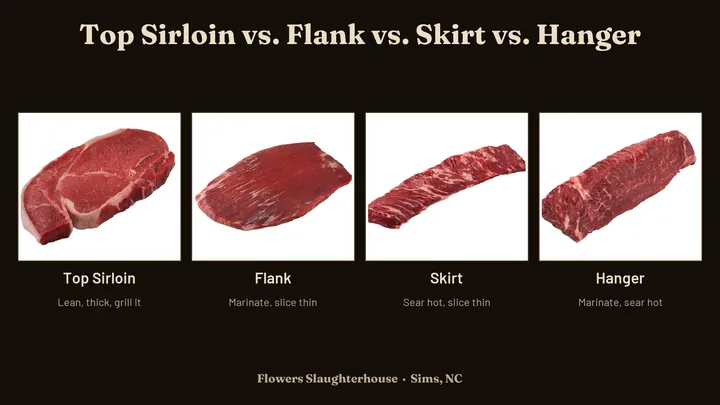
- Grain. Skirt and flank have long, coarse muscle fibers running the length of the steak. Cut with the grain, you chew through long fibers. Cut thin, across the grain, and the same steak is tender. The beef checkoff says slicing against the grain is "even more" important for thin, coarse cuts like skirt and flank [3] [4].
- Which skirt. There are two. The outside skirt (diaphragm) is the very tender one. The inside skirt fell in the intermediate group [2]. Both are sold as "skirt steak" [5].
The chuck isn't all tough either
The chuck (shoulder) has some of the toughest muscles on the steer, and some of the most tender. The beef checkoff calls the top blade "the second most tender muscle in the animal," once a tough strip of connective tissue running through the middle is cut out [6]. That's where flat iron steaks come from. The serratus ventralis, which runs under the shoulder blade, also tested very tender [2].
The rest of the chuck, the arm, neck and clod, is better as pot roast, stew meat or ground beef. If you want flat irons or Denver steaks out of your chuck, ask on your beef cut sheet. They take extra knife work, and the default is roasts and ground.
What steaks people actually buy: the national survey
The beef checkoff funds a National Beef Tenderness Survey about every five years, testing steaks bought at stores and restaurants across the country. The 2021 survey from Texas A&M found [7]:
- Tenderloin had the lowest shear force (most tender) at both retail and foodservice, and retail tenderloin got the highest consumer ratings.
- Most retail steaks tested were "very tender," and every retail cut was more tender than in the 2015 and 2010 surveys.
- USDA grade (Prime, Choice, Select) didn't significantly change shear force or consumer ratings for the restaurant steaks tested.
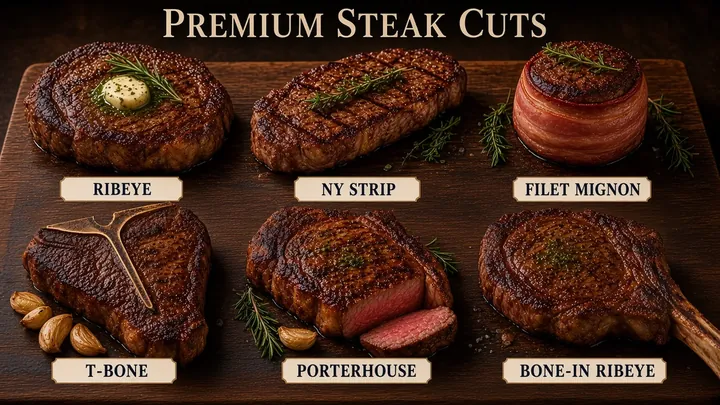
The retail steaks in that survey were top blade, ribeye (bone-in and boneless), top loin (strip, bone-in and boneless), T-bone, porterhouse, top sirloin and tenderloin [7]. For a closer look at those steaks, see our premium steak cuts guide.
Two kinds of toughness
Meat scientists talk about two things that make beef tough. Knowing which one you're dealing with tells you how to cook it.
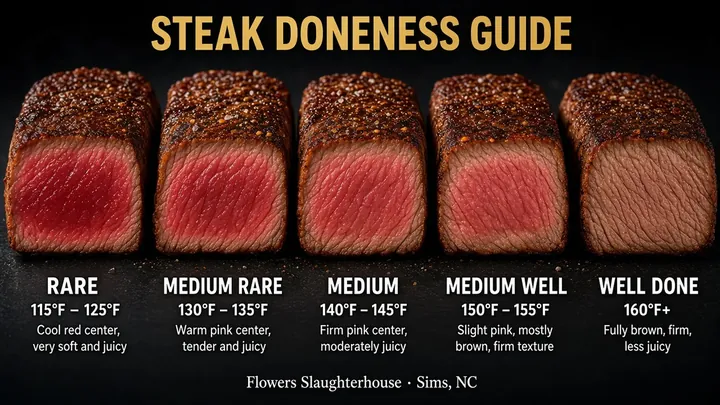
1. Muscle fiber toughness. Lean muscle gets firmer and drier the hotter you cook it. Texas A&M's meat science program explains that the muscle-fiber part of tenderness gets tougher as internal temperature goes up [8]. This is why a filet, strip or eye of round is best pulled at medium-rare to medium.
2. Connective tissue toughness. Brisket, chuck and shank are full of collagen. Collagen turns into gelatin with enough heat and time, and that conversion takes a higher internal temperature, about 185 to 195°F [8]. Cook a brisket to medium and it's like a rubber boot. Cook it low and slow past 190°F and it falls apart.
So the rule of thumb is: tender cuts, cook fast and stop early. Tough cuts, cook slow and go long.
Other things that make beef more tender
- Marbling. USDA says marbling makes beef more tender, flavorful and juicy [1].
- Aging. Commercial aging, done under controlled temperature and humidity for 10 days to 6 weeks, adds tenderness and flavor. USDA does not recommend aging beef in a home refrigerator [1].
- Slicing. Thin and across the grain, every time, for flank, skirt, round and brisket.
- Grinding. Grinding tenderizes the meat. That's why the less tender cuts usually become ground beef [9].
- Moist heat. Braising cooks tough cuts in a little liquid, covered, over low heat for hours until fork-tender [10].
How to cook each tenderness group
| Group | Examples | Method | Target |
|---|---|---|---|
| Very tender | Filet, flat iron, outside skirt | Hot grill, cast iron, broiler | Medium-rare to medium. Safe minimum 145°F + 3-min rest [11] |
| Tender | Ribeye, strip, top sirloin, tri-tip, flank | Grill or sear; tri-tip roasted or reverse-seared | Medium-rare to medium; slice flank and tri-tip across the grain |
| Intermediate | Eye of round, top round, bottom round | Roast and slice paper-thin, or marinate and grill; or braise | Medium-rare for roasts sliced thin; fork-tender if braised |
| Tough | Brisket, chuck roast, shank, short ribs | Smoke, braise, stew, pressure cook | Probe-tender, usually past 190°F |
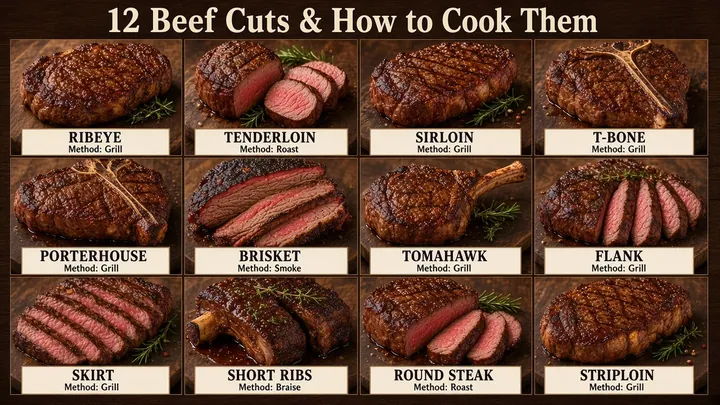
Our 12 beef cuts and how to cook them guide gives cut-by-cut methods and times, and the steak doneness guide covers temperatures.
Frequently asked questions
What is the most tender cut of beef?
The tenderloin, which is where filet mignon comes from. It's the most tender retail steak in national testing. The top blade (flat iron) is usually listed as the second most tender muscle.
What is the toughest cut of beef?
The shanks and the brisket, along with some chuck muscles. They're tough because they move the animal and are full of connective tissue, but cooked low and slow, they turn tender.
Is flank steak tender?
Flank tested in the "tender" group in lab research, but it has long, coarse fibers. Cook it hot and fast, don't take it past medium, and slice it thin across the grain.
Does USDA grade change tenderness?
Higher grades have more marbling, which helps tenderness and juiciness. But in the national tenderness survey, grade didn't significantly change tenderness for the restaurant steaks tested. Cut, aging and cooking matter at least as much.
Choose your tender cuts on the cut sheet
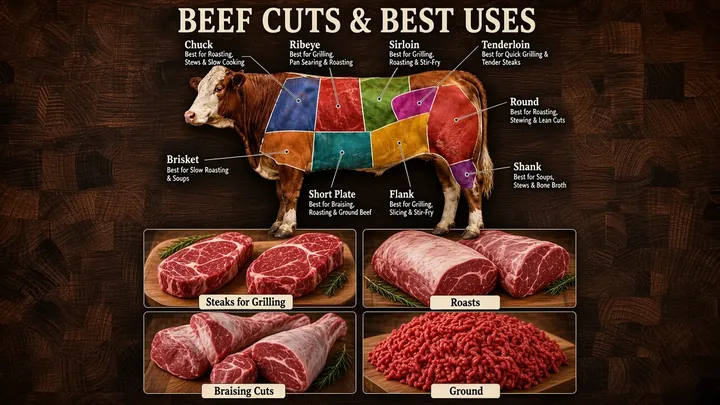
When we break down your beef, the cut sheet decides which muscles become steaks, which become roasts and which go to the grinder. If you want flat irons out of the chuck, tri-tips out of the sirloin or more ground and less roast, tell us. Call or text 252-885-1892, fill out the beef cut sheet, or see our beef cuts and uses guide and beef processing page.
Sources
- Beef From Farm to Table — USDA Food Safety and Inspection Service
- Warner-Bratzler shear evaluations of 40 bovine muscles (Belew, Brooks, McKenna and Savell, Meat Science 64:507–512, 2003) — PubMed / National Library of Medicine
- Outside Skirt — Beef. It's What's For Dinner. (Cattlemen's Beef Board / NCBA)
- Flank Steak — Beef. It's What's For Dinner. (Cattlemen's Beef Board / NCBA)
- Inside Skirt — Beef. It's What's For Dinner. (Cattlemen's Beef Board / NCBA)
- Top Blade — Beef. It's What's For Dinner. (Cattlemen's Beef Board / NCBA)
- National Beef Tenderness Survey – 2021 — Beef Research (Beef Checkoff), Texas A&M University
- Barbecue Science — Texas A&M AgriLife, Department of Animal Science, Meat Science
- Ground Beef and Food Safety — USDA Food Safety and Inspection Service
- Braising Basics — Beef. It's What's For Dinner. (Cattlemen's Beef Board / NCBA)
- Safe Minimum Internal Temperature Chart — USDA Food Safety and Inspection Service