People ask us all the time whether an Angus steer will "eat better" than a Hereford or a crossbred calf off their own pasture. The honest answer is that breed is one factor among several. Here's what the research and USDA say, and what to do on your cut sheet.

The primals in one paragraph
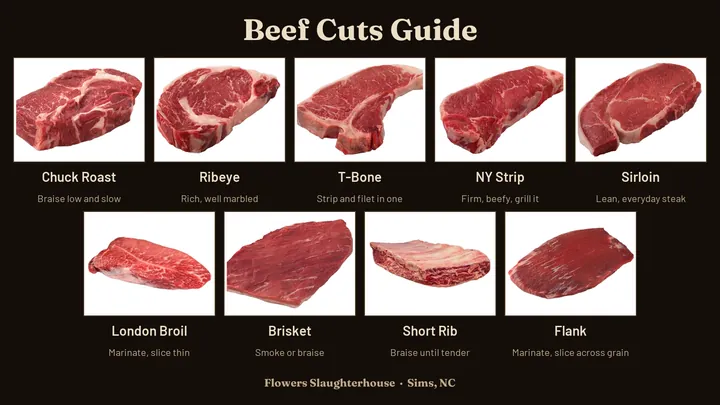
USDA's beef fact sheet names four basic primals (chuck, loin, rib and round) and gives the rule of thumb: chuck and round are less tender and usually need moist heat like braising, while loin and rib can be broiled or grilled [1]. The meat trade splits the animal further, adding the sirloin, brisket, short plate, flank and shank. A live steer of about 1,000 pounds yields roughly 450 pounds of edible meat [1]. For the full map with NAMP numbers, see our beef cuts chart.
Five signature cuts and how to cook them
| Cut | Primal | NAMP/IMPS | What it's like | How to cook it |
|---|---|---|---|---|
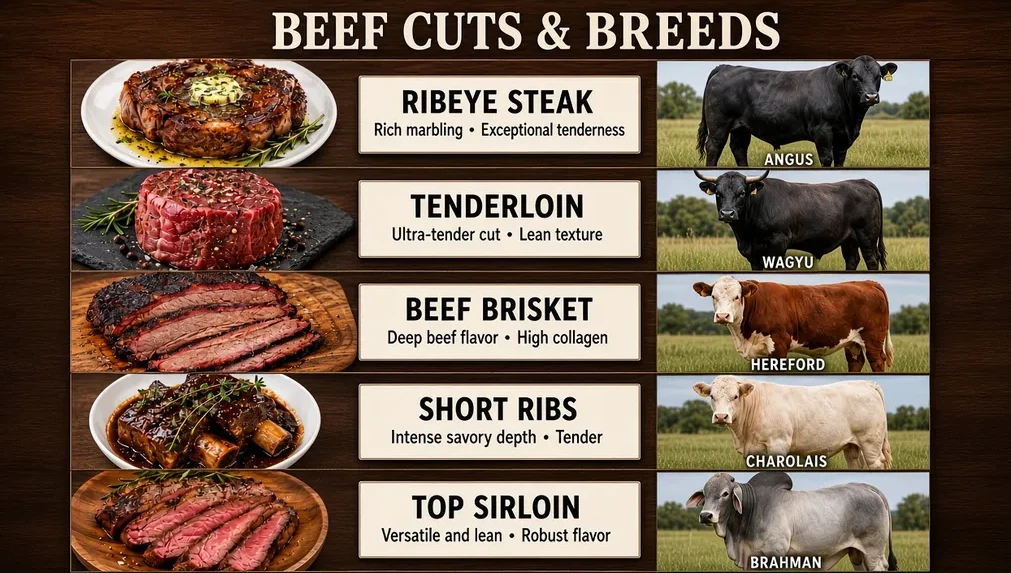
| Ribeye | Rib | 1112A | "Rich, juicy and full-flavored with generous marbling" [2] | Hot grill or cast iron |
| Tenderloin (filet mignon) | Loin | 1189 | "The most tender steak," lean, from the least-exercised muscle [3] | Sear and finish in the oven, or roast whole |
| Top sirloin | Sirloin | 1184 | "Flavorful," versatile and juicy [4] | Grill, skillet, kabobs |
| Brisket | Brisket | 120 | The breast, tougher "because it is used for movement" [5] | Smoke or braise low and slow |
| Plate short ribs | Short plate | 123A | "Good beef flavor" [6] | Braise, or grill or smoke with a rub |
Ribeye
The ribeye comes from the rib primal, between the chuck and the loin. Its marbling (the white flecks of fat inside the muscle) is what USDA says makes beef more tender, flavorful and juicy [1]. Cook it hot and fast. A ¾-inch steak takes about 4 to 5 minutes per side on the grill or under the broiler [1]. Thicker is better: 1 to 1½ inches gives you a crust without overcooking the middle. On the cut sheet, the rib section becomes either ribeye steaks or a standing rib roast. USDA's planning time for a 4- to 6-pound bone-in rib roast is 23 to 25 minutes per pound at 325°F [1].
Tenderloin
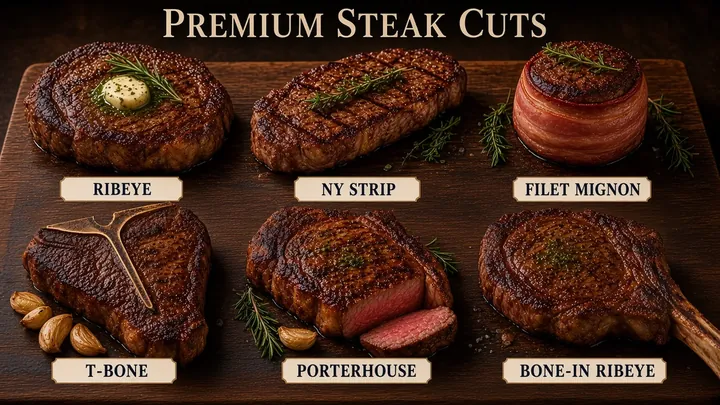
The tenderloin runs under the backbone in the loin and does almost no work on the live animal, which is why it's the most tender muscle in the carcass [3]. The trade-off is a milder flavor. It's lean, so keep it at medium or below. Roast a whole tenderloin at 425°F for 45 to 60 minutes total [1], or cut it into filets. Remember that on a cut sheet you get either whole filets or T-bones and porterhouses from the same side. Our premium steak cuts guide explains that choice.
Top sirloin
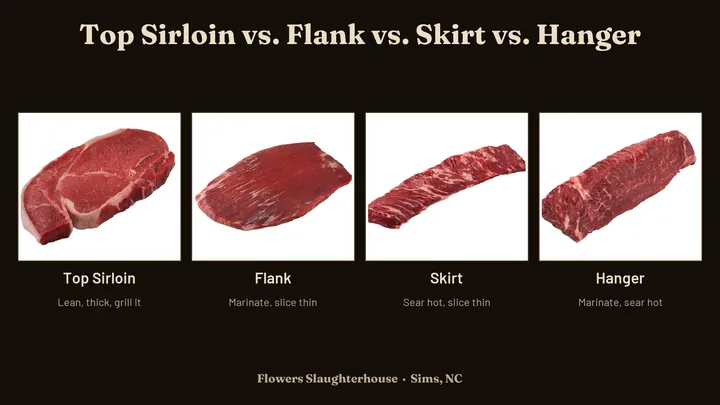
Top sirloin sits behind the loin. It's leaner and firmer than a strip, costs less, and is one of the most useful steaks on the animal: grill it whole, slice it for salads and sandwiches, or cube it for kabobs [4]. Slice it thin across the grain. We compare it with flank, skirt and hanger in our top sirloin, flank, skirt and hanger guide.
Brisket
The brisket is the breast, just below the chuck and in front of the short plate [5]. It carries the animal's weight, so it's full of connective tissue that only melts with long, slow cooking. In eastern North Carolina it's mostly a smoker cut. In the oven, braise a 3- to 4-pound piece at 325°F for 1½ to 2½ hours [1] and keep going until a fork slides in easily.
Short ribs
Short ribs come from the short plate under the rib, and from the chuck. The plate ribs (sometimes sold as "dino ribs") are big and meaty [6]. They braise beautifully. Brown them first, then cook in a small amount of liquid over low heat for several hours, which the beef checkoff describes as the way to turn less tender cuts "into rich, fork-tender dishes" [7]. USDA lists 1½ to 2½ hours at 325°F for 4-inch short ribs [1]. On the cut sheet, decide between English-cut (single bones) and flanken (thin strips across the bones) for Korean-style grilling.
Breed notes: what the major beef breeds are known for
USDA says there are at least 50 beef breeds in the U.S., but fewer than 10 make up most of the cattle, and it names Angus, Hereford, Charolais and Brahman as major breeds [1]. The breed histories below come from Oklahoma State University's livestock breeds reference.
Angus. Black, naturally polled (hornless) cattle from northeastern Scotland. The first four Angus bulls came to Kansas in 1873 [8]. Angus has a reputation for marbling, and the breed's best-known beef program, Certified Angus Beef, requires Angus-influenced cattle plus a minimum marbling score of Modest, a step above the Choice minimum of Small, along with other carcass specs in a USDA-AMS specification [9]. In other words, "Angus" alone isn't a quality grade. The brand adds the marbling requirement on top.
Hereford. Red with white faces, developed in Herefordshire, England, starting around 1742 to turn grass into beef efficiently. Henry Clay brought the first Herefords to the U.S. in 1817 [10]. You'll see plenty of Herefords and black baldies (Angus × Hereford crosses) in pasture herds around here.
Charolais. Large, white or cream cattle from central France, selected for size and muscling. Mature bulls can weigh 2,000 to more than 2,500 pounds [11]. OSU notes that Charolais caught on in the U.S. when producers wanted bigger-framed, heavier cattle than the traditional British breeds [11]. Charolais-cross beef tends to be lean and heavily muscled.
Brahman. Bos indicus cattle from India, with the hump over the shoulders, loose skin and big ears. Brahmans handle heat, humidity and insects far better than European breeds, which is why Brahman crosses are common across the Gulf Coast and the South [12]. OSU notes their carcasses have a high dressing percentage with little outside fat [12].
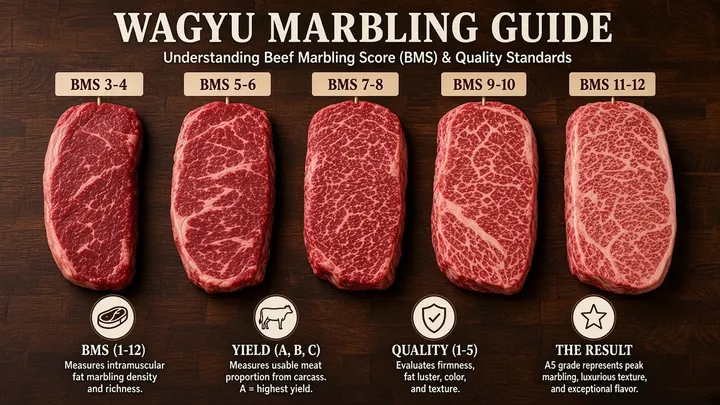
Wagyu. "Wagyu" means "Japanese cow." The American Wagyu Association says Wagyu cattle were first imported to the U.S. in 1975 and are known for exceptional marbling [13]. Wagyu has its own grading language (BMS and A5), which we cover in our Wagyu marbling guide.
Does breed change tenderness?
Sometimes, yes. The clearest example is Brahman influence. A University of Florida study of 673 Angus–Brahman crossbred steers found breed makeup had a significant effect on tenderness, and steers that were more than 80% Angus had the most tender meat [14]. The researchers tie much of that difference to the calpain and calpastatin enzyme system, which controls how much muscle protein breaks down during aging [14]. The shoulder hump is the giveaway trait of Bos indicus cattle [12], and Certified Angus Beef's spec rules out carcasses with a hump taller than 2 inches [9].
But breed isn't the whole story. These matter just as much on your plate:
- Marbling and grade. USDA grades beef mainly on marbling and maturity. Prime needs at least a "slightly abundant" amount of marbling, Choice at least "small" and Select at least "slight" [15]. Grading is voluntary, and a plant pays to have it done [1].
- Finish. USDA notes that all cattle start out on grass and about three-quarters are finished in feedlots on grain-based feed [1]. A well-finished animal of any breed usually eats better than a thin one.
- Age. USDA grade standards account for maturity, and beef from cows isn't eligible for Prime at all [15].
- Aging. Commercial aging under controlled temperature and humidity takes 10 days to 6 weeks and builds tenderness and flavor. USDA doesn't recommend aging beef in a home refrigerator [1].
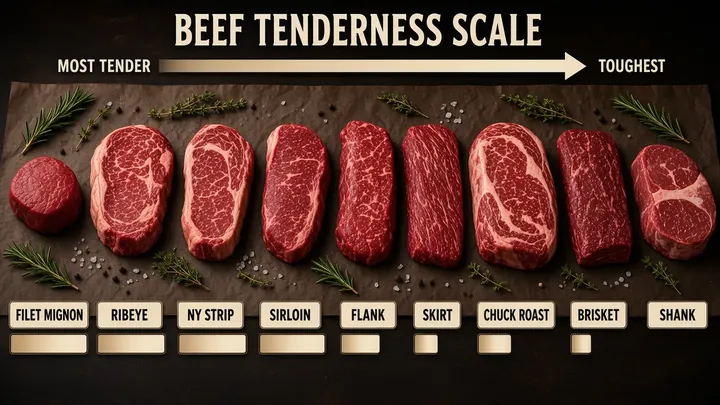
- The cut and how you cook it. A Brahman-cross ribeye grilled to medium-rare will be more tender than a Prime brisket that's been rushed. Our beef tenderness scale ranks the muscles.
Safe temperatures for every breed
Breed doesn't change food safety. USDA's safe minimum for beef steaks and roasts is 145°F with a 3-minute rest, and ground beef is 160°F [16]. Brisket and short ribs pass 145°F early in the cook. You keep going for tenderness, not safety. For doneness by color, see our steak doneness guide.
Using this on your cut sheet
- Want lots of steaks? Ask for ribeyes and top sirloins cut 1 to 1¼ inches thick.
- Smoke a lot? Keep the brisket whole, and ask for plate short ribs instead of grinding the plate.
- Feeding a family on a budget? More roasts and ground beef from the chuck and round, and fewer premium steaks.
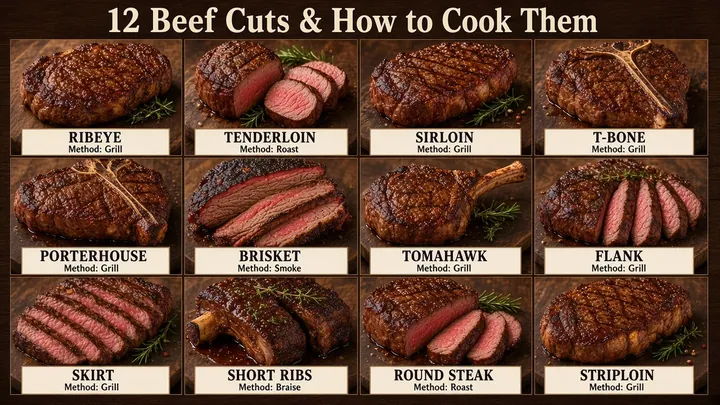
- Brahman-cross or grass-finished calf? Lean toward thinner steaks, marinated grill cuts and more braising cuts. See our 12 beef cuts guide for how to cook each.
Frequently asked questions
What are the primal cuts of beef?
USDA names four basic primals: chuck, rib, loin and round. The meat trade divides the carcass further into sirloin, brisket, short plate, flank and shank, for nine sections in all.
Which cattle breed has the best beef?
There's no single answer. Angus and Wagyu are known for marbling, Charolais for muscle and size, Hereford for efficiency on grass and Brahman for heat tolerance. Marbling, finish, age, aging and how you cook the cut matter as much as breed.
Is Brahman beef tough?
Research on Angus–Brahman crosses shows tenderness tends to drop as the Brahman share rises, and steers more than 80% Angus were the most tender in one University of Florida study. Brahman-cross beef can still eat well, especially with good finishing, aging and the right cooking method for each cut.
Does "Angus" on a label mean the beef is high quality?
Not by itself. Angus is a breed. Branded programs such as Certified Angus Beef add quality requirements, like a minimum Modest marbling score, that USDA graders check.
Bring us a beef, any breed you raise
We do custom slaughter and processing for steers and heifers, whole, half or quarter, cut to your sheet. We don't sell beef by breed, and we can't promise a grade on custom beef, but we'll help you get the most out of the animal you raised. Call or text 252-885-1892, read about beef processing, fill out the beef cut sheet, or book a date if you sell beef by the cut.
Sources
- Beef From Farm to Table — USDA Food Safety and Inspection Service
- Ribeye Steak — Beef. It's What's For Dinner. (Cattlemen's Beef Board / NCBA)
- Tenderloin Steak (Filet Mignon) — Beef. It's What's For Dinner. (Cattlemen's Beef Board / NCBA)
- Top Sirloin Steak — Beef. It's What's For Dinner. (Cattlemen's Beef Board / NCBA)
- Brisket — Beef. It's What's For Dinner. (Cattlemen's Beef Board / NCBA)
- Plate Short Ribs — Beef. It's What's For Dinner. (Cattlemen's Beef Board / NCBA)
- Braising Basics — Beef. It's What's For Dinner. (Cattlemen's Beef Board / NCBA)
- Angus Cattle — Oklahoma State University, Breeds of Livestock
- Certified Angus Beef G-1 Specification (PDF) — USDA Agricultural Marketing Service
- Hereford Cattle — Oklahoma State University, Breeds of Livestock
- Charolais Cattle — Oklahoma State University, Breeds of Livestock
- Brahman Cattle — Oklahoma State University, Breeds of Livestock
- Why Should You Eat Wagyu? — American Wagyu Association
- Association of μ-Calpain and Calpastatin Polymorphisms with Meat Tenderness in a Brahman–Angus Population (Leal-Gutiérrez et al., 2018) — Frontiers in Genetics / University of Florida
- Carcass Beef Grades and Standards — USDA Agricultural Marketing Service
- Safe Minimum Internal Temperature Chart — USDA Food Safety and Inspection Service