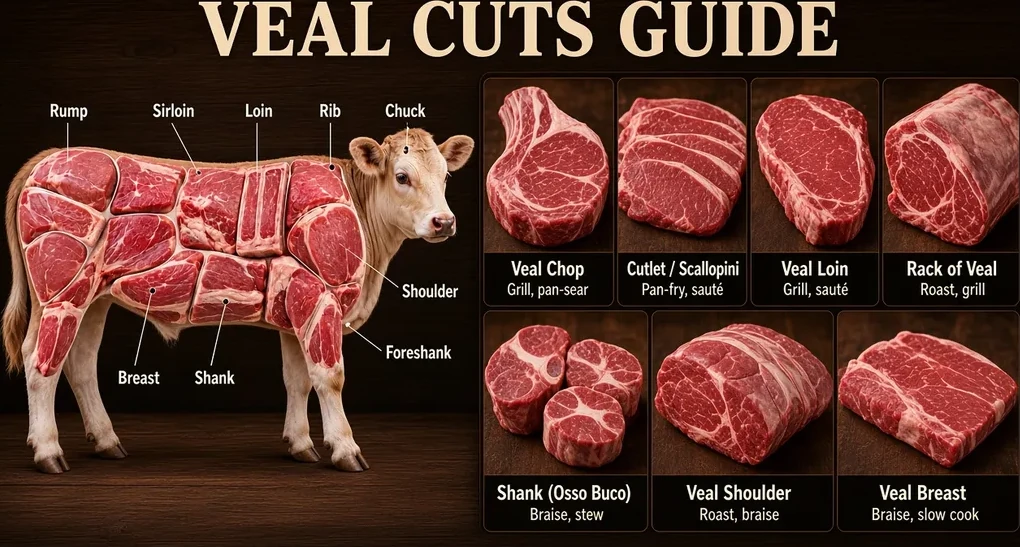
Most folks in eastern North Carolina have eaten veal parmesan at a restaurant but have never cooked it at home. Veal is mild, fine-grained and very lean, which is why it shows up as thin cutlets and slow-braised shanks more than thick steaks. This guide walks through the calf section by section, then covers the dozen cuts you're most likely to see.

What counts as veal
FSIS uses a few terms [1]:
- Veal: meat from a calf or young beef animal. Most veal calves are male dairy calves.
- "Bob" veal: about 15% of veal calves, marketed at up to 3 weeks old or 150 pounds.
- "Special-fed" veal: calves fed a balanced milk- or soy-based diet. FSIS says most veal calves are special-fed.
- Calf: a young bovine up to about 9 months old and 750 pounds live weight.
Color is one of the ways graders tell veal, calf and beef apart. Veal lean is a grayish pink. Calf is grayish red [1]. USDA veal grades, when a plant pays for grading, are prime, choice, good, standard and utility [1].
Five primals, seven cuts or four sections?
You'll see veal split different ways depending on who drew the chart. They're describing the same calf.
- FSIS names seven basic cuts: leg (round), sirloin, loin, rib, shoulder, foreshank and breast [1].
- Culinary meat-cutting texts group them into five primals. The carcass is split between the 11th and 12th ribs into a foresaddle (shoulder, foreshank and breast, rib) and a hindsaddle (loin and leg, with the sirloin counted as part of the leg) [2].
- Canada's meat cuts manual uses four sections: leg, whole loin (loin plus rib), front (shoulder, breast, shank and neck) and flank [3].
We'll use the five-primal layout below because it lines up best with how cuts are sold.
| Primal | Share of carcass | Popular cuts | Best heat |
|---|---|---|---|
| Shoulder | about 21% | Shoulder roast, blade and arm steaks, stew veal, ground veal | Braise or stew |
| Foreshank and breast | about 16% | Breast (stuffed and rolled), foreshank osso buco, riblets | Braise |
| Rib | about 9% | Rib chops, rack (hotel rack), rib roast | Roast, grill, sauté |
| Loin | about 10% | Loin chops, tenderloin, medallions, loin roast | Grill, broil, sauté, roast |
| Leg (with sirloin) | about 42% | Cutlets, scaloppine, top round, leg roast, hind shank osso buco | Sauté, roast, braise (shank) |
Percentages are from the Welsch and Thibodeaux meat fabrication text [2]. A whole veal carcass runs about 60 to 245 pounds, so every cut is smaller than its beef equivalent [2].
Front of the calf
Shoulder
The veal shoulder is like the beef chuck. It holds four rib bones (beef chuck has five) plus parts of the backbone, blade and arm bones. You can cut chops and steaks from it, but they aren't as good as rib or loin chops. Shoulder meat is often ground or cubed, and because it has a fair amount of connective tissue, it's best braised or stewed [2]. FSIS lists arm and blade steaks, ¾ inch thick, at about 7 minutes per side under the broiler or on the grill [1].
Foreshank and breast
These sit under the shoulder and rib and are sold as one primal. The breast is often boned, stuffed, rolled and braised, or trimmed for stew and ground veal. The foreshank is flavorful but tough. Braise it whole, or cut it across the bone and braise it as osso buco [2]. FSIS times a stuffed boneless breast at about 1¼ to 1½ hours for 2 to 2½ pounds, braised [1].
Along the back
Rib (the rack)
The double rib, or hotel rack, is small, very tender and expensive. Each side has seven rib bones. It's roasted whole, split, boned into a veal rib eye, or most often cut into rib chops for the grill or sauté pan [2]. FSIS plans a 4- to 5-pound rib roast at 25 to 27 minutes per pound at 325°F [1].
Loin
The loin sits behind the rack and contains ribs 12 and 13. It holds the loin eye on top of the bones and the tenderloin underneath, the most tender cut of veal there is. It's usually cut into loin chops, bone-in or boneless, or the tenderloin is pulled and cut into medallions. Cook it with dry heat: broil, grill, roast or sauté [2]. FSIS lists 1-inch loin or rib chops at about 7 minutes per side on the grill [1].
Back of the calf: the leg
The leg (including the sirloin) is the biggest primal, about 42% of the carcass. It's tender enough to roast whole, but it's usually broken into its major muscles and sliced into cutlets and scallops (scaloppine). Trim off fat and connective tissue, slice across the grain, then pound gently so they cook evenly and don't curl [2]. The hind shank is a little meatier than the foreshank and cooks the same way [2]. Veal parmesan, schnitzel and piccata all start with those leg cutlets.
12 popular veal cuts and how to cook them
| Cut | From | How to cook it |
|---|---|---|
| Rib chop | Rib | Grill or sear, then finish in the oven |
| Rack of veal | Rib | Roast whole |
| Loin chop | Loin | Grill, broil or pan-sear |
| Tenderloin / medallions | Loin | Quick sear. Don't overcook |
| Cutlets | Leg | Bread and pan-fry, about 3–4 minutes if ⅛ inch thick |
| Scaloppine | Leg | Pound thin, flour, sauté |
| Leg or top round roast | Leg | Roast |
| Osso buco | Fore or hind shank | Braise or simmer about 1–1¼ hours |
| Breast | Breast | Stuff, roll and braise |
| Shoulder roast | Shoulder | Braise or pot roast |
| Stew veal | Shoulder, breast | Simmer 45–60 minutes |
| Ground veal | Trim | Meatballs, meatloaf, patties to 160°F |
Times are from FSIS's veal cooking chart [1]. FSIS's rule of thumb matches the table: leg, cutlets, patties and rib or loin chops take dry heat, while cross-cut shanks, stew meat, round steak and breast generally need moist heat. Pounding and marinating can make tougher cuts work with dry heat [1].
Veal organ meats
Calf organ meats are milder than beef. Sweetbreads are the thymus gland. They shrink as the animal ages, so they come only from young calves and lambs. Calves' liver is more popular than beef liver because it's tender and mild. Kidneys do best with moist heat [2]. Cook all veal organ and variety meats to 160°F [1].
Safe temperatures and handling
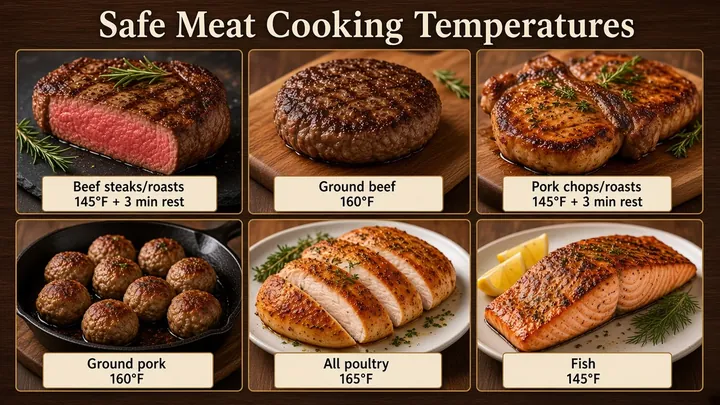
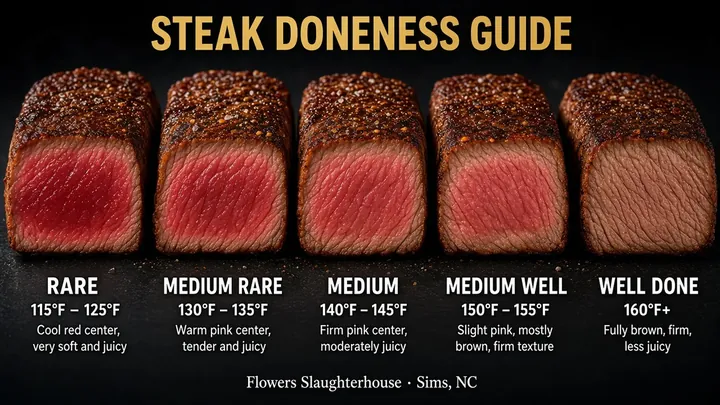
- Veal steaks, chops and roasts: 145°F, then rest at least 3 minutes.
- Ground veal: 160°F.
- Heart, kidney, liver, tongue and sweetbreads: 160°F.
- Leftovers: reheat to 165°F and eat within 3 to 4 days.
Veal cutlets are thin, so push the thermometer in from the side until the tip reaches the center [5].
Storage. Refrigerate chops and roasts 3 to 5 days, ground veal and stew meat 1 to 2 days. Frozen at 0°F, veal stays safe indefinitely. For best quality, use frozen chops and roasts within 4 to 6 months, and ground veal or stew meat within 3 to 4 months [1].
Thawing. In the refrigerator, plan 4 to 7 hours per pound for a large roast, 3 to 5 hours per pound for a small one, and about 12 hours for 1-inch chops. Don't cook frozen veal in a slow cooker [1].
Veal vs. beef: what changes in the kitchen
- Leaner, milder, smaller. Cuts cook faster than their beef namesakes. Watch the thermometer, not the clock.
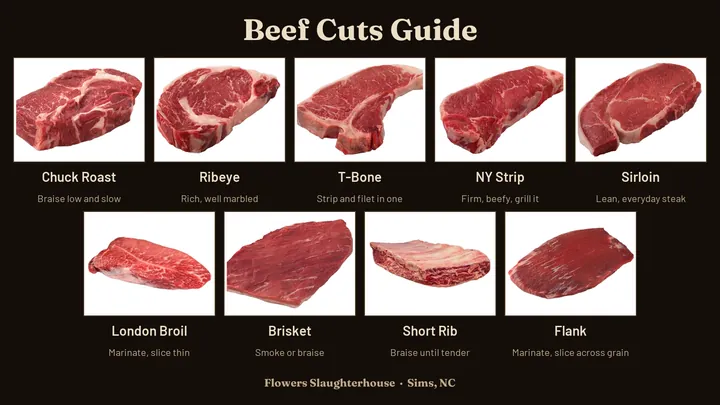
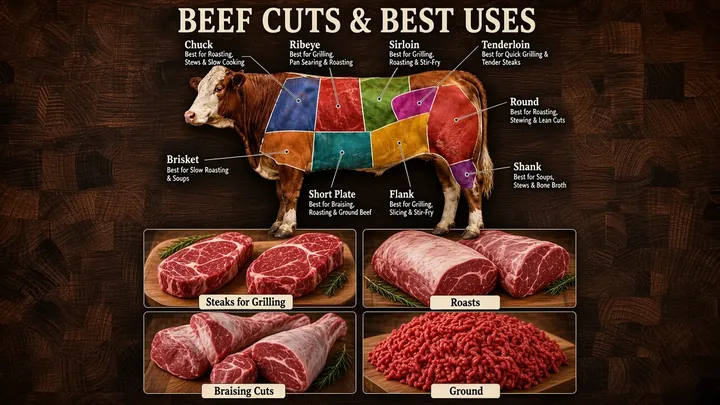
- Same map. A veal loin chop is a little T-bone. Veal top round is where cutlets come from, just as beef top round makes London broil. Our beef cuts chart shows the full-size version.
- Thin and quick, or slow and wet. There isn't much middle ground. Cutlets take minutes, shanks take hours.
Frequently asked questions
What is the most tender cut of veal?
The tenderloin, which sits under the loin. Rib and loin chops come next. All three do best with quick, dry heat.
What cut of veal is used for osso buco?
Cross-cut slices of the shank. The foreshank is the more common one, and the hind shank is a little meatier. Braise them in liquid until tender.
What temperature should veal be cooked to?
145°F with a 3-minute rest for chops, steaks and roasts. 160°F for ground veal and organ meats like liver and sweetbreads.
Where do veal cutlets come from?
The leg, mainly the top (inside) round. The muscle is trimmed, sliced across the grain and pounded thin for scaloppine, schnitzel or veal parmesan.
Questions about a calf?
We do custom processing for steers and heifers, cut to your sheet. Veal calves aren't something we list as a regular service, so if you're raising calves and want to talk about processing, call or text 252-885-1892 first and we'll tell you what we can and can't do. You can also check our beef page and misc species page. For full-grown beef, see our beef cuts and their uses guide and the beef cut sheet. For every species in one place, see the safe meat cooking temperatures chart.
Sources
- Veal From Farm to Table — USDA Food Safety and Inspection Service
- Introduction to Veal Identification and Fabrication (Meat Identification and Fabrication, Welsch and Thibodeaux) — Workforce LibreTexts
- Veal — Meat Cuts Manual — Canadian Food Inspection Agency
- Safe Minimum Internal Temperature Chart — USDA Food Safety and Inspection Service
- Food Thermometers — USDA Food Safety and Inspection Service