We don't sell Wagyu, and we don't grade beef. This guide explains what the labels mean so you know what you're paying for.

How Japanese beef is graded
Carcass grading in Japan follows standards from the Japan Meat Grading Association [2]. The Japan Meat Information Service Center explains the two parts in English [1]:
Yield grade (the letter). It's calculated from rib eye area, rib thickness, subcutaneous fat thickness and chilled carcass weight. A grade of A means an estimated yield of 72 or higher, B is 69 to under 72, and C is under 69 [1].
Quality grade (the number). It runs from 5 (best) to 1 and is based on four things: marbling, meat brightness, meat firmness and texture, and fat brightness and quality [1].
Put them together and you get 15 possible grades, from A5 down to C1 [1].
The BMS scale
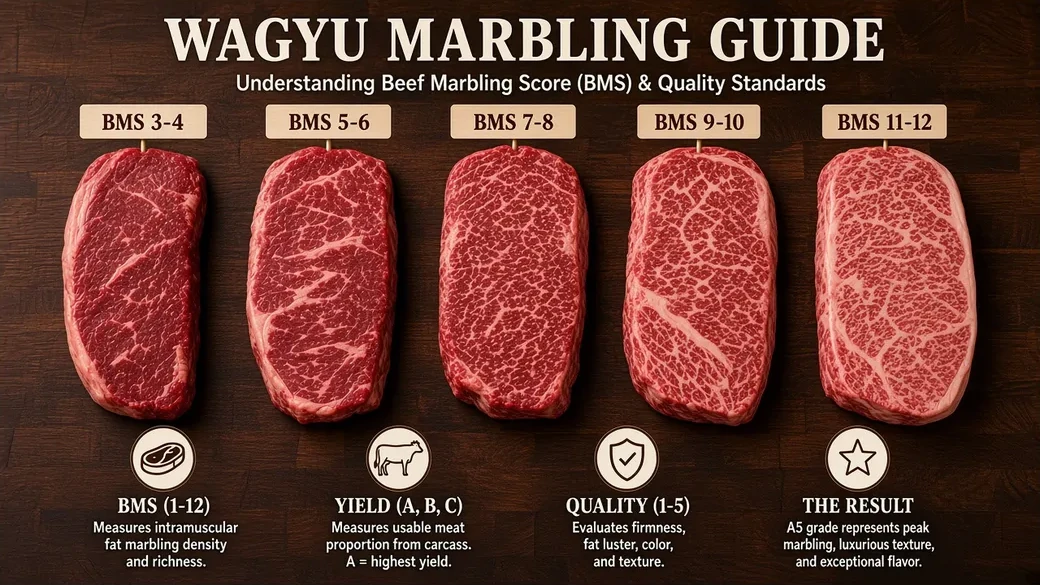
The Beef Marbling Standard rates marbling from No. 1 to No. 12. Here's how BMS numbers map onto the marbling part of the quality grade [1]:
| Marbling grade | Description | BMS No. |
|---|---|---|
| 5 | Very abundant | 8 to 12 |
| 4 | Somewhat abundant | 5 to 7 |
| 3 | Standard | 3 to 4 |
| 2 | Somewhat scarce | 2 |
| 1 | Very scarce | 1 |
That's why two A5 steaks can look different. One might be BMS 8 and another BMS 12, and both count as grade 5 marbling. If a menu or a seller lists the BMS number, it tells you more than "A5" alone.
What makes beef "Wagyu" in Japan
According to JETRO, Japan's trade agency, Wagyu means four native breeds: Japanese Black, Japanese Brown, Japanese Shorthorn and Japanese Polled, plus crosses among them. More than 90% are Japanese Black, the breed known for heavy marbling [3].
Since 2007, beef sold under the "Wagyu" label in Japan must come from cattle bred in Japan, with an individual identification number that traces each animal. Beef from Wagyu-type cattle raised abroad can't be re-imported and sold as Wagyu in Japan [3]. JETRO also lists regional brands such as Matsusaka, Kobe, Omi and Yonezawa [3].
What makes beef "Kobe"
Kobe beef is a brand with a long list of rules, set by the Kobe Beef Marketing and Distribution Promotion Association. To qualify, the beef must come from Tajima cattle bred and fattened in Hyogo Prefecture, from a steer or a cow (female), and the carcass must meet all of these [4]:
- Yield grade A or B
- Quality grade 4 or higher
- BMS No. 6 or higher
- Carcass weight of 270 to 499.9 kg for females or 300 to 499.9 kg for steers
The association's criteria page also requires fine meat texture and firmness [5]. Only officially certified beef gets the association's chrysanthemum stamp [5].
So all Kobe is Wagyu, but most Wagyu isn't Kobe. The American Wagyu Association puts it the same way: "Kobe beef is Wagyu, but not all Wagyu is Kobe beef" [6]. Note that Kobe doesn't have to be A5. A4 with BMS 6 can qualify.
American Wagyu
Wagyu cattle first came to the United States in 1975, when Morris Whitney imported four bulls, according to the American Wagyu Association [6].
A USDA Agricultural Marketing Service live-animal specification for American Wagyu Association programs sets these levels [7]:
- Fullblood: 100% Wagyu, with both parents registered with the American Wagyu Association and DNA-verified.
- Purebred: at least 93.75% Wagyu.
- Wagyu influence or American Wagyu: at least one Fullblood or Purebred parent registered with the American Wagyu Association.
Cattle in all three programs must be born, raised and harvested in the U.S. A parental registration certificate requirement takes effect January 1, 2030 [7].
American Wagyu is graded on the USDA scale, not BMS. The association's own "Authentic Wagyu" program requires USDA Prime with moderately abundant marbling, which it describes as the second level within Prime [8]. For comparison, USDA Prime starts at slightly abundant marbling and Choice starts at small [9].
A note on health claims: the American Wagyu Association says Wagyu has a high oleic acid content "which may contribute to a more heart-healthy fat profile" [10]. That's the breed association's claim. It's still a very fatty beef.
How to read a Wagyu label
| Label says | What it tells you |
|---|---|
| "Japanese A5 Wagyu" | Top yield and quality grade under Japanese standards. Ask for the BMS number |
| "A5, BMS 10" | Top grade, upper-middle of the grade-5 marbling range |
| "Kobe" | Should come with proof of the Kobe association's certification |
| "American Wagyu" or "Wagyu cross" | U.S.-raised, at least one registered Wagyu parent under the AMS spec. Graded USDA, not BMS |
| "Fullblood Wagyu" | 100% Wagyu genetics, both parents registered and DNA-verified |
| "Wagyu-style" or just "Wagyu beef" with no details | Ask questions |
How to cook highly marbled beef
- Small portions. Heavily marbled Japanese beef is rich. A few ounces per person is plenty, which is why it's often served thin-sliced, in cubes or as a shared steak.
- Thin cuts cook fast. Sear hot for a short time. The fat renders quickly and can flare on a grill, so a cast-iron pan is easier.
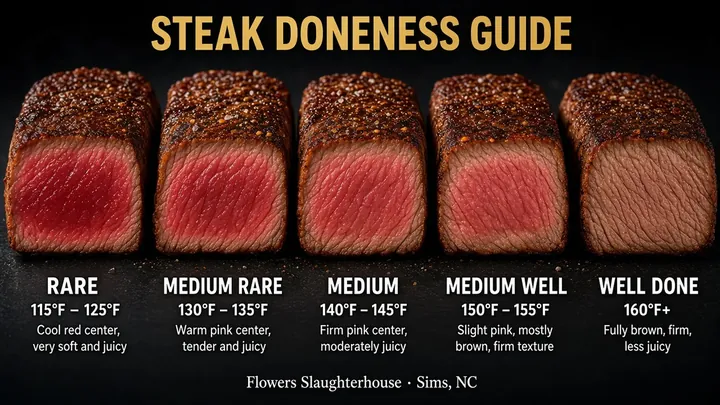
- Safe temperature is the same as any beef. USDA's minimum for beef steaks and roasts is 145°F with a 3-minute rest, and ground beef is 160°F [11]. Marbling doesn't change that.
- American Wagyu steaks are usually thicker and cook more like a Prime ribeye or strip. Our steak doneness guide covers pull temperatures.
Frequently asked questions
What does A5 Wagyu mean?
A5 is a Japanese grade. "A" is the top yield grade, meaning the carcass gives the most usable meat. "5" is the top quality grade, based on marbling, meat color, firmness and texture, and fat quality. On the marbling side, a 5 corresponds to BMS No. 8 to 12.
What is BMS in beef?
BMS stands for Beef Marbling Standard, a Japanese scale from No. 1 (very little marbling) to No. 12 (the most). It's one part of the Japanese quality grade.
Is all Wagyu Kobe beef?
No. Kobe is one brand of Wagyu. It must come from Tajima cattle bred and fattened in Hyogo Prefecture and meet strict carcass standards, including BMS No. 6 or higher. Most Wagyu, in Japan and elsewhere, is not Kobe.
Is American Wagyu the same as Japanese Wagyu?
No. American Wagyu is raised in the U.S., and the label can include Wagyu-influenced cattle with just one registered Wagyu parent. It's graded on the USDA scale (Prime, Choice and so on), not the Japanese BMS scale, and it can't be sold as Wagyu in Japan.
Raising Wagyu-influenced cattle?
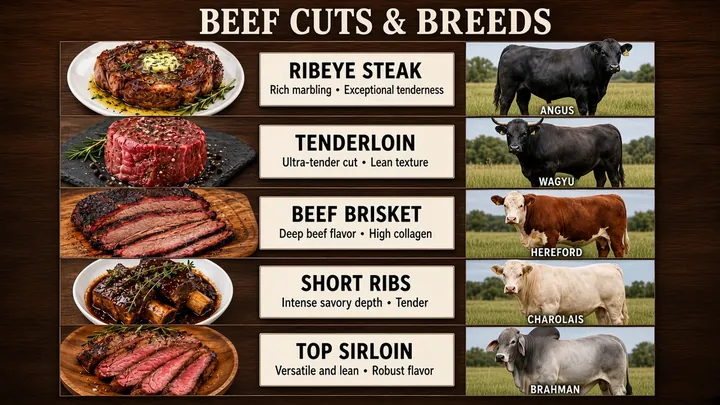
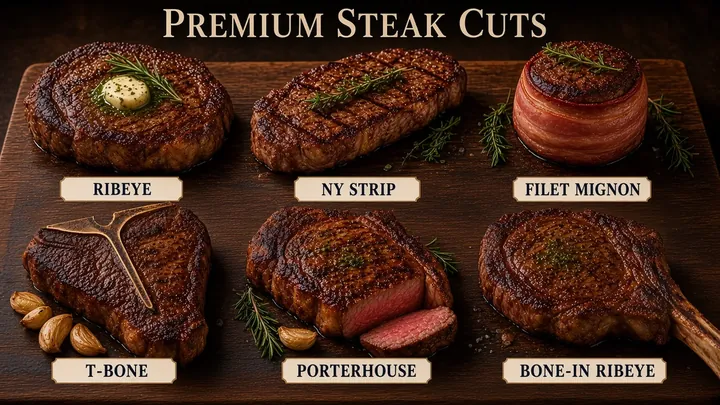
We don't sell Wagyu, and we can't promise a USDA grade or a BMS score on custom beef. But if you raise Wagyu or Wagyu-cross cattle, call or text 252-885-1892 to talk through processing and your cut sheet. Highly marbled beef can change how you want steaks cut and how much goes to grind. See our beef processing page, the beef cut sheet, our guide to primal beef cuts and cattle breeds and the premium steak cuts guide. Business customers can book here.
Sources
- Beef Carcass Grading (Yield and Quality Grades, BMS) — Japan Meat Information Service Center
- 牛枝肉取引規格 (Beef Carcass Trading Standards) — Japan Meat Grading Association
- Wagyu — JETRO (Japan External Trade Organization)
- Definition of Kobe Beef — Kobe Beef Marketing and Distribution Promotion Association
- Kobe Beef Criteria — Kobe Beef Marketing and Distribution Promotion Association
- FAQs — American Wagyu Association
- American Wagyu Association Wagyu Live Animal Specification (PDF) — USDA Agricultural Marketing Service
- Authentic Wagyu Process Verified Program — American Wagyu Association
- Carcass Beef Grades and Standards — USDA Agricultural Marketing Service
- Why Should You Eat Wagyu? — American Wagyu Association
- Safe Minimum Internal Temperature Chart — USDA Food Safety and Inspection Service