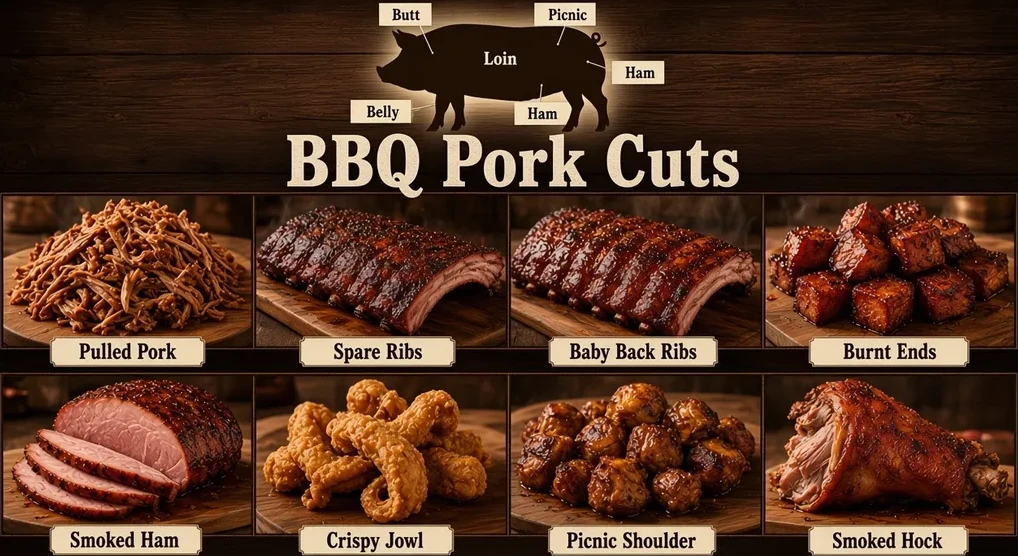
In eastern North Carolina, pork barbecue is a big deal, and pig pickin's are part of how people around here celebrate. We cut hogs for families, farms and folks cooking for a crowd. Here's how a hog breaks down for barbecue, and what each cut needs from you and your smoker.

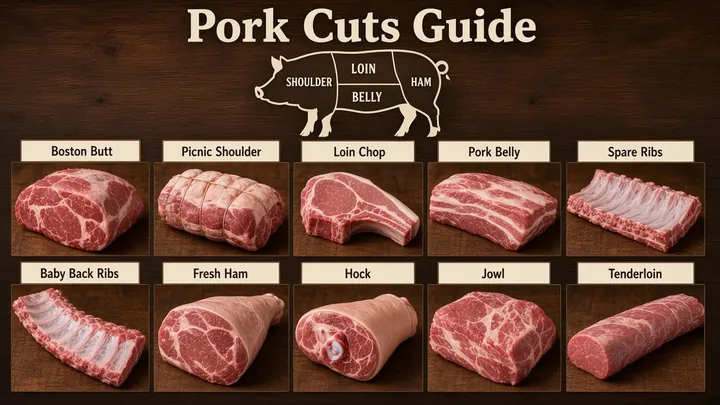
BBQ pork cuts at a glance
| Cut | Primal | Best for | Cook it to | Notes |
|---|---|---|---|---|
| Boston butt (pork butt, blade roast) | Shoulder (upper) | Pulled pork, chopped BBQ | 195–205°F for shredding [4] | Good marbling, holds up to a long cook |
| Picnic shoulder | Shoulder (lower) | Pulled pork, smoked picnic | 195–205°F for shredding [4] | Often sold skin-on; more connective tissue |
| Spareribs | Belly side of the rib cage | Smoked ribs | Tender; Pork Board says ribs are best around 180°F [1] | Largest, meatiest rib [3] |
| St. Louis-style ribs | Trimmed spareribs | Competition-style ribs | Same as spares | Squared off and flat; trimmings are rib tips [3] |
| Baby back (loin back) ribs | Loin | Faster-cooking ribs | Same as spares | Smaller than spareribs [3] |
| Country-style ribs | Where loin meets shoulder | Grilling, braising | 145°F safe; cook longer for tender | Eat with a knife and fork [3] |
| Belly | Side | Bacon, smoked belly, burnt ends | Tender | Where spareribs and bacon both come from [5] |
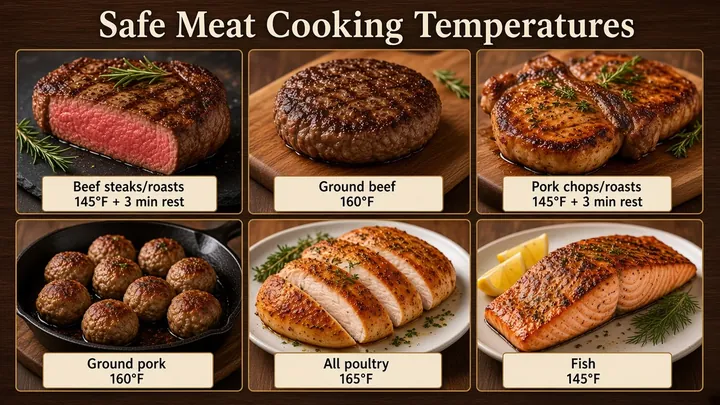
| Fresh ham | Leg | Smoked fresh ham, roasting | 145°F + 3-min rest (safe minimum) [7] | Lean; big enough to feed a crowd |
| Hocks and jowl | Leg / head | Seasoning meat, greens, beans | Simmer until tender | Easy to forget on a cut sheet |
The shoulder: where pulled pork comes from
The Pork Board says pork shoulder is sold under several names, including picnic roast, Boston butt, blade roast and pork butt. Common ways to cook it are braising, smoking, roasting, grilling and slow cooking [2]. On the hog, the shoulder splits into two pieces:
- Boston butt. The upper part of the shoulder, with good marbling. This is the standard cut for pulled pork.
- Picnic. The lower part, down toward the front leg. It has more connective tissue and is often left skin-on. It makes good barbecue but takes a little more work.
Why so hot? The shoulder is a working muscle with a lot of collagen. It's safe at 145°F [1], but at that temperature it's still tough. Long, slow cooking breaks the collagen down. For slow-cooker shoulder, the Pork Board's target is 170°F, followed by a 10- to 15-minute rest before shredding [2]. Michigan Pork notes that a shoulder for shredding usually ends up at 195–205°F [4]. Pitmasters go by feel at the end: when a probe slides in like it's going into soft butter, it's done.
Ribs: spares, St. Louis and baby backs
The National Pork Board describes these rib cuts [3]:
- Back ribs / loin back / baby back come from the blade and center part of the loin, with the "finger meat" between the bones. They're called "baby" because they're smaller than spareribs.
- Spareribs come from the belly side of the hog. They have lots of flavor and are bigger and meatier than the other rib cuts.
- St. Louis style is spareribs squared off, straight and flat.
- Rib tips are the bottom part of the spareribs left over after the St. Louis trim.
- Country-style ribs come from where the loin and shoulder meet. They're a mix of fat and lean and are eaten with a knife and fork more than off the bone.
A cut sheet trade-off: baby backs come off the loin. If you want baby back ribs, the loin is boned, and you'll get boneless chops or roasts from it instead of bone-in chops. Spareribs come off the belly, and the rest of the belly can still go to bacon. Ask us to explain what each option means for your hog before you choose.
Belly: bacon, burnt ends and pork belly
UW–Madison Extension notes that the side/belly is where both spareribs and bacon come from [5]. Most customers have the belly cured and smoked for bacon. For smoking, pork belly cut into cubes makes "pork belly burnt ends." Fresh belly slabs are good slow-roasted too. Mark it on the cut sheet.
Cooking a whole hog for a pig pickin'
A whole hog has all of these cuts on it at once. The shoulders and hams are thick, and the belly and ribs are thin, so a whole-hog cook is mostly about managing fire so everything is done at the same time. Pitmasters handle that in different ways. The safety rule doesn't change: the fresh ham is the thickest part, and USDA's minimum for fresh ham is 145°F with a 3-minute rest [7]. For pulled and chopped barbecue, you'll take it much hotter than that for tenderness.
If you're ordering a hog for a pig pickin', call ahead and tell us how you plan to cook it. That way it's ready the way your cooker or rig needs it.
How much meat comes off a hog
UW–Madison Extension says a market hog typically dresses at 70–75% of live weight [5]. Its worked example:
| Step | Example |
|---|---|
| Live weight | 250 lb |
| Hot carcass ("hanging") weight at 70% | 175 lb |
| Chilled carcass after ~3.5% cooler shrink | 169 lb |
| Take-home retail cuts at ~67% cutting yield | ~125 lb |
Source: UW–Madison Extension [5].
Cutting yield depends on how much you have boned out. UW Extension puts average yield at 74% for bone-in retail cuts and 65% for closely trimmed boneless cuts [5]. By primal, it estimates the cut-out at roughly Boston butt 10%, picnic 11%, loin 25%, side/belly 21% and ham 25% [5]. Plan on about 1 cubic foot of freezer space per 35–40 pounds of pork [5]. The University of Maine Extension uses a more conservative 30 pounds per cubic foot [6], so leave a little extra room.
Breed matters too. The University of Maine Extension notes that heritage hogs, many of them originally bred for lard, usually carry more fat and less muscle than commercial white hogs [6]. That can be a good thing for barbecue and sausage.
Filling out your hog cut sheet for BBQ
Decide on these before your date:
- Shoulders: whole Boston butts and picnics for smoking, or cut into steaks and ground for sausage?
- Ribs: spareribs (or St. Louis trim) from the belly, baby backs from the loin, or both? Remember the loin trade-off.
- Belly: cured and smoked bacon, or fresh slabs for smoking?
- Hams: fresh ham roasts, cured and smoked ham, or ground into sausage?
- Extras: hocks, jowl, fatback, skin, head and feet, if your recipes call for them.
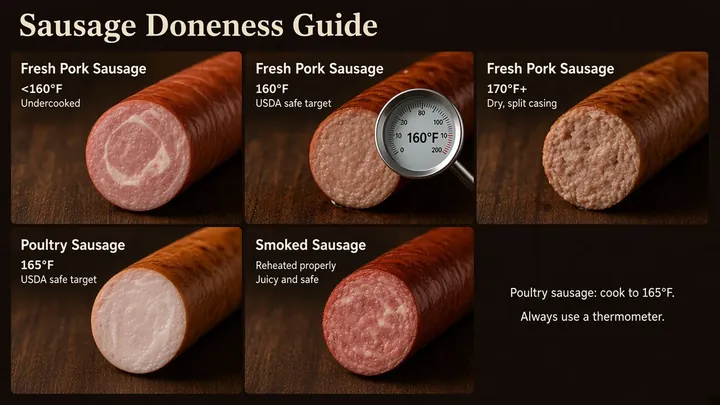
- Sausage: seasoning, links or bulk, and how much trim goes into it. See our sausage doneness guide.
Our pork page and cut sheets go through the options, and the glossary explains hanging weight and cutting yield.
Frequently asked questions
What is the best pork cut for pulled pork?
Boston butt is the standard. The picnic shoulder works too. The Pork Board lists both under pork shoulder [2].
What temperature is pulled pork done?
It's safe at 145°F [1], but pulled pork is usually cooked to 195–205°F so it shreds [4]. The Pork Board's slow-cooker guidance is 170°F, then a rest before shredding [2].
What's the difference between spareribs and baby back ribs?
Baby backs come from the loin and are smaller. Spareribs come from the belly side and are bigger and meatier [3].
How much meat will I get from a 250-pound hog?
UW–Madison Extension's example comes to about 125 pounds of take-home cuts from a 250-pound hog [5]. That number goes up with more bone-in cuts and down with more boneless ones.
Book your hog
Whether you need a freezer full of chops and sausage or a hog for Saturday's pig pickin', call or text us at 252-885-1892. We'll help with the cut sheet and get you on the schedule. Flowers Slaughterhouse, 5154 St. Rose Church Rd, Sims, NC.
Sources
- Pork Cooking Temperature — National Pork Board
- Pork Shoulder — National Pork Board
- Pork Ribs — National Pork Board
- Cooking Time and Temperature (pulled pork directions) — Michigan Pork Producers Association
- How much meat should a hog yield? — University of Wisconsin–Madison Extension
- Bulletin #1073, Understanding Pork Yields — University of Maine Cooperative Extension
- Safe Minimum Internal Temperature Chart — USDA Food Safety and Inspection Service